 EN
EN PT
PTAppendix A: My Journey In Diet and Nutrition
“You are what you eat” – Common Wisdom
If you have gotten this far in the book, you may want to leave a review for it on Amazon or any other site you bought it from. Why not engage also on our social media channels listed on this website?
Disclaimer: While I have spent decades researching and experimenting with nutrition, I am a computer scientist and yogi, not a registered nutritionist or medical doctor. The dietary habits, routines, and supplement regimes shared in this appendix are simply a reflection of my personal journey and what works for my unique biology. They are for informational and educational purposes only. Please exercise your own reason, do your own research, and consult a qualified healthcare professional before making any radical changes to your diet. The author assumes no legal liability or responsibility for any consequences arising from the application of this information.
In all the previous chapters I provided insights on how food relates to Yoga. For instance: “Chapter 3 What is Yoga” talks about moderation and discipline in regards to food. “Chapter 6 The Path of Yoga – My Personal Journey” talks about addictive foods and how I quit sugar. “Chapter 9 The No God No Things No Thoughts” talks about fasting from a very abstract point of view of going from “food” to “no food”. We also talk about re-wilding which involves changing our relationship towards food and nature.
In this appendix we talk mostly about what I eat. We do not always talk about why I eat it. For that, you will have to do the research yourself. Just search for: “the benefits of ...” It is always good to do the research yourself.
For me, this research on nutrition ended up in a divorce from the food industry. This divorce was after I learned about: (1) the horrendous chemicals typical food companies add to our meals, (2) their mistreatment of farm animals, and (3) their damages to the environment. I therefore eat as naturally as possible.
If you lack motivation to eat naturally, then you need to do some research and experimentation into it as a start. I suggest you do your research as broadly as possible. Use resources that are audio, visual, textual so it is more fun. I suggest watching documentaries such as: “Our Daily Bread”. Apparently, this documentary can be watched for free on YouTube.com under the title: “Unser täglich Brot 2005”. Do not worry about the German; the movie is a silent meditation on food.
Research different themes: children’s malnutrition, malnutrition in developed countries, obesity, ultra-processed foods, food forests and permaculture, and soil health.
I talk about this change of our relationship towards food, sex, socialising, and nature on both “Chapter 5 The Path of Yoga” and “Chapter 9”. Again, read about these subjects to spark a motivation to change your relationship with them.
On this process, I recall two important Buddhist nuggets of wisdom. Pema Chödrön’s “heartbreak with samsara”; and Buddha’s concept that “Merit is built little by little,” and demerit also.
I had this breakup with samsara little by little, addressing different areas of samsara at different times: junk food, rat racing, negativity. I broke-up with bad food way before I broke-up with rat racing. And even on breaking up with junk food, I made one change at a time. For instance, I quit refined sugar totally (breads, cookies, pastas, and sugar-added junk). I quit it, as I described elsewhere, by using more fruits (dates being one of the sweetest). Then I proceeded to quit fried food, salt, most packaging, and so on.
In the process, I found out eating naturally tops it all. I would never accept fast-food ice cream dessert in place of a fruit salad of mangoes, coconut milk, and red-chilli pepper flakes, or a self-made energy bar from cocoa beans mashed with dates and popped-quinoa flakes.
Can you do it all at once? For instance, go on a retreat and quit junk food, social media addiction, using sex for relaxation, eating to forget your problems, and negativity such as gossiping?
The problem with using retreats to quit eating habits is that the food often served on retreats is not the type of food you will be willing to come back to when you go back home. On retreats, they may serve you boring cucumbers, the fourth state of water. They will not serve you mangoes with coconut cream and chilli pepper flakes, or cocoa nibs, dates, coconut flakes, and tahini. This is because the retreats are mostly about lack of sensorial stimulation, to help you quit all at once.
Quite often, people leaving retreats relapse on their old eating habits because their shopping list is the same, their cooking recipes are the same, their way of eating with colleagues at work is the same (e.g., no packed lunch). The same goes for quitting other habits with retreats.
Therefore, it works better if you have already experimented with alternatives to food, sex, friends, socialising before you come out of the retreat. In some areas, you probably need to have made the change already or be in the process of change. For example, how about three years to quitting four things and incorporating a few retreats throughout that time?
On The Importance of Diet for Spiritual Progress
Like Lama Zeupa says, “it is the whole package that counts” for a yogi. A good, nutritious diet (including moderation and fasting) is certainly part of that package. However, so are practices like: renunciation, meditation, sporting, and cold exposure. If you are doing cold exposure, include these in your diet, as they will help build healthy brown fat and burn the unhealthy yellow fat: capsaicin, green tea, curcumin, mint (not for males), fish oil, rosemary, apples, iron sources.
This is an interesting story on the importance of a good diet for spiritual progress. Matikamata was a laywoman who practised Buddhism in the time of the historical Buddha. She was accomplished in some of the four stages of awakening which are from first to last: (1). Sotāpanna; (2). Sakadāgāmin; (3). Anāgāmi; and (4). Arahant. Rising from a sort of bliss, Matihkamata “learnt that those monks had had enough potentiality for the attainment of arahatship (last stage of awakening above), but they needed proper food. So, she prepared good, choice food for them. With proper food and right effort, the monks developed right concentration and eventually attained arahatship” – Treasury of Truth: Illustrated Dhammapada - https://www.buddhanet.net/dhammapada/
Good Diet is Only One of the Factors
A counter-example is Milarepa, who, according to many, was very thin and ate a not-so-nutritious diet, and yet achieved enlightenment early through practice and his good heart. At least he had no junk food in his time.
“He lived in a bare cave, where there was no mattress or carpets. He was living like that, with one scarf, and his only food was nettles. He practised the path, though his holy body was very thin; however, the great yogi Milarepa, by following the path with much hardship, received enlightenment a long time ago,” – Lama Yeshe.
In contrast, we, with all the amenities and comforts, including access to a wide variety of food, are still in Samsara.
Therefore, one must ask: “What is holding me back?” “Is it the junk that I eat? My overeating, or perhaps the lack of fasting? My lack of practice of meditation?” In my opinion, but also according to the scriptures, the answer is: all of these, and above all, what is causing them.
On the negative consequences of overeating: the Dhammapada mentions that King Pasenadi of Kosala was often drowsy from his large meals. My teachers also warn about the dangers of having too big a meal. This is science-backed, as we know ketones (which are produced when we fast) are a better fuel for the brain than glucose. Evolutionarily, I imagine this made us sharper to fetch our next meal, or just sharper to rethink our ways and then have a meal that was in store all the time. I simply love the enhanced bliss that comes with intermittent fasting.
Periods of fasting or deprivation are often associated with increased spiritual insight and clarity. This is also backed by the wisdom of sensitive people, not only the Dhammapada: “a fat stomach never breeds fine thoughts” – Saint Jerome.
If the amount of food we consume can be detrimental, the type of food, particularly junk food, introduces a whole new set of concerns for our well-being. Several scientific articles link junk-food to brain inflammation. As Kris Gunnars, BSc Medicine, notes, “It stimulates the reward system in the brain in the same way as addictive drugs, such as cocaine. For susceptible people, eating junk food can lead to full-blown addiction, which shares the same biological basis as drug addiction.”
As a computer scientist, I see it this way: you can get the best computer in the world (think of the best body and brain), but if you are running bad software on it, it is only going to produce junk computations.
For Yoga, it is the same, you need good enough hardware (your body), and then wonderful software installed (your mind and diet). This software includes both the quality of your thoughts and the food you consume, which surely influences our (or your) mood, energy, and neurotransmitters. For instance, there are foods that are depressive, and other food that fights depression and promotes a blissful state, such as plums, blueberries, bananas, and tomatoes.
When I say that you need good “hardware,” I mean that the body, besides the food and thoughts, can elevate us spiritually. You do not need to be at a Shaolin monk’s fitness level, but that will surely help to lift the mind, especially due to the discipline aspect of their training (if it is done with self-compassion and balance). Notice that too much exercise can also be damaging by causing inflammation and tight muscles which make it hard for the energy to flow, especially around the sacrum, and spine. This is why in Tummo or Kundalini Yoga we do Sufi grinds, or Kundalini circles, to ease the energy flow around that area.
Eating, Emotions, Character, Detachment: Neither Gluttony, nor Disgusted Pickiness Helps
We already spoke about King Pasenadi of Kosala, who was often drowsy with overeating. But what is behind gluttony or picky eating? I argue that what is behind these is what we learned about pain and pleasure and the transcendence on Chapter 9.
My yogi colleague Manu told me that the Dalai Lama participated in the MasterChef event in Australia where he was supposed to eat and score the finalists’ dishes.
The Dalai Lama tasted all the wonderful dishes, and then when asked to score them, he said he could not score any. His explanation to the cameras was: “Buddhist monks are not right to prefer this food or that food. According to the Buddhist tradition, whatever you get (as a monk) you must accept.” One of the chefs replied beautifully: “Today our cooking was not about winning, but about the offering of food.”
The lesson here is that the purpose of food is to nourish the body, not to always give pleasure. If we must eat rotten fish, then we will. Of course, it is nice to have some taste, but the most important is nutritional value. Socrates is with us yogis on this: “Some men live to eat and drink, I eat and drink to live.”
Note, however, that we are talking in all cases above about food. I do not consider added taste enhancer a food, even though Glutamate is naturally present in eggs, or cheese. The difference is in between naturally present and what is merely added. And surely, what is not naturally present anywhere is even worse.
For instance, I love to subject myself to eating retreat food. But even then, I stay away from the sugary desserts or gluten, as I do not consider these real food. Also, often on retreats, I ask for a larger lunch because I start fasting at 14:00. It is nice to sit with the others to socialise at 17:00 while fasting. I have no problem seeing them eating. This is because I am already feeling the goodies from fasting by that time; usually the good feeling already kicks-in in three hours after the last meal.
The above talk about accepting food, or trying other people’s food means we do not have to eat a perfectly balanced natural diet every day. If some nutrients are lacking one day or another, we should eat and not complain, like the Buddhist monks. The body can take a blow and is able to compensate immensely sometimes by making its own nutrients (e.g. cholesterol) and sometimes by amplifying the absorption rate of what is lacking. It may actually help our body becoming less “lazy.” It may bring variety and some natural ingredients we never shop for.
The body needs and thrives on some swing from time to time. This could be some alternation of fasting and eating; cold or warmth exposure; or ketogenic or higher carb alternation. One exception can be made to the first meal time, which can best be the exact same hour every day. Our circadian rhythm depends on this first meal time and its regularity, and many bodily processes depend on the circadian rhythm. Thus stick to a perfectly planned first meal, unless it is a fasting day or the morning after your friends’ birthday party.
Regarding vs. Enjoyment in Food: A Lesson in Yoga
During my Sivananda Yoga teacher’s training in India, I was asked on my surprise oral exam to produce an explanation about calcium.
I explained that one does not need to worry about getting sufficient calcium intake, stating that a vegetarian or ovo-lacto-vegetarian yogi likely gets enough calcium from foods like nuts and dark leafy-greens. I also mentioned that excess calcium could calcify your pineal gland, which is undesirable, especially for a yogi. (I add here that Natto, with its Vitamin K2, helps direct calcium to the correct parts of the body). I conceded that concerns about extra calcium, perhaps through calcium-fortified foods, would be valid for a child growing their bones.
At this point of the oral exam, I asked: “Do you know how most of the calcium-fortified foods are made? They boil and grind chicken eggshells.” Half of the student audience responded with a chorus of “Yuk, disgusting.” The teacher intervened, offering a powerful lesson: “How are we going to feed ten billion people on the planet if not by avoiding wastage, even of eggshells? If you do not work through your emotion of disgust, you most likely will not get liberated.”
Do you see how eating properly is an act of Yoga? How it is our transcendence from pain and pleasure? Disgust being a sort of a reaction to certain eating sensations?
A good test of disgust occurred when I visited Tokyo and asked some locals to take me out to eat. The locals struck me a deal: they would take me to several restaurants on the condition that they would order my food in Japanese, and only later would they tell me what I ate. I basically unknowingly ate everything from the sea, from sea cucumber to urchin, to jellyfish, to fugu fish (blowfish, which is poisonous if not filleted correctly). Nearly everything was deliciously prepared and I surely learned that disgust can often be our mind’s fabrication, as most emotions are. It also taught us all a lesson on acceptance (of each other’s culture and habits). Milarepa would not cook meat for himself, but if somebody cooked it for him with a warm heart, he would accept.
At a visit to a monastery in Nepal, I had the pleasure of drinking a sort of bitter rotten milk with one of the local ten-year-old monks. It was rotten, sour, bitter, stinky to the point of throwing it away. It was so bad that maybe some mold could have been floating on it. I am not sure what lesson that was, from the various mime pranksters I got there. I asked him in between sips: “Do you drink that frequently?” He understood my English and answered: “Yes.” We both started bursting into laughter in between the sips, and the drinking experience was so enjoyable we finished our cups in bliss. I guess some bonding took place between us.
Such trainings with sensations bear some resemblance to Tantra, which uses sensations, pleasant or unpleasant to train the mind. In Tantra, the sensations can be either real or imagined (c.f. Tantric meditation on the last chapter). Do not underestimate how these Tantric daily practices can work out. Let us dive deeper into the dark dungeons of our shadow regarding food; indulgence and disgust.
The emotion of disgust, for instance, has much deeper roots and ramifications than just food. What do you feel when you eat meat? Disgust? Fear of germs? Compassion? What do you feel when you eat meat mindfully?
Disgust is characterized by a nose pinch or nose wrinkle. It is often accompanied by: a raised upper lip, lowered eyebrows, and narrowed eyes. I suspect such expressions may have the biological, evolutionary origins of a fish squeezing its “mouth and nose” to close them from anything it judges not good to become part of “me” or my world. It is in this “part of me or my world” that racism shares a root in disgust. Therefore, any training you make on food, will also train our character.
Let us look at a good example of character and approach towards food in one person, Marcus Aurelius the Stoic emperor. He auctioned the valuable contents of the imperial palace and his family’s possessions to ease the situation with the plague and the lack of tax income. That to me seems the opposite of greed and gluttony. I present some of his views on food, sex, ego in his own words:
“How good it is when you have roast meat or suchlike foods before you, to impress on your mind that this is the dead body of a fish, this is the dead body of a bird or pig; and again, that the Falernian wine is the mere juice of grapes, and your purple edged robe simply the hair of a sheep soaked in shell-fish blood!
And in sexual intercourse that it is no more than the friction of a membrane and a spurt of mucus ejected.
How good these perceptions are at getting to the heart of the real thing and penetrating through it, so you can see it for what it is!
This should be your practice throughout all your life: when things have such a plausible appearance, show them naked, see their shoddiness, strip away their own boastful account of themselves.
Vanity is the greatest seducer of reason: when you are most convinced that your work is important, that is when you are most under its spell.”
– Marcus Aurelius
It is amazing how Marcus Aurelius goes from food to seeing things as they are, to character in a single text. Did he possess some special knowledge about the link between these elements? A man does not live by bread only, but by every word that proceeds from the mouth of God.
– Jesus Christ.
Indeed, there is the gross sustenance for the body and the subtle sustenance for the mind, and both are linked, much like the physical body in Yoga is linked to the subtle body. All the examples above of character imbalances reveal this connection. Kecharī mudrā and simpler versions of it such as putting the tongue against the palate, are examples of other body-mind interactions that counter hunger, bliss coming from their practice (see the last chapter for the practice and possible mechanism by which it works).
We Could Not Skip Talking About Ayurveda
There are many other testimonies from the yogic path regarding the practical use of diet, nutrition, and fasting. Let us provide one testimony from Ayurveda, an ancient Indian healing tradition.
Ayurveda discovered many useful natural medicines, though it did not use the modern scientific method exactly. Its discoveries came from the power of mind and experience. I mean sensitive yogis experimenting with food, herbs. Among 1000s of medicines, Ayurveda uses a special root called Curcuma (turmeric).
Curcuma has been highly praised by many branches of science:
- Gastrointestinal medical doctors praise it for improving the gut flora;
- Sports medicine specialists praise it for reducing inflammation, better than most pharmaceutical anti-inflammatory drugs;
- Neuroscientists praise it for its adaptogenic effects.
These effects provide the capability of transforming one’s mental state, such as when coping with change in the environment and the stress that can come with it.
Caution: excessive consumption of Curcuma, Ginger, Green tea, and Astragalus can lead to liver damage. For this you can consume the supplement with the active principle in more concentration. For instance, I consume an extract that has less curcuma oil which is responsible for the liver damage. Likewise for Green tea. While I do have Matcha (a form of Green Tea), I also buy L-Theanine, which is an isolated active principle of Green Tea that does not attack the liver.
A Summary of What I Eat Regularly
About twenty-six years ago, I read a Yoga book and decided to become vegetarian. It was a failure; I was not fat, but I lost 12% of my mass, mostly muscle mass. In my youth! Besides doing Yoga, I was swimming two times per week. With help from a nutritionist, I learned to eat an ovo-lacto vegetarian diet with some supplements. With this diet, I regained my weight and health.
My typical daily intake of food is: three eggs; some yogurt; and unlimited plants (seeds, roots, leaves, fruits, stems).
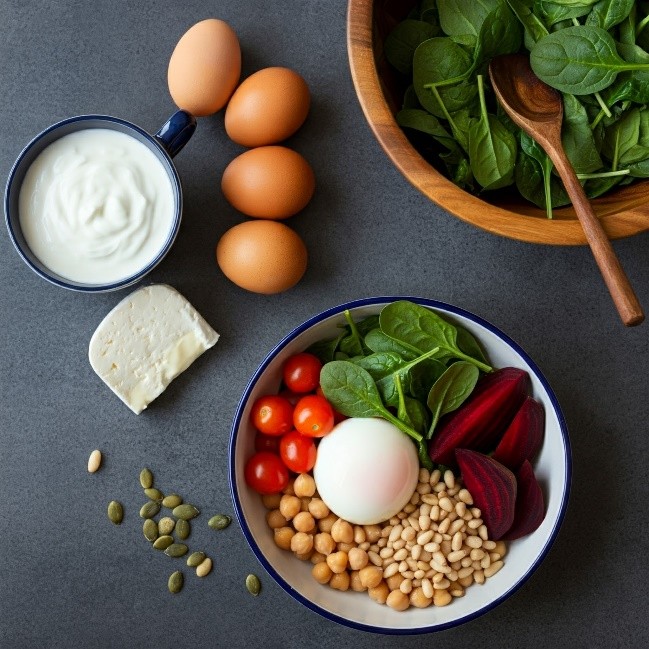
Diet and nutrition for me – for the last twenty-six years – have been this adapted ovo-lacto-vegetarian diet. The animal products are not strictly ovo-lacto. I consume 1000mg of fish oil daily; and on approximately 1% of the days, I consume one sardine, some anchovies or one herring instead of the fish oil.
Regarding compassion, I am waiting to buy the vegetarian fish oil from a company that was able to produce fish oil from genetically engineered flax plants. I already buy the eggs from a company that does not kill the male cockerels that cannot lay eggs, it uses genetic engineering to ensure 100% of the offspring are egg laying females.
Qualifying What and How I Eat:
Mediterranean. My diet resembles a lot the mediterranean diet. Both in its plant-based and animal-based components.
I practise intermittent fasting, but not on every day. My diet includes intermittent fasting on the days that I do not swim. On these days, I stop eating around 14:00 and only resume the next day after 7:00 AM.
On the days I swim, I like to have a meal after the swim, which usually means I do not do intermittent fasting or only do a shorter intermittent fasting of, say, 13 hours instead of 16 hours.
Other fasting: once or twice per year I do a 24h fasting with just water and sea salt or electrolyte (no sugar or sweetener added). I once did a three-day fast with just water and sea salt, along with extra magnesium.
I want to do a four-day fasting, as some scientific studies on proteins in the blood have shown a positive change on the fourth day. I also did a five-day Fast Mimicking Diet (FMD) fast. This one involves food, 800 calories a day and a multi-vitamin pill, to which I added fasting mimetics (you’ll get the list later).
After long fasts, I break with a B1 vitamin pill and some moderate amount of mild food like some watermelon or coconut water.
Besides its many medically proven benefits, fasting acts as a powerful form of mind training. As noted in the Commentary on the Dhammapada Illustrated, “Exercising control of our eating habits and overcoming laziness are necessary to maintain the practice of focusing attention on right things and thereby clearing the thoughts of emotional attachments.”
Now, let us look closer at the specifics of my eating habits and diet.
I primarily follow a ketogenic diet. My daily regimen is often ketogenic because my breakfast consists of low-carb animal foods, supplemented with some vitamin C from a tomato or radish for instance (to help mineral and protein absorption). My lunch and daily snacks usually have more carbs. To further make it ketogenic around the fast period, I often have the last meal with low carbs and natural fasting mimetics. Fasting mimetics are: olive oil, capers, cinnamon, some compounds in mushrooms (such as Cadaverine). Common low carb foods are items like cucumbers and tomatoes. Our body naturally thrives on swings and cycles: night and day, cold and heat, or fasting and food. Similarly, it needs to alternate in between: ketogenic (burning fat) and a carbo-burning state. This constant challenge is essential for the body and mind to function well, transcend extremes, combat laziness, and build both physical strength and mental character.
Continuing the qualification of my eating habits and diet:
It is a diet that promotes good flora. By avoiding animal foods after the first meal, my diet also promotes very good flora since there are studies showing that the flora associated with constant eating of animal products is not so good (that animal food flora releases toxins in the blood). The fermented products I consume are also good for the flora: kefir (the best), kombucha, kimchi, natto (good for women). Raw cheese also promotes good flora: Gouda, buffalo mozzarella, Brie, Camembert. Prefer sheep or goat to cow dairy. If you have cow dairy try to find the ones that are naturally lactose free.
Continuing the qualification of my eating habits and diet:
It is a diet that is aligned with the most typical circadian rhythms. The first meal is the largest, and all others are decreasing in size (eat breakfast like a king; lunch like a peasant; dinner like a pauper). Which helps digestion since our digestive juices are at their prime in the morning. And helps sleeping since our body is shutting down as the sun moves lower in the horizon.
As a partial conclusion on my diet, I point out this article on the above combination of intermittent fasting; ketogenic; mediterranean: “How do keto, Mediterranean diet, or intermittent fasting lead to healthy aging?”, Kelsey Costa, MS on medicalnewstoday.com.
But the above is not all that qualifies my diet.
My diet (as if I had invented natural eating) is a diet that is not addictive, all from mother nature. I consume near-zero sugar and gluten, near-zero. Also near zero: processed food; cooked food; salt; fried food. All the above is backed by several scientific articles. On a normal day, the only thing I cook is the egg-white which cannot be eaten raw for the Avidin content.
Do I ever make exceptions? Yes. Last year, at a party, I drank 200ml of beer with alcohol. This year I drank 50ml of wine to try wine that my colleague produced himself. I probably eat chicken a couple of times the last six months (at social events usually). I probably ate one bread or two in the last six months; at a restaurant; and I was lucky they had sourdough bread. I confess that sometimes I like a gluten-free pizza and I know some great places in Brussels to have them.
Here are some details of my eating habits for the last 26 years. Breakfast is my biggest meal. I try to exercise a bit before breakfast, in fasting, so that the breakfast has something to repair. I often do some elastic bands exercises before the meals, especially when I work from home. One series of rowing exercises with the Pilates elastic bands already counters sitting on the desk for too long. Inverted plank is not a bad choice either.
I start my day with three eggs (four if I sport that day); white cheese and/or kefir and/or yogurt with no sugar; some omega three; some low carb source of vitamin C like half a tomato to help the protein and mineral absorption. This is my breakfast. Sometimes I soak chia seeds on the yogurt and kefir mix overnight. I also soak cocoa nibs, almonds, in the kefir for a change. I try to make the breakfast more ketogenic (low carbs).
The eating of eggs does not seem to interfere with Kundalini practice, chakras, etc. At least not for me. All I narrate on this book about chakras, Kundalini manifests normally with daily eggs (three in my case). The egg yolks may increase testosterone and libido however, which may at first be annoying if you are practising a period of abstinence for subtle energies or Kundalini Yoga. In the end it helps Kundalini as it is exactly this kind of energy that forms at the base chakras and can be moved-up.
If you have cocoa nibs for their multiple benefits, build a habit to have them mostly in the morning as cocoa has caffeine, which has been shown to be the most beneficial if consumed in the morning. No, I do not have coffee. Also, cocoa has stimulants, which interfere less with your sleep if taken in the morning.
After breakfast I can have as many smaller meals as I want, all free of animal food so that the flora is improved by the cleansing provided by vegetable juices and fibres. In these meals I consume an unlimited variety of plant parts not forgetting carrots or mangoes weekly to be able to get enough vitamin A (more about it later).
I like to have my supplements with this second or third meal for a couple of reasons: (1) these subsequent meals will not have much calcium (most of it is in the breakfast yogurt). Calcium blocks the absorption of other minerals such as zinc or magnesium (I supplement with tiny amounts of these two, like 25%-40% of the RDA). (2) Some supplements are proteins (cysteine; lysine; glycine; etc), and the 100% vegetable meals that come after breakfast can se some extra protein.
On Vegetarianism, and On Most Doctors Being Unanimous in Recommending Creatine, Omega 3, Vitamin D, Vitamin A
Regarding vegetarianism. My current teacher Lama Zeupa says it is okay to have a chicken every now and then. They lived in the Himalayas and there it is hard to grow veggies. They rely a lot on the Yak for their sustenance. Buddha was also from the north of India, and ate even pork at times, and certainly in his last meal. Tilopa had fish, fried. Be aware that fried food is one of the causes of Alzheimer. Tilopa even performed a little miracle with the fish when Naropa complained about his meat eating habits. Christ had fish for sure and was surrounded by fishermen (many of his Apostoles). Milarepa was mainly vegetarian, but when offered meat he would take it.
And then Hitler was vegetarian in his late years. So let us not be hypocritical. There is a lot more one can do for himself and the world than eating strictly vegetarian.
It is not so much the meat itself, but our attitude towards animals, society, the ones next to us. I would bet my money that hunter and gatherers were more spiritually connected to nature than farmers. This makes me remember of the Cyclops story, a one-eyed farmer in a cave, farming sheep and eating the sailor crew also. Of the Hero Hercules cleaning the stinking stable from king Augias, perhaps a story of an early insight into the environmental damage from mass farming.
Animal food is important. A well-functioning body needs: carnitine; creatine; taurine; b12; cholesterol all only available from animal products or laboratory in some cases. These nutrients are so important that they are all present in mother’s milk. Luckily you get enough from these by eating eggs and dairy daily which do not require killing and have a smaller environmental footprint than meat. I do supplement with some of these also. Yes, it is true that the human body makes most of them, except B12. But for most of them, the body often does not make them in sufficient quantity. Worse still! For many of these, the body’s ability to synthetise them starts decreasing after a certain age, an example is carnitine which helps burning fat. No wonder people gain weight with age.
Most medical doctors are unanimous in the need to supplement with creatine and omega 3. Omega 3 is this wonderful supplement that has a remarkable positive impact on: pregnancy; newborns; children and adults. The impact is mainly on intelligence, concentration, motor coordination, science abilities. To top it all, in 2024 a scientific article proved that omega 3 reduces aggressive behaviour by 30%. Thus, we should administer omega 3 in prisons and to some world leaders (smile). It is ironic how an animal product (fish oil) contributes to less aggression and showing of our sharp meat cutting canine teeth.
Omega 3 can be consumed in the form of one sardine a day, or pills. This is one that can come from vegetable sources in the form of ALA. It's worth noting that while ALA is just one of the essential Omega-3 fatty acids, our bodies can convert it into the other beneficial Omega-3s called eicosapentaenoic acid (EPA) and docosahexaenoic acid (DHA). However, this conversion process is not very efficient! Reason why it pays to consume some EPA, DHA from fatty fish (sometimes algae oil can be used as a source of EPA, DHA). This is why algae oil is considered vegan Omega-3, vegan EPA, DHA.
It is not only Omega-3 and Creatine that are abundant in animal products that we are lacking. The world faces a deficiency of vitamin D. Vit. D is available for instance from: sunbathing; animal products; pills; upside-down sundried mushrooms. At my age I prefer no direct sun exposure, except when swimming outdoors. Because I do not stay in the sun that much, I compensate a bit with near infra-red light therapy at home (near infra-red does not build vitamin D, but has many other benefits one would get from sunbathing because the sun energy is about 50% infra-red spectrum).
The world also faces a deficiency of vitamin A even on rich families. The only sources ensuring large amounts of vitamin A are carrots and mangos, ensure you shop for them fresh weekly. Mangos is a little better choice if you live close to the tropics, I explain why soon.
Now Explaining My Diet in More Details
Below I describe a diet that I love. It is environmentally friendly; healthy; cheap (no meat); easy and time saving (no cooking). Yet many people ask: but are you happy with such a diet? Surely. I am not addicted to junk food such as fried, salty, sugary, oily crap. I am happy from inside and I enjoy such natural food. Sometimes I have a burger and I realise it is terrible as it ruins my stomach or gives me a headache. It happened when a friend came over for Christmas and she wanted to have chicken. I ate half a roasted chicken and spent the whole day with a strong headache. Never again.
By eating natural food, I reduce packaging and I develop a better relationship with nature. A more direct one. Packaging is shown to introduce microplastics in food.
It helps a lot that I am responsible for preparing my own meals and doing my own supermarket shopping. Some products simply never enter the shopping cart. That is the easiest way to control it: out of sight, out of mind.
Many ask: “but how can you eat like this socially?” Social food is the exception, maybe 5% or less of my meals. When I go to work, I pack my own lunch (I am not counting work lunches in those 5% thus).
Of course, when I go on vacation, my friends or mother insists that I eat with them, and eat what they have. Or when I am on week-long Yoga workshops I sit and eat with all. But that is an exception, not the rule. And even then, I am a bit selective.
I do not have much time here to go at length over all that I read on nutrition. And I am also not very accredited to give advice on nutrition, but well knowledgeable and experienced about it.
I can tell you how I eat and you can perhaps research the science behind it or ask me why I do it. Use your own reason as guide here.
First: I did a medical grade DNA test and it showed that I am very susceptible to gluten intolerance. I therefore quit bread, pasta, etc. The only gluten I get is perhaps from tiny spoons of soya sauce (it contains wheat) or maybe by mistake when going out. I cut gluten even though I read that if one does not develop gluten intolerance 40 years of age, it will rarely manifest after that. Gluten and refined or brown sugar are pro-inflammatory and useless. The whole world would be a better place without these: less ADHD, diabetes, brain inflammation, cavities, low grades in maths, etc.
I had this diet for 26 years or more. I have always had check-up exams every five years or so. The check-up exams results were in the range, or very good. I am talking here about in-range results for: hormone, neurotransmitters; minerals; vitamins; cholesterol; white cells; red cells; etc. As measured in saliva, blood, urine. These are expensive and way better tests than what the Dutch or Belgium government normally provide for free (I know both governments regular health care practices).
This diet works for me. It may not work for other people as diets are largely dependent on taste, body type, metabolism type, genetics, physical activity, culture (including cultural ignorance and herd behaviour), religion, etc. But notice that what I eat is aligned mainly with science: (1). A mediterranean diet is the science gold standard. (2). Ovo-lacto diets are not hard to balance to achieve all nutrients mentioned above. (3). Ketogenic and intermittent fasting, when done with moderation and alternation, have been praised by science.
Notice that vegan or strictly-vegetarian diets may require a lot more supplementation to reach all nutrient levels. My compliments for you if you are going to that effort for the planet. Congrats too if you are considering moving from meat eating, to ovo-lacto vegetarian, perhaps just for 5 days a week for a start.
How This Diet Fits in My Routine
I wake up early; without alarm. Usually at 5-6am. While I wait for my breakfast at 7am, I do several things. I open the window or curtains and look at the sun for the circadian rhythm; switch-on extra lights during winter; move my spine a bit (table posture in bed; cat and dog; sleeping child; pelvic floor tilts).
At this time, I like to do headstands. After the headstand I usually brush my teeth and drink some water with a tiny pinch of sea salt or electrolyte (research why it is good to wake up the organs). If I still have time before breakfast, I will do some rowing with the Pilates elastic bands to counter rolled shoulders from desk work; swimming; driving.
In the last 30min or so before breakfast I do a meditation. If I am running out of time (say I woke-up naturally a bit late at 6:30am), I will do it later in the day or before bed.
I break my fast regularly around 7:20. This regularity is good for the circadian rhythm and therefore for the pineal gland health.
The right amount of eggs and yogurt, for me, for my weight of 75kg, is about 3 eggs a day with some 200+ of dairy. The 200+g of dairy is usually: about 200g of yogurt, 50g of white cheese. The cheese is preferably non-pasteurized, raw cheese.
There are other reasons for having breakfast as the biggest meal. One of them is that our juices and digestive system is primed for the morning breakfast. And therefore, I can break the protein from animal food better.
There is a reason for eggs and dairy instead of meat. They have the same nutrients as meat without the toxins of something alive and excreting. Yes, every cell of meat is filled with not yet excreted toxins. Evolutionarily, eggs and dairy contain the best from mother to child. Any toxin passed to eggs or milk would have meant an evolutionary disadvantage to chickens or cows/sheep.
By the way, the best dairy is not from cows, but from sheep, goats, buffalo. The majority of cow dairy has lactose, which impacts the flora negatively, among other drawbacks. I like a lot: goat milk; low salt bio feta; buffalo mozzarella; buffalo camembert; cow’s milk kefir; cow’s milk yogurt.
The yogurt and kefir I have is from cows, they are cheaper, and the fermentation will reduce the lactose content. For more on the benefits of dairy to the flora and cancer prevention see: “Milk boosts gut-friendly bacteria while cheese alters microbiome balance, study reveals” – Vijay Kumar Malesu
Anyway. I will stop explaining why and just give you the nutrients, you will have to research yourself if interested.
I eat about three eggs a day. These are the most nutritious and highest quality products on my shopping list. I am talking about eggs that are: bio, certified from chickens that sunbathe, listen to classical music and practise chicken Yoga. The yolk is consumed separately from the white. I consume the yolk raw and the whites cooked.
The raw yolks are mixed with wasabi; sometimes with soya sauce. See this video on youtube.com (What If You Ate 5 EGGS A Day For 30 Days? That is a video from Dr. Sten Ekberg).
Yes, you read it right, raw egg yolks! The cooking makes the egg yolk nutritionally worse impacting its proteins and fats. Once in a year, an egg yolk will come spoiled and stink; I throw it away immediately. If I had cooked it, the smell of spoiled egg-yolk would be mostly gone, and I would probably have eaten it even though it was spoiled.
One advantage of cooking is that it kills bacteria. Still, salmonella has never been a problem to me. It is a problem to young, elderly with weaker immune systems. Most salmonella is in the egg-shell, the inside of the egg tends to be pristine. So, after you crack the eggs, wash your hands after. It also helps that I buy eggs three times per week or so (fresh thus).
I cook the remaining three egg whites, sometimes with Curcuma added at the end of the cooking; black garlic added after cooking; seed mix added anytime. For seed mix I use: sesame, pumpkin, pine, but not sunflower as it is not such a good oil and contains more heavy metals. Sometimes I have the egg with broccoli, brussels sprouts. Often with radishes or tomatoes for the vitamin C and low carbs.
How about the supplements. I prepare different pouches of supplements for the days I swim and for the days I don’t swim (just do mild exercise at home). I remove most of the capsules when consuming the supplement pills, these capsules in excess can be laxative sometimes (depending on the material.
The supplement list is long. (1) Lysine (every other day or half a dose, certainly on the days I sport); (2) glycine (almost three days per week on the low protein meals); (3) collagen (a few times per week on the low protein meals); (4) whey protein (when I sport and remember); (5) krill oil/fish oil; (6) carnitine; (7) creatine; (8) nac-cysteine; (9) taurine. (10) Magnesium (including threonate, bisglycinate) in small doses (< 25% of the RDA); (11) zinc in small doses (< 25% of the RDA); (12) vit. D ( <=1000IU, skip a few days, almost nothing during summer as I swim outdoors); (13) k2 (natto is a wonderful natural source, but I also buy capsules); (14) Shilajit.
There is a reason and a study behind taking each one of these supplements, but no space to explain it all here.
I avoid multi-vitamin tablets. They are a nuisance! For instance, most of them provide vitamin-E. I get my vitamin-E from nuts with a lower cost and environmental footprint. To sell vitamin E in a supplement, the manufacturer is required to provide just one type of vitamin E, but in nature there is a handful of types of vitamin E, and your body needs all of them for balance. Therefore, by eating multi-vitamin pills you are bringing yourself out of balance, and spending money on what is not needed and readily available from plants in a more balanced form. Vitamins for me are mostly coming from mother nature directly.
Another nuisance in multi-vitamin pills is vitamin-C. This is the most abundant vitamin in nature. Nearly everything green has it. Here in Europe, our ancestors would get vitamin C during winter from consuming pine leaves tea for instance. Vitamin C is so abundant that our body does not produce it like it does with cholesterol and D. Why producing yourself something abundant? Vitamin C for me is basically some berries or greens. I cannot see why one would waste money buying something so natural, it must be a person who only eats fast food or wants to pollute the world with packaged stuff. Not to mention that many forms of supplement Vitamin C are worse than the natural ones.
Still on supplements, my generic antiviral kit for when I know I am risking falling ill from viruses like flu or Corona is: bromelain with quercetin and zinc. These are all natural, but not obtained in enough quantity from nature to set the brakes on virus reproduction. Bromelain can come from pineapple, quercetin from onions, zinc from pumpkin seeds, but just not in enough quantity to block virus reproduction, therefore I supplement when I notice I am falling ill or next to a sick person.
Bromelain helps quercetin be absorbed by the digestive system. Quercetin helps zinc enter the cell. Finally, zinc in the cell stops these viruses from replicating. Next to that research anything anti-viral such as: propolis; garlic; curcumin. If still under the weather, and it is a respiratory virus, the inhalation with essential oils helps: eucalyptus, mint, juniper berry, cinnamon, other oils are known by science to give lung viruses a hard time reproducing. That said I spend on average more than three years without getting a single cold or flu.
I wish they had told us that with Corona in 2020, yet they sold some modern vaccine for billions that on the population studies from 2025 came out as ineffective (see first Czech republic population study on Corona Vaccine). I do take vaccines by the way, especially the old school ones from weakened viruses such as the Dengue one from Takeda Laboratories. I am a bit more wary of these new and not fully proven RNA vaccines.
I also supplement with many herbals sporadically (thus skipping many days): Ginko biloba; Curcuma; Ginseng; Ashwaghanda; Astragalus; Bacopa; Green tea; L-theanine; Lemon balm; Lion’s mane or some other medical mushroom such as Renshi, Shitake. So maybe from these I consume two capsules a month each on random days. Keeps my mood fluctuating and makes every day a surprise since I do not even know which herbal I am taking on each day.
Be sure to avoid liver damage from excess: Ashwaghanda; Curcuma; Astralagus; Ginger; Green tea; and some others I do not take because I have not studied them yet: Garcinia cambogia; Red yeast rice; Black cohosh. All of these do attack a bit the liver. These supplements can be limited the standard dose consumption of one of them alone a week. A smart way to avoid the liver damage is to consume one or more of the active principle compounds of these supplements, while leaving the liver damaging compounds out. For instance, some curcuma extract will concentrate the active principle and leave behind the oil that is liver damaging. L-theanine isolates one of the good active principles from Green tea.
NMN or NAD+ on days I swim: 500 mg. NMN apparently only works well with some flavonoids and B6 . Take care! There are multiple sources and types of B6. I like to take the second B6 form on this vitamin’s metabolic pathway. For flavonoids, I take from natural and supplement sources mixed: pollen; quercetin; cocoa; pistachios; apigenin, chamomile tea.
I take HMN and betaine on days I swim (before or after swim, always with meals). If I have beetroot I just eat beetroot instead of taking betaine pills. Creatine is best consumed approximately 3h before swim. Collagen and some berries 3h before I swim. I consume watermelon before and after sport to fight lactic-acid build-up (watermelon is high in citrulline which can be bought in isolation and is way more boring to consume and more environmentally taxing).
Curcuma and ginger: I take at least once a week. I typically add curcuma to the egg whites after cooking them. More recently I have been taking curcuma extract to reduce liver damage by curcuma oil.
Vitamin A: I get enough Vitamin A from one mango per week (half in one day; half some days later). Or carrots. I prefer mangos due to the symbiotic relationship of some primates and fruits. Fruits have evolved to have less toxins to the benefit of the animals that spread their seeds. Such symbiosis does not exist with roots, which usually protect themselves from being eaten with toxins. For instance, even though they give carrots to babies, carrots have some toxins such as: furanocoumarin, carotatoxin. Mangoes do not have toxins, giving your body an easier time and saving some metabolic energy and body stress. Believe me, every minute stress counts on the big picture.
Talking about babies eating carrots. The balanced good quality baby food sold in pots is exactly my diet. Their typical ingredients are: cooked eggs, veggies and fat sources, that is a summary of what I eat daily. Therefore: stop buying baby food glass pots and make your own baby food with the right amount of eggs, omega three, good veggies like pureed broccoli, mangoes. You can basically copy their ingredients proportions from the baby food label, and add the omega three that the cheap brands leave-out. Let our mother nature, not the food industry educate your child’s palate. Let us go back to nature and take these companies from in between us and nature. Continuing on what I eat:
Kefir left overnight outside the fridge with chia seeds; maybe coconut rasps; maybe soaked almonds/nuts; maybe cocoa nibs. Take care with the almonds, every now and then there is what is called a bitter almond in between them. You will notice the flavour. What I do: spit out the whole mouthful in the rubbish bin. Rinse. Continue eating and hope for no other bitter almond.
I buy cocoa nibs from Venezuelan cocoa of porcelana variety that is low in Cadmium. Here in western Europe you can buy it online from a chocolatier in Germany that tests for heavy metals. They even sponsored my birthday party two kilo chocolate package with some brochures and extra free chocolate bars. Kudos for them for testing food properly.
While the food source and supplement list above sounds too large, remember I take them very sporadically as an insurance. Most doctors would agree on the need for creatine and fish oil. D and A are world-wide in shortage, so keep an eye on your intake/blood levels of these.
Let us go back to my breakfast and then on the paragraphs below I talk about lunch and other meals. Breakfast is my only scheduled meal. The rest I eat when I am hungry or it is the time to eat with others.
On breakfast I consume a tomato or something low in carbs with the eggs. The tomato has vitamin C to help absorb the minerals and proteins from the rest of the breakfast. Radishes are not a bad choice, they help memory. Sometimes I add a bit of avocado to the breakfast for its ketogenic role. A bit of wakame sea weed for the iodine (important for the brain and thyroid).
My lunch is: some high carbo food to cleanse the guts from the animal products from breakfast (scientifically proven way to improve flora). During lunch time you are at the peak of your energy spending and heart rate and so is the sun at its peak. You can use some energy here. Some favourite high energy lunch foods: oranges, beets, or just a salad with chickpeas, lentils, artichokes, Brussels sprouts, olives, avocado, rosemary, parsley/petersellie, Coriander, asparagus, pistachios, lettuce, grapes, mandarins, almonds, macadamias; pecans, wallnuts, cashews, hazelnuts, dates, bananas, pinneapples, watermelon, Galia melons, pessimons; pomegranates, plums, cherries, berries, blackberries, Kombucha, Kimchi, Tempeh, Natto, apples, mustard seeds, Cardamon, Cloves, rocket, cappers, Parsley, radish, Broccoli sprouts, frozen blueberries, apples, dates, Tahini.
What I do not consume: mint. It is bad for male’s testosterone. I do inhalation with mint, which is good against lung viruses and a blessing to prevent Alzheimer (at least proven in mice experiments). Other things I do not consume: flax seeds; red meat (very rarely, like maybe 1x per year); salami; cured meats; non-fermented soya.
I prefer to all plant parts for variety: roots, seeds, stems, fruits, flowers eat them all for variety, but with a focus on trying to eat mostly fruits. Fruits are what nature evolved symbiotically with us as seed spreaders. I trust nature knows best. Also, some of the scriptures say yogis can best eat sweet food such as fruits.
Make sure you drink some water when you eat food with low water content, for instance a self-made energy, protein bar from mashed cocoa bens, dates, puffed quinoa with a bit of whey protein powder. Also make sure you do not fill-up your stomach entirely. Leave some air as the early Hindu scriptures recommended.
Some nice recipes: (1) Dates; Greek yogurt; tahini, roasted sesame sprinkled on top. (2) Coconut milk, mangoes, chili-pepper. (3) Mashed blueberries with cocoa nibs soaked in kefir for a few hours. (4) Chia seeds soaked in kefir topped with fruits. (5) Our own energy bars or hand crushed balls/truffels from ingredients cocoa beans, dates, puffed quinoa, and powders such as whey protein, collagen.
My movie night snack is some air popped popcorn with apple cider vinegar, and a pinch of sea salt and/or grated pecorino cheese.
I stopped having nachos with melted cheese or guacamole. I stopped because that increases sugar intake and can cause cancer. Why it can cause cancer? Nachos, like all bread crust, chips crust go through a Maillard reaction which creates acrylamide (carcinogenic). Therefore, it is not C for crust, it is C for cancer. You like texture, crunchiness? Me too. Suggestion: go for nuts; seeds; tempeh (a nice byte); cheese; etc. Take a nice byte on a juicy apple. Make your own crunchy energy bars.
So now I prefer avocados with lemon on a plate with chickpeas. I prefer that to nachos with the guacamole full of E numbers from the supermarket.
I prefer pure mediterranean diet snacks like cheese cubes, olives, dates, pistachios, sundried tomatoes, cappers; peppers, anchovies, grapes, etc.
If you want to do some nice dips you can dip baby carrots in your own spreads made from Greek yogurt mixed with curry, etc. Or your own guacamole (so easy to do). Or your own tzatziki sauce. Or your own hummus. These are good for visits.
Sometimes I have so little time that I just mash the avocado with the back of the fork, and sprinkle lemon, pepper, and that is my dip. Likewise for other dips, their making can be shortcut, think of chickpeas mashed and adding tahini. It is even better when it is all not fully homogeneous.
I used to filter water, but the Britta filter was above 1 micron which does not counter microplastics. Also, the tap water is sadly full of female hormones, Prozac, cocaine, forever chemicals, and other apocalyptical chemicals to turn us into zombies.
Therefore, with all the contaminants in city water, I buy local mineral water in a glass bottle and hope for better days. However, even glass bottles are not entirely safe, as improperly washed plastic caps can leak microplastics even in greater amounts than plastic bottles. Plastic water bottles, for sure, release microplastics that enter your body tissues, disrupting hormones, and so on. People who drink from plastic bottles are often accumulating a teaspoon of microplastics as part of their brain. The consequences of that are still being studied by scientists. However, I’ve heard, for instance, about lowered IQ. Whether this low IQ is coming mostly from plastic or not, I bet it is from nutrition. We are going through a mass experiment on what causes low IQ, cancer and other health issues. And those making money from it are loving it, whether it is from the plastic bottle or from the cancer or hormonal treatment.
This whole microplastics ordeal is a shame to the science and public policy over the last 40 years. I lost my trust in them, with reason. I am taking such public matters in my own hands. People were so ignorant, they would put fluoride in the city water when I was a child. Fluoride is one of the worse substance for your pineal gland! Monkey planet ignorance. We have pigs as leaders. We could start by forcing gender equality on leadership roles. They know how to feed their babies. There are about 4x less narcissists and psychopaths among women.
Continuing on my rant about where we lost our ways. We have scientists able to take us to the moon and for 48 years of my life they could not analyse microscopically the micro-plastics going everywhere. And then we have these terrible governments unable to forbid harmful packages, food additives. It is such a collective shame. One must do something about it, hence this text.
Talking about or planet madness. I avoid mushrooms, especially wild ones due to Cesium from Chernobyl which is spread in Europe forests, but also farmed ones due to heavy metals. I try to get my mold/fungae nutrition from white mold goat cheese or some other culture on the fermented foods.
My last meal typically involves some fasting mimetics to make the fasting period more intense. These fasting mimetics can be: some lion’s mane extract; green tea; a salad with a tea spoon of olive oil; cappers; cinnamon. If I finish the last meal at 15:00 max I will have fasting much greater than 12h. Ketosis will typically start after 12h of fasting. Thus a 12h and 1minute fasting means perhaps 1 minute of ketosis. Far too little! Therefore I go for 13h; 14h; 15h; 16h intermittent fasting.
I tell people. Before you stop eating (i.e. start fasting). Learn to eat properly first. If you eat sugar and you try to fast, you are not really fasting, you are going cold turkey from sugar and other junk food. Then fasting is no fun, joy, bliss. Like it should be.
On the days I sport, I either do not do intermittent fasting or I ensure I eat after sporting at least, but not three hours before bed (I like to make it four, five just because I am used to). On these sport days I sometimes have a spoon of bio-honey with electrolytes and water before bed. The electrolytes can be just sea-salt mixed with some extra magnesium l-threonate that is known to break the brain barrier and provide energy to the brain. Avoid electrolytes full of artificial flavours and sweeteners, other than stevia, all sweeteners seem to be harmful. On such sport days, I still do not eat 3 hours before bed (most recommended) and finish light with for instance some olives marinated in honey; olive oil; apple cider vinegar; rosemary.
What water to have? Without added fluor, low in fluor. Fluor is one of the worst things for the pineal gland health. Gas or no gas? I sometimes have gas water with meals as the Ph helps digestion. For the remaining occasions I have plain mineral water, preferably in a glass bottle and from not far away (food miles). I try to avoid bottled water by consuming water from juicy fruits such as watermelon.
When is it good to have water? It is good to have something like half a glass of water at these times: (1) After waking up and brushing your teeth, but not before the morning headstand. This is still in fasting, waiting for the same regular hour to break the fast. This glass of water can have a bit of electrolytes (sea salt or any electrolyte without sweeteners, calories). (2) Before taking a shower. Just regular, no electrolytes. (3) Before bed. Just regular water. Perhaps half a glass if you have to stand-up to go to the toilet at night.
Whenever thirsty… as yogi you want to listen to your body, heart, thirst, etc. But you can also quench thirst with a fruit (most fruits are 70% water anyway). For this purpose: watermelons, melons, citrus, pears, tomatoes.
Food I do not have: I do not have bread (I used to have 100% sourdough fermented 24h from artisan bakeries). I don’t even have something like rice crackers or corn crackers to put Tsasiki, Guacamole on them. Why? Acrylamide. Why? The Tsasiki, hummus you buy on all supermarkets today is full of bad chemicals on them. I simply buy cooked chickpeas and mash them, add tahini and sprinkle some pepper/garlic. I simply buy avocado, mash them with the fork and squeeze a lemon on top and eat with tomatoes, olives, etc. No bread, no crackers. I use baby carrots to dip on sauce/patés.
I rarely have pasta, dough, etc. Sometimes when my friend and I go out I ask to go to this pizzeria that has glutten free pizza. I also found a nice bakery that makes chickpeas farinata (looks like a pancake). For instance, the Veldkeuken in Utrecht-Netherlands makes this farinata. Brugges has also a glutten free pizzeria. Brussels has two or three on the east side. If you contribute to the list, please link to my book site and I will expand this list online with your restaurant entry.
I do not have sugar apart from the occasional gluten free pizza dough; popcorn (yes these are sugars). I never have added sugar such as in soft-drinks; or yogurt. Sugar is total poison for the reward system from our brains.
I do not have much salt. Why? I buy 1kg bags of seaweed (wakame) and there is enough salt in it (I eat just a few spoons a day of seaweed, too much is not good for the Iodium). Also, a lot of the cooked chickpeas I buy come with salt. I also often take electrolytes when waking up and staying without food for long (like waking up 5am and doing yoga until 7am which is time for breakfast).
I do not cook with oil. I basically have stick free pans and for what still sticks on it I clean. At the most I cook the white from the eggs for denaturing the avidin and cook them lightly (around 60 degrees Celsius is enough to denature the avidin).
Alcohol, coffee, cigarettes: these are socially accepted drugs. I do not consider them food. See scientific article references in the book chapters about alcohol. My life is better without them. I did drink alcohol (frequently during university) and coffee. My life is better without them. It is my life. I do not live my life to follow a herd.
Bottled juice. No, no! These are filtered, low in fibre, pasteurised, etc… Eat the fruit. Avoid pasteurized products (cheese, etc) unless you are in situation that requires them (pregnancy perhaps, baby food).
What is surprisingly okay to have:
Frozen fruit (e.g. blueberries) or frozen spinach. Defrost naturally without microwave heat or similar! Some frozen products often preserve better the vitamins than food allowed to rot while being transported to you. It is better to cook the spinach for the oxalates or not eat too much of it if raw.
Drinking water in the morning can be important. First brush your teeth so you do not slick what is in your mouth with the water. I often wake-up 5am, 6am naturally and have some water before yoga and meditation. It does not get in the way of the first meal which is usually at 7:20am. My stomach is used to the water before the meal. But sometimes I hear/feel the stomach juices flowing and I realize it is best to eat now to avoid wasting these juices. In those cases I may even have breakfast before 7am. It makes for a nice meditation when the belly is full, but most of us can forget of yoga with a full stomach, although some stretches are still possible.
When you drink water, make sure to drink slowly and hold it in the mouth a bit, there it mixes with saliva which is alkaline and then it helps neutralize the stomach juices. Which may be handy as I avoid drinking water with the meals anyway…. most of my meals have enough liquid content.
I do not count calories or meals. But I naturally space meals with pauses of at least 2h. I can have way above the USA FDA recommended 200g of fat a day, and I do not get overweight. I basically eat unlimited plants after the breakfast, until I am no longer hungry. My weight has been boring stable at ±1kg for more than three decades. But that may have to do with a lucky metabolism and DNA.
Cheese has a lot of calcium which I do not need for my bones and calcium is not so good for the pineal gland. I already have enough calcium from yogurt and leafy greens. Therefore, I do not have cheese daily. Does that impact my protein intake if I have less cheese? No. If I need more protein I can do an extra egg, or add whey protein (less calcium per gram), or some other protein mix. I take Lysine and NAC-Cisteine, Colagen; and Glycin, so that all helps balance proteins in way that I do not need to eat too much cheese.
I hope this was useful. Notice this was built over decades. For instance, when I started quitting sugar I relied a lot on dates for my sweet craving. One of my favourite foods are dates, grapes, blueberries. What do you like? It is possible to be very happy with natural food.
§§§§§