 EN
EN PT
PTAppendix C: Silk Road Map And Location of Artifacts
Throughout the book we have presented a number of artifacts which helped explaining the Yoga journey.
In this appendix we present a map of the Silk Road overlayed with the locations where key artifacts were found, along with their estimated dates. I also plan to publish an article on the book website detailing a European tour of artifacts related to the book.
Silk Road Map Overlay
While the map below is from the 1st century, the history of the Silk Road between Europe and China reaches back to 600 CE and perhaps earlier. It is known that around the year 600 CE, gold, jade, and silk were traded between Europe and Western Asia and the advanced states of the Zhou dynasty (1045–221 BCE). Among the evidence: silk was found in a 6th-century tomb in Germany.
Around 300 BCE, civilizations active in the Silk Road trade included Ancient Greece, Persia, Yuezhi, and the Qin State, which controlled the eastern part of the Hexi Corridor (or Gansu Corridor in Gansu Province).
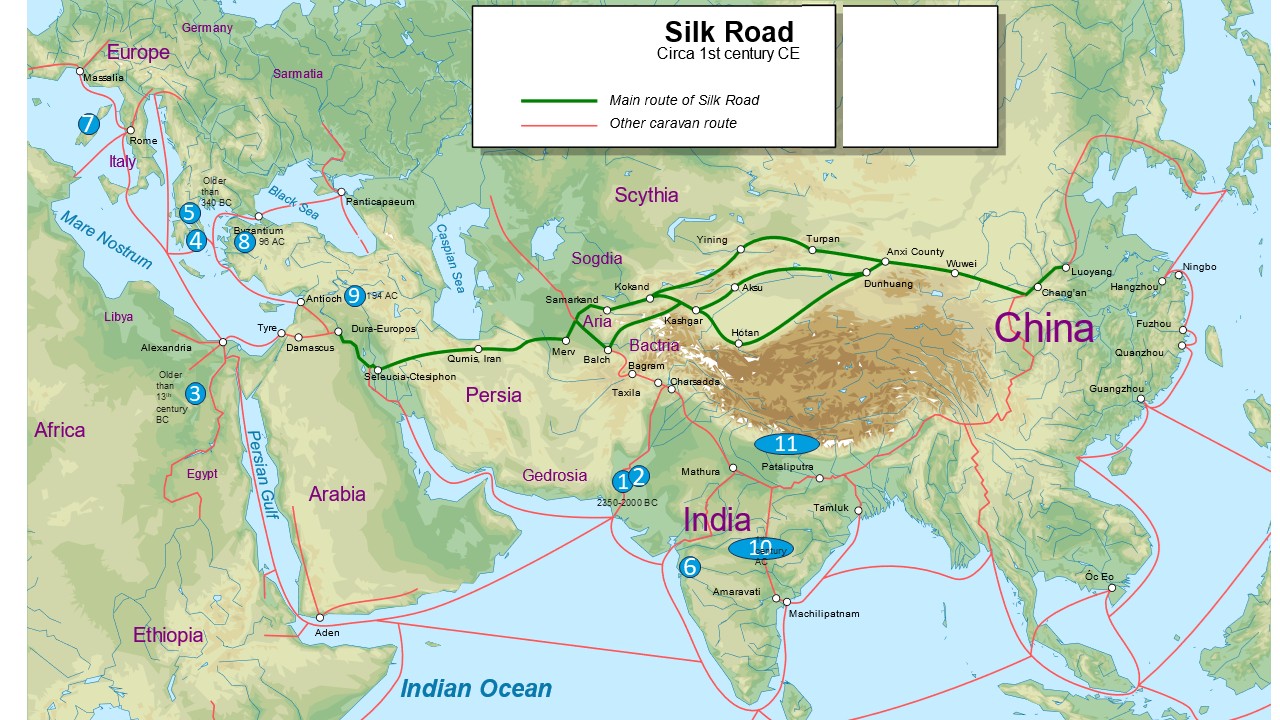
Describing the blue orbs on the silk route map. These are our book artifacts and they are ordered chronologically below:
- Artifact: “Pashupati Seal”. Date: 2350-2000 BCE. Location found: Mohenjodaro. Location displayed: Nationaal Museum New Delhi. Note: see chapters 4, 11 for a reproduction. What is interesting about this seal is that it predates even the Rigveda writing, one of the books we quote as the first to mention chakras.
- The Rigveda. The Rigveda was composed between c. 1500 and 1200 BCE in the northwestern region (Punjab) of the Indian subcontinent, not far from the Pashupati Seal location. The oral transmission dates back to at least from 2000 BCE.
- Artifact: “Isis nursing Horus child” statue. Location: Egypt. Date: although this specific artifact dates from the 7th century BCE, similar depictions of Isis with the lunar disk on top of the crown chakra go as far back as the 13th century BCE, thus overlapping with the Rigveda timeline. See Chapter 12 for a reproduction.
- Various ceramic paintings of Ulysses and his companions blinding the cyclops Polyphemus. Context: specifically, the one that most likely represents the Kundalini serpent dates back to 565 BCE (see Chapter 11 or https://commons.wikimedia.org/wiki/File:Odysseus_Polyphemos_Cdm_Paris_190.jpg). Note: To appreciate the antiquity of the Polyphemus story, note that oldest depiction in ceramic is the Proto-Attic amphora, found at Eleusis (near Athens): https://en.wikipedia.org/wiki/Eleusis_Amphora. The amphora dates to ca. 660 BC and it features early Greek art that clearly show scenes familiar from Greek mythology such as (1) a Lion chasing a boar (a familiar scene for readers of this book), (2) Ulysses blinding Polyphemus, and (3) a decapitated medusa (to me similar in meaning to blinding the Cyclops). This Amphora can be seen at the Archaeological Museum of Eleusis. But the Polyphemus story roots go even further back in time to the Paleolithicum; for that see the work from Julien d’Huy on Polyphemus.
- Artifact: Manuscript from Damascius called: Problems and Solutions Concerning First Principles. 5th Century CE. The part we are interested refers to the Orphic Theogony, composed before than 340 BCE. Note: The first explicit verse quotation of an Orphic theogony is found in the newly discovered Derveni Papyrus, dated between 340 and 320 BCE. Location: Athens, other. See Chapter 11 for text and visuals, including a reproduction of the later Orpheus mosaic from Edessa. The author of the Theogony (Orpheus) was from Phrygia, which is a little to the right of the number 7 on the map. He had also been to Egypt (number 3 on the map). This period from Orpheus is most likely overlapping with the life of The Buddha (450 BCE – 370 BCE).
- Elephanta Caves and Sopara Ancient Maritime Silk Road Trade Port. Context: Elephanta Caves (https://en.wikipedia.org/wiki/Elephanta_Caves, dating from the 2nd century BCE) and the nearby ancient maritime trade port of Sopara (active from the 3rd century BCE). The Sopara port traded with Mesopotamia, Egypt, Cochin, Arabia, and Eastern Africa (https://en.wikipedia.org/wiki/Nallasopara). Relevance: The Elephanta Cave temple contained the following sculptures of relevance to this book: 1. A three-faced Shiva (Sadashiva Trimurti). 2. Ardhanarishvara. 3. A Linga (or Shiva Lingham) as the central focus of the temple (related to tantric practice, among other things).
- Artifact: “Orpheus mosaic from Porto Torres”. Date: 46 BCE. Note: Again, Orpheus himself dates back to at least 340 BCE.
- Artifact: “The Book of Revelation from the Bible”. Date: est. 96 CE in Asia Minor. Context: The author was probably John the Elder from Ephesus. See Chapter 11 for a text and visual description.
- Artifact: “Orpheus mosaic from near Edessa”. Date: 194 AC. See Chapter 11 for reproduction and description. Again, Orpheus himself dates much further back.
- Artifact: “Ardhanarishvara”. Date: various depictions going as far back as the 1st century from the Christian era. Locations: Greece and India. See Chapter 11 for one reproduction with explanations. Of particular interest, is the Ardhanarishvara in the Elephanta caves on the Elephanta island, dated back to the 2nd century BCE, that is located on point 6 on the map, next to the Sopara port. See point 6 description above.
- Artifact: “Vajrakilaya” and other 3-faced Buddhist goddesses. Various dates. Mostly from Tibet and India. Some of its tantric practices are also quoted on Chapter 6.
§§§§§