 EN
EN PT
PTAppendix B: An Exercise in Symbolism in Art
“Decipher me or I will devour you” – The Sphinx from Thebes
Throughout this whole book, I have quoted numerous sources of wisdom (e.g. the Vedas, Christianity, Greek mythology, and art) and shown how they all point in the same direction as Yoga. I did this on purpose; had I only spoken about Indian culture, I could easily have been rejected by many, making Yoga less accessible to the world. Instead, I showed that Yoga and wisdom are all around us.
For instance, the quote above, from the sphinx from Thebes, is clearly similar to the Ulysses story of the Cyclops eating or devouring sailors. This is also seen in the Mahamudra Chod. It all points to the same direction of failure to unite (Egyptian, Greek, and Tibetan).
One of the key mysteries unravelled here starts with the Pashupati seal in Chapter 4 and fully unfolds with the Giorgio Kienerk painting: “Pain, Silence, and Pleasure” in Chapter 10, 11. Again, they point to the same direction: union.
The reader who likes symbolism in art and its relation to Yoga, union, and spirituality can practise further by analysing another painting in this appendix.
Here is the exercise, to contemplate and analyse the painting below:
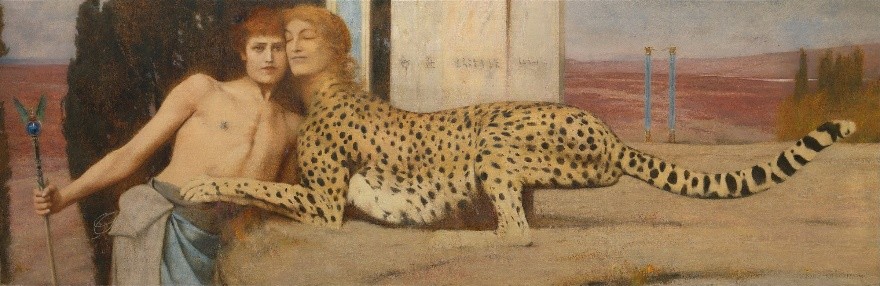
If you wish, analyse the painting first without consultation, and then continue below, to see some hints and connections.
Now, check our analysis:
(1). Did you know that Oedipus is one of the Greek Mythology characters who is enlightened?
(2). He holds a caduceus with a globe (totality) and wings (liberation).
(3). He looks straight at us (like the middle face from the three faces); he is the transcendence jumping out of the painting.
(4). He receives a caress from a Sphinx. The sphinx also presents an enigma to mankind (remember the painting from Giorgio entitled, “The Human Enigma, Pain, Silence, Pleasure?”). What did this sphinx from Thebes say to passers-by? “Decipher me or I’ll devour you”. What did the sphinx ask Oedipus to decipher? It asked: “What walks on four legs in the morning, two legs in the afternoon, three legs in the evening, and no legs at night?” The answer is man: as a baby he crawls, as an adult he walks normally, as an elder he walks with a cane, and finally in death he is free. Sounds a lot like Chapter 13 and the figure of the baby, toddler, and so on.
For those who read Chapter 11, the Sphinx often has the head of a human, plus wings, the torso of a lion, and the lower body of a bull.
So, this is an invitation to self-knowledge, to know man himself, which is a very yogic motif.
Moreover, to be put to task to decipher your own nature or be devoured by it, that is very Mahamudra Chod motif.
(5). The sphinx next to Oedipus occupies a similar position as the ladies on the side of the triptych.
(6). The two pillars as gates to the desert could well symbolise duality like the sides of the painting by Giorgio.
(7). The passage into the desert could symbolise transcendence from duality, from the relative to the absolute, to the silence of the desert. The centre part of Giorgio’s painting was also called silence. Remember even Christ went into the desert to meditate?
(8). How about the cypress tree? Note that it is an evergreen type of tree and also points straight upward. Therefore, no more ego rebirth or cycles like the seasons. Remember the seasons were present in the dualistic part of Giorgio’s painting? The cypress tree is also a symbol for Orpheus or for Christ (as in the façade of the Sagrada Familia Church).
(9). How about the writing on the Greek marble wall? Well, I could not decipher that. Can you? I guess the writing on the wall is what all the books are about. The books take one through such gates.
§§§§§