 EN
EN PT
PTAppendix E: Why The Ox, The Bull, and the Eagle?
Where do the bull, the lion, and the eagle from Chapter 11 come from? Some hypothesize they are ancient symbols (since neolithic times) for the calendar seasons. Do you remember the mosaic of the seasons from Orpheus, the seasons in Giorgio Kienerk painting of the seasons, or the seasons engraved on the four wings of the Mithraic Aion god? Seasons represent cyclicality, or at least duality (winter and summer). We have seen that they could also symbolise desire (the bull) and fear (the lion) and the conquest of these (when the human slays the bull or becomes the lion god).
For details see: https://oldeuropeanculture.blogspot.com/2019/04/four-living-creatures.html; https://oldeuropeanculture.blogspot.com/2020/07/mahishasuramardini.html; https://drmsh.com/ezekiels-vision-part-2/;
As a summary from these two websites:
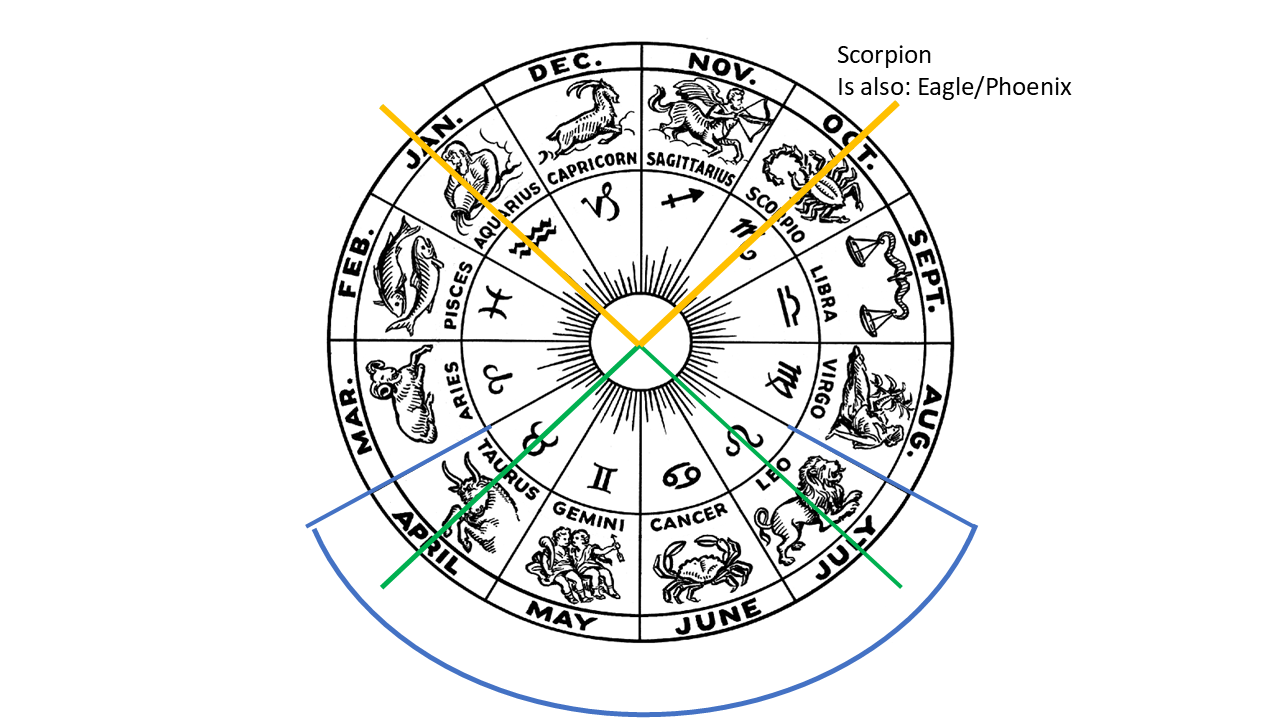
The websites above relate Ezekiel’s vision symbols to the succession of constellations in the sky as the seasons pass. Specifically, Ezekiel’s ox is in Taurus; the lion is in Leo; the man is in Aquarius (21st Jan-19th Feb, coldest days in the northern hemisphere); the eagle is in Scorpio (few people know that Scorpio has another form, the Eagle or sometimes the Phoenix), which is the middle of fall. Connecting the four symbols from Ezekiel we have an X cross. They mark the natural seasons per the Celtic and Serbian calendar (Celtic: Imbolc, ..; Serbian: St. Sava, ..) and as they are felt by living beings regarding coldest and warmest days (rather than the shortest and longest days). The coldest days in the northern hemisphere are not in 21st of Dec, but somewhere in between 21st Jan-19th of Feb. The sun is the central figure of pagan adoration and transcendence in the zodiac, and with Mithras, and in Egypt, and in many other religions and cultures. In other artifacts, the central figure of transcendence is Orpheus or Shiva/Parvati, or Christ.
Coincidence or not, there is something the website authors did not bring up. Do you remember Chapter 11? We showed Pashupati, Ardhanarishvara, Mithras, and Orpheus Theogony. Many of these symbologies displayed a bull to the left and a lion to the right. For instance, for Pashupati, Ardhanarishvara, and Orpheus, as displayed from left to right: (1) Bull, (2) Pashupati, Shiva/Parvati in union or Orpheus in harmony/peace, and (3) a Lion (Tiger for Pashupati). And how about the Mithras reliefs? They first show the bull, then the twins, then the lion. We will look at the sky map from right to left. This is the sequence of the zodiac symbols: first Tauri, then the Twins, then Leo. Twins is also a symbol for duality, and the transcendence thereof.
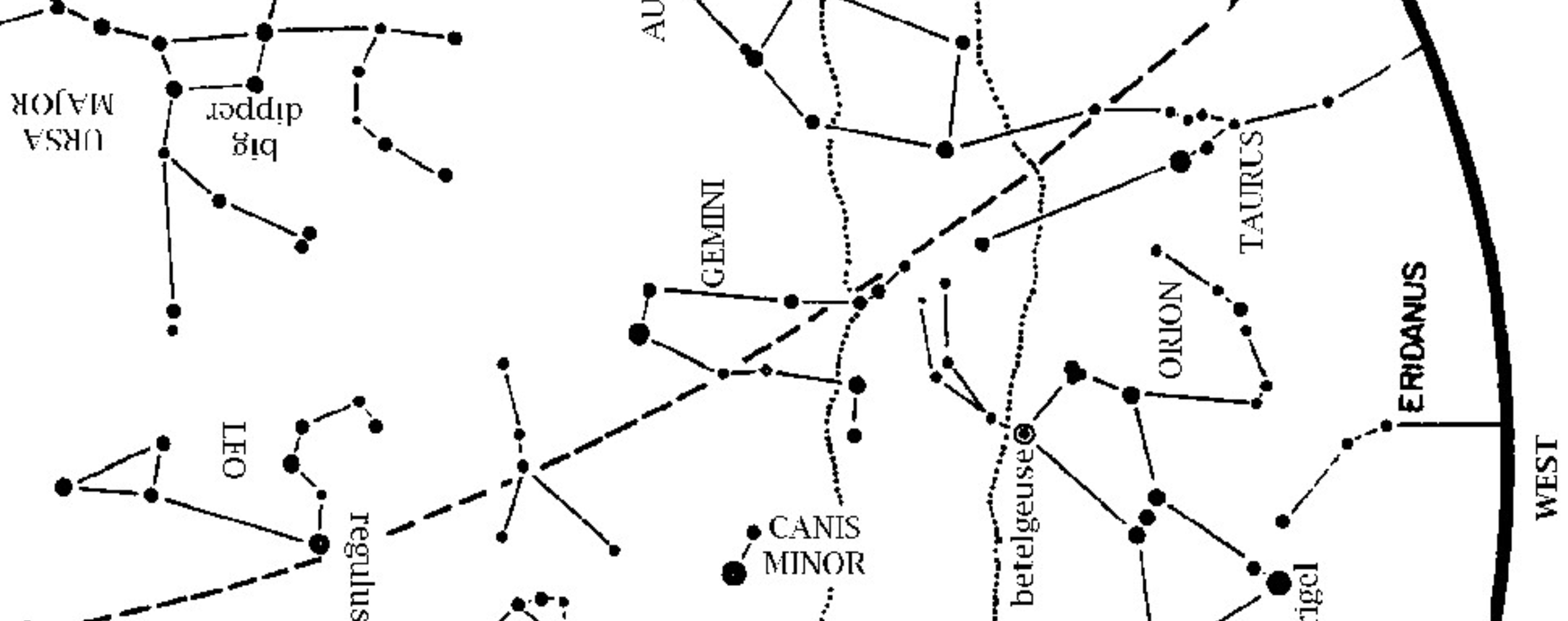
Hindu astrology reinforces the potential coincidence in the order of symbols, and the order of constellations passing in the ecliptic line of the sun (see the dashed line). In Hindu astrology, Gemini (Mithuna in Sanskrit) has a unique role because it represents two sides of the same coin—two sides, as in having the male and female together as Ardhanārīśvara. Ardhanārīśvara sits between the lion and the bull, just as the Gemini constellation sits between Leo and Tauri in the sky. Is this a coincidence? Or further reinforcement for what they conveyed: cyclicality, duality, cold and warm, and the transcendence thereof?
For the oldest symbols such as Pashupati (2350-2000 BCE), this close match with the zodiac animals might at first be labelled a coincidence. After all, the zodiac in its complete form dates back to 1st millennium BC in Babylonia, while Pashupati dates back almost to the 2nd millennium BC. But given what we see above, the zodiac symbols are also in Hindu astrology.
Could it be that the bull and the lion were already known as constellations before by the Harappans, Hindus, and Mesopotamians. Our hypothesis is further strengthened when we look at, for instance, the following Tamil Nadu relief (knowing that Tamil received Indus valley immigration before 700 BC):
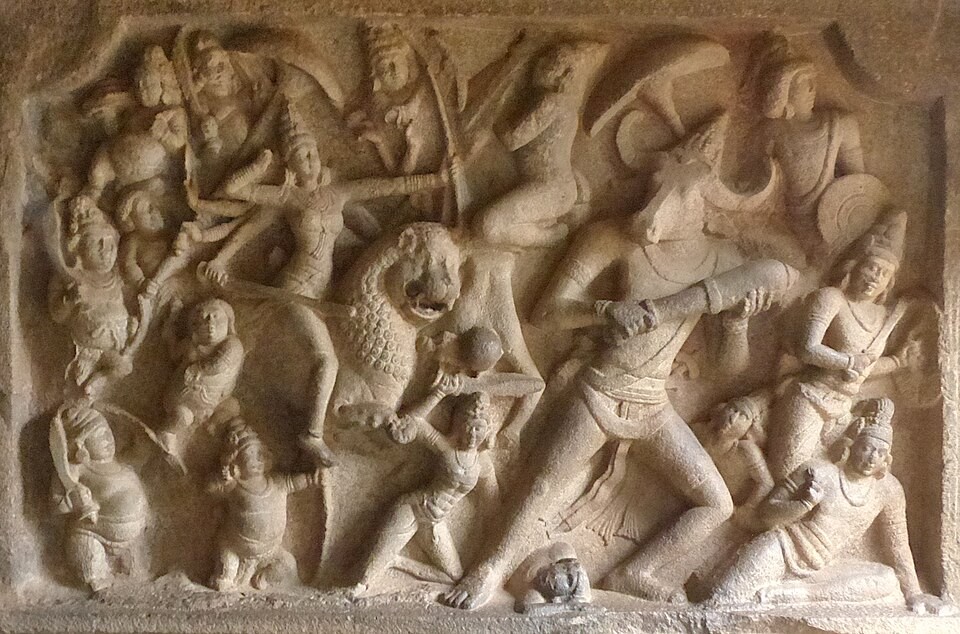
This is the 7th c. CE depiction of the moment when the Devi (goddess) Durga riding on a lion slays Mahisha (Asura, demon) whose name means buffalo... From Mahishasuramardini Mandapa, Mamallapuram, Tamil Nadu, India. The website above (old European culture) mentions that this symbology is about one season giving way to another (the bull season in April giving way to the lion season in July). Surprise surprise, one of her six arms holds a disc like Aion, like Narasinha as we saw on Chapter 11.
Our hypothesis, that the bull constellation was known to the Harappans, is yet again strengthened when M. Rappenglueck shows that the Taurus constellation—with the adjacent Pleiades star cluster—had most likely been painted on the walls of the Lascaux cave in France in 15300 BCE! That is surely enough time for the myth to spread wide and far. See article: “The Pleiades In The ‘Salle des Taureaux’, Grotte de Lascaux. Does a rock picture in the cave of Lascaux show the open star cluster of the Pleiades at the Magdalénien Era (CA 15300 BCE?)”.
Was the bull, or Taurus, the only constellation adored so many thousands of years ago? Absolutely not. More than one figurine of a human or god with the head of a lion has been found in caves in Europe. One of the oldest, if not the very oldest, dates back from something in between 41000 or 35000 years ago!: https://en.wikipedia.org/wiki/Lion-man. While scholars say it was either shamanic or related to the Leo constellation, it is not yet proven to be one or the other. How could it be proven dating back so far? Unless they depict the stars from the Leo constellation it cannot be entirely proven.
In any case the conquest of desire (bulls) or fear (lions) have been part of the human unconscious for quite a long time.
When humans looked at the night sky through the ages, they connected the dots to make shapes and symbols that were more a reflection of their own experience on earth and their own unconscious than something really written in the stars. Get two humans and ask what shapes they see on the stars and their imagination will differ; get 10s, 100s or 1000s of humans sharing stories of the heavens, and the symbols start converging to the collective unconscious and spreading wide and far. Not only did they converge to the collective unconscious, they are an aggregate of the spiritual symbology from those cultures. An example is the story of Polyphemus, which evolved since the Palaeolithic, to incorporate Kundalini symbology in its mid-to-late renditions. See the work from J. d’Huy on the evolution and lineage of the story of Polyphemus.
Both websites quoted at the start of this appendix mention that in some regions of the globe, the animals’ mating seasons (lion and bull) match the zodiac constellations (Tauri and Leo) for the respective months. Yes, even the mating seasons of other animals depicted (elephant, crocodile, eagle) seem to match. But do take into account that the lion mates during any season. In any case, humans chose to mark the constellations that pass with the seasons with an ox (Tauri constellation) and a lion (Leo constellation). While there is a resemblance of the star configurations to the animals shape, we could have equally marked Tauri as the ‘fork’ constellation for missing the bull horns resemblance and taking it to be more like a fork-shaped shale tool; and likewise Leo can be seen as the cobra snake (with a hood) constellation. Feel free to check their star arrangements in the picture above, if you can see a fork and a cobra hood. The reality is that we project our unconscious into what we see as dots in the sky. And people were more prone to imagine a lion or liked the interpretation of a lion. We write our spirituality in the sky. We see our divinity in nature and the sky. Why not? This is who we are.
The reality is that the ancients were not separate from nature, and they made their mythology and spirituality an expression of the phrase, “as within so without” or “the micro is like the macro”. So much that we have shown in Chapter 9 that the Orpheus Theogony is as much a story of the human spirit as it is a real cosmology of the gods in heaven. Yes the Theogony has the bull and the lion in the sky with Chronos, as the constellations, but we see them within as the theogony itself says, “naturally originated”. It is natural to be stuck in between running from the lion and towards the bull.
We have been running away from lions and similar predators, and running towards oxen and similar prey for a long time. We have also moved away from hunting and gathering to farming; thus from the lion to chasing the ox. Both symbols remain strong in our collective unconscious be it for seasons, duality, cyclicality, or their transcendence. We are constantly balancing our wild and tamed sides, as individual and as societies.
Even before all that is mentioned above (Lamassus and Pashupati, Zodiac, Orpheus surrounded by a Bull and a Lion, and Ardhanarishvara)—even before all these, the megalithic circles have been aligning our activities on earth symbolically with the central figure of the sun and the seasons, marking both the longest and shortest days, as well as the coldest and warmest days (Celtic and other calendars). Our spirituality was not separate from nature; duality and cyclicality had perhaps their most potent manifestations in winter and summer.