 EN
EN PT
PTArtwork from Chapter 11
Here is a list of all the artwork quoted in the chapter. It is displayed in colour in the sequence it appears in the book for those who want to listen to the book on Kindle and see the illustrations here.
Optimisation Landscape
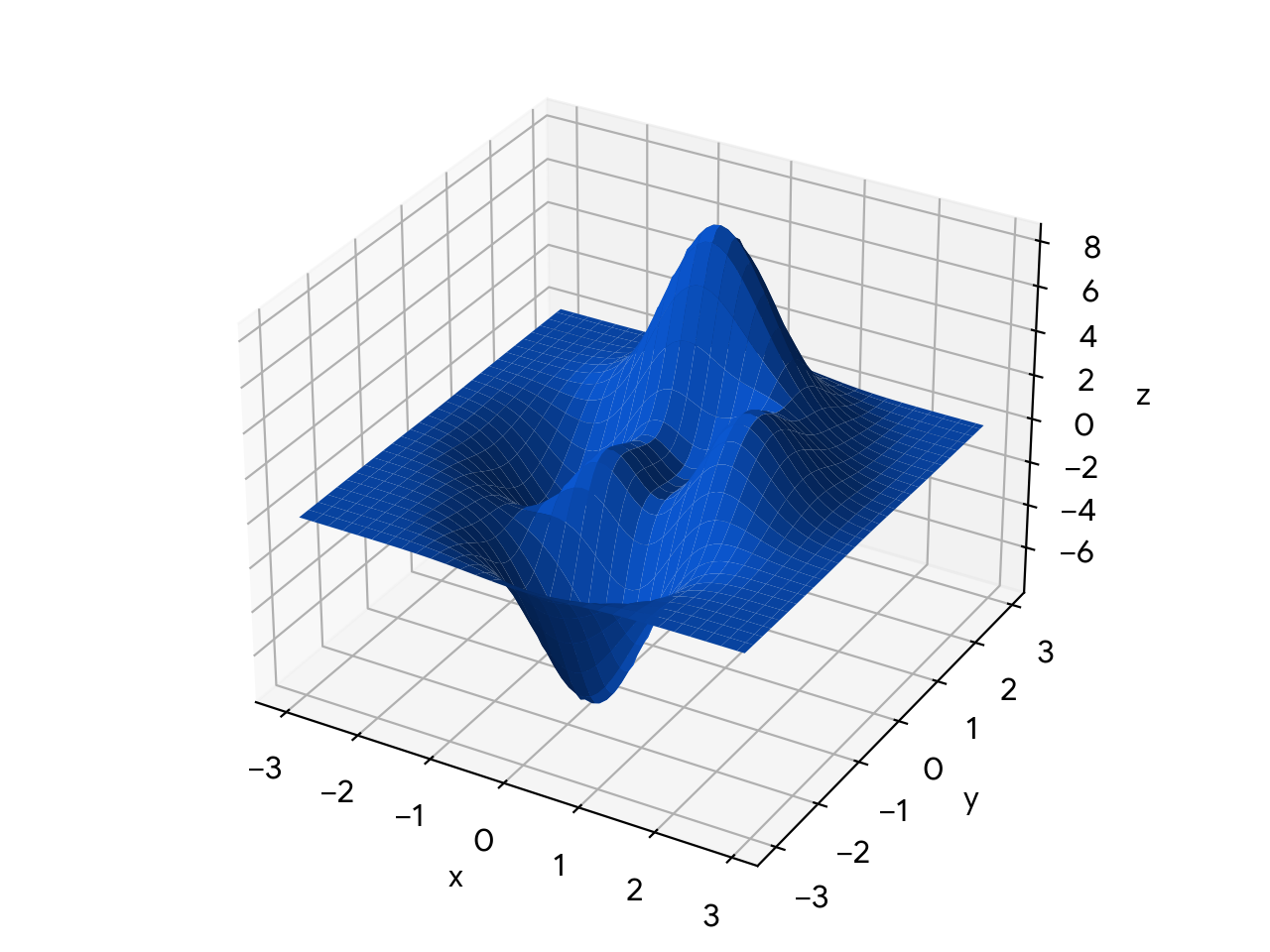
Artist: AI Generated for this edition at least.
Source; License: Source: Gemini. Copyright: André Cesta.
Chapter: Chapter 11: Transcendence From Duality, Illustrated
Description: If you do not understand enough about optimization … no problem. Just think of a mountainous landscape. There is usually one peak that is higher than all the rest. Such as the Mt. Everest in the Himalayas; or Mt. Olympus in the Greek mythology. All the other peaks are local maxima; only Everest is the global maxima. The maximum of all maxima. The highest peak from ocean level.
Book Excerpt
An example application of optimization would be to try to make the sweetest yogurt that tastes like honey, like Greek yogurt. The optimisation variable space is the time fermenting; the amount of milk; how much you churn it; the temperature; etc. The optimisation surface has a peak of sweetest yogurt. On that peak the optimal amount of fermentation time; churning is applied, not less not more from any variable; or you descend from the peak. The peak is where all these variables are at their best tuning point.
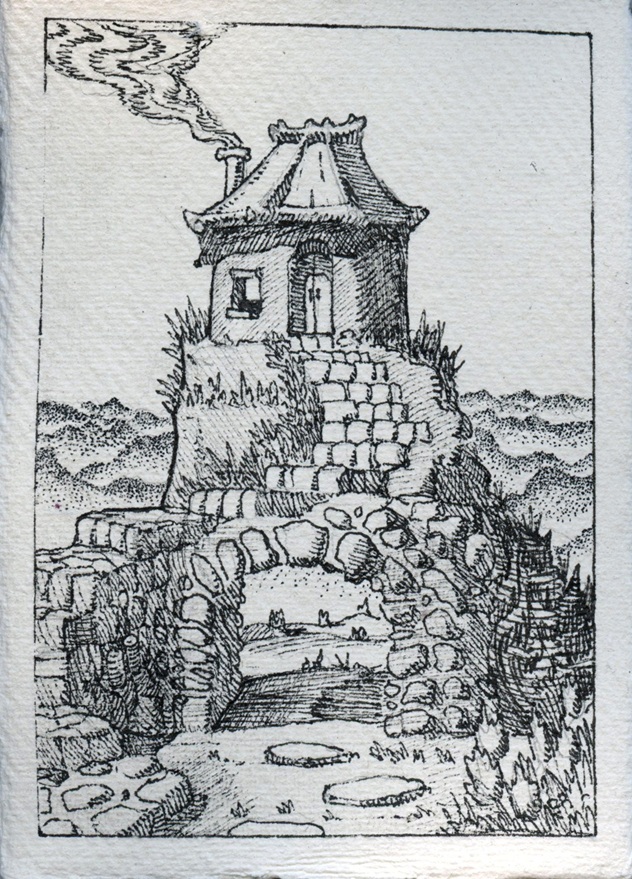
View from a Global Maximum, the Highest Peak to be Climbed: the Mountain of Mind
Artist: Stefan Lucas Allen.
Source; License: Illustration commissioned for the book. Permission to share provided credits to the artist and book are clearly provided below the picture.
Chapter: Chapter 11: Transcendence From Duality, Illustrated
Description: We can describe this global maximum more in terms of climbing activity than in terms of a mount name or a place with geo-coordinates.
Book Excerpt
We can describe this global maximum more in terms of climbing activity than in terms of a mount name or a place with geo-coordinates. It is a journey; it is not a destination. An optimal journey within our reach. Here the climbing activity is: being good, compassionate for ourselves and others; finding our true nature; being focused. If you want to name this mountain, I suggest you call it: “the mountain of mind”; “being (super)-human”; “yoga as a way of life”; “a new home”.
Pain, Silence and Pleasure, the Human Enigma

Artist: Giorgio Kienerk.
Source; License: Wikipedia. Public Domain.
Chapter: Chapter 11: Transcendence From Duality, Illustrated
Description: Pain and pleasure; duality; pairs of opposites and their transcendence.
Book Excerpt
Remember we were talking about local and global optimization? And that people get stuck in local optima or maxima without ever climbing the full mountain of mind to the global maximum?
Upon contemplating this painting, it dawned on me immediately that running away from pain and towards pleasure was the typical local optimization, with the sub-optimal, represented by the two extremes of the triptych: pain and pleasure.
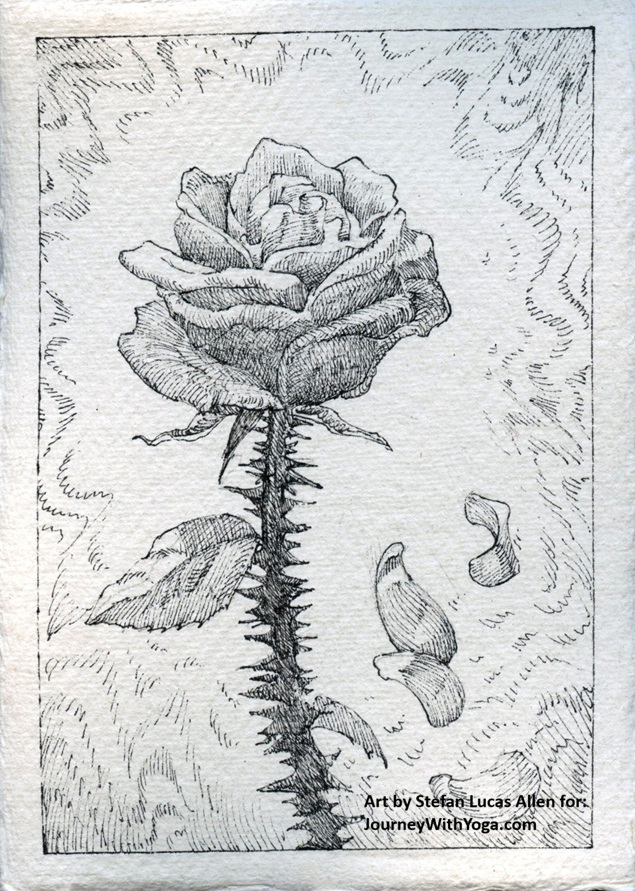
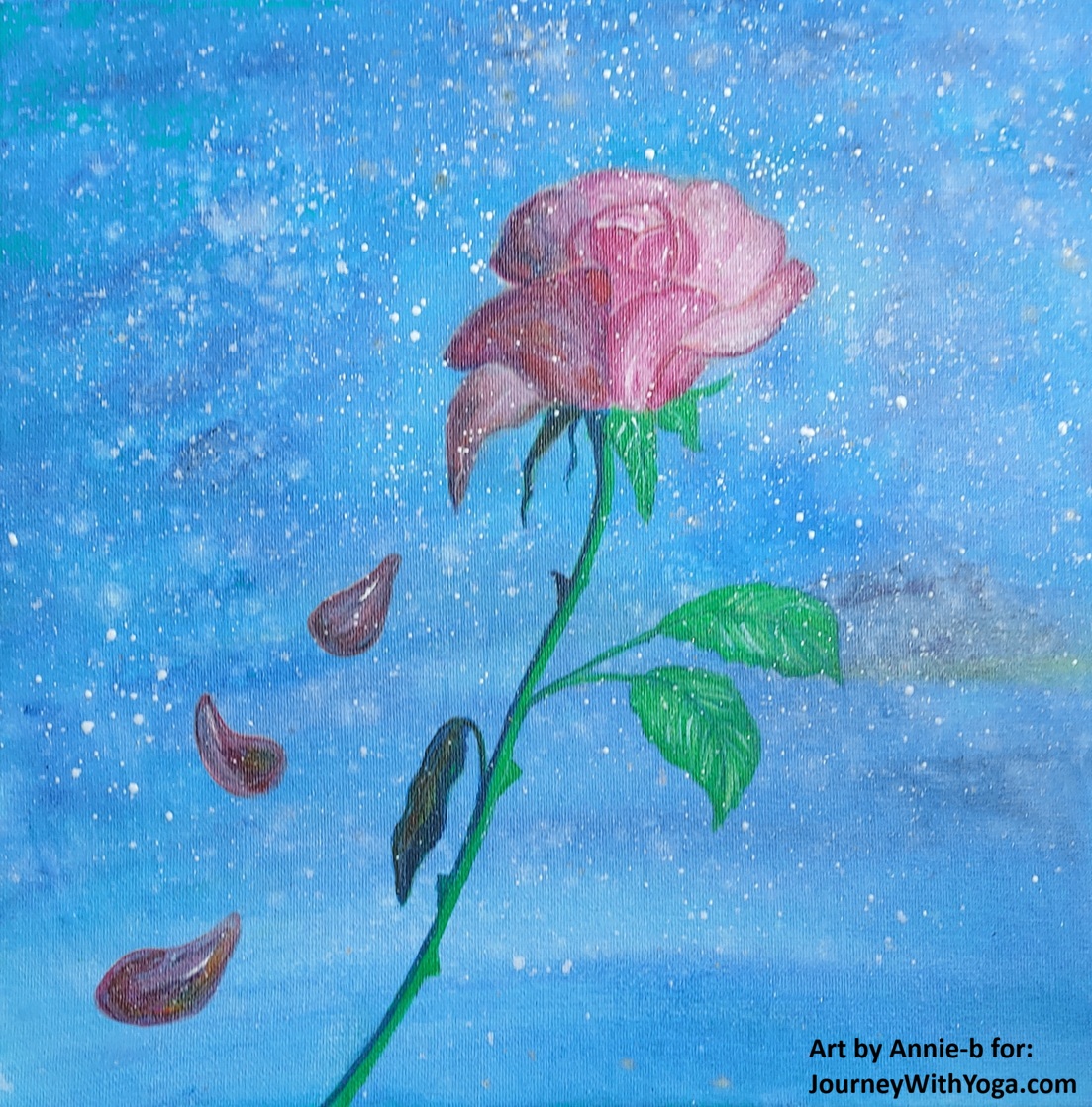
Why is Pain the Other Side of Pleasure?
Artist: Stefan Lucas Allen (Left/First/Drawing), Annie-b (Right/Second/Colour).
Source; License: Illustration commissioned for the book. Permission to share provided credits to the artist and book are clearly provided below the picture.
Chapter: Chapter 11: Transcendence From Duality, Illustrated
Description: Why is pain the other side of pleasure? It is so at the sensorial level; but it is also so at the level we process sensations.
Book Excerpt
If I soak my body in a warm bath at 33 degrees Celsius, I may feel pleasure at first, but after some time in the warm water, unable to sweat to cool my body down, I may start going somewhat unnoticeably from pleasure to pain in a matter of minutes, and leave the bath completely exhausted with a headache that will last the whole day.
The Hunt
Artist: Kristina Kurilionok.
Source; License: Illustration commissioned for the book. In author's collection. Permission to share provided credits to the artist and book are clearly provided below the picture.
Chapter: Chapter 11: Transcendence From Duality, Illustrated
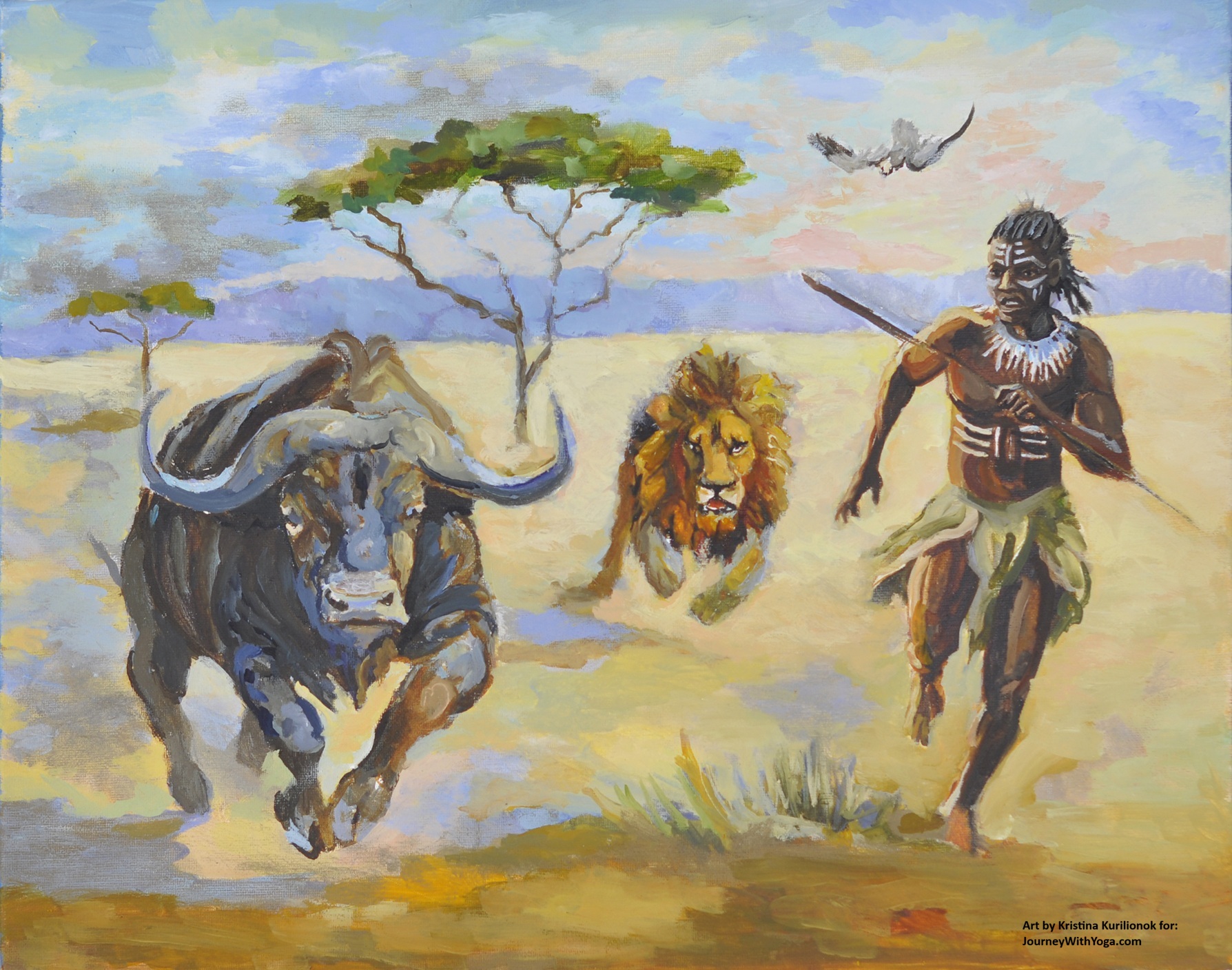
Description: The alternative: chasing pleasures and fleeing pains is not a life. It is being stuck in an eternal run. It is waking up hungry to hunt a bull, and finding yourself being chased from behind by the lion.
Book Excerpt
For those of you with some sense of humour. Consider the painting above. Ladies, that is not your husband returning from work. Gentleman, the bull is not the job that pays your livelihood, and the big cat is not boss, or your wife waiting for you when you get home.
Hercules and the Hydra
Artist: Antonio del Pollaiolo, 1475.
Source; License: Source: Wikipedia. License: Public Domain.
Chapter: Chapter 11: Transcendence From Duality, Illustrated
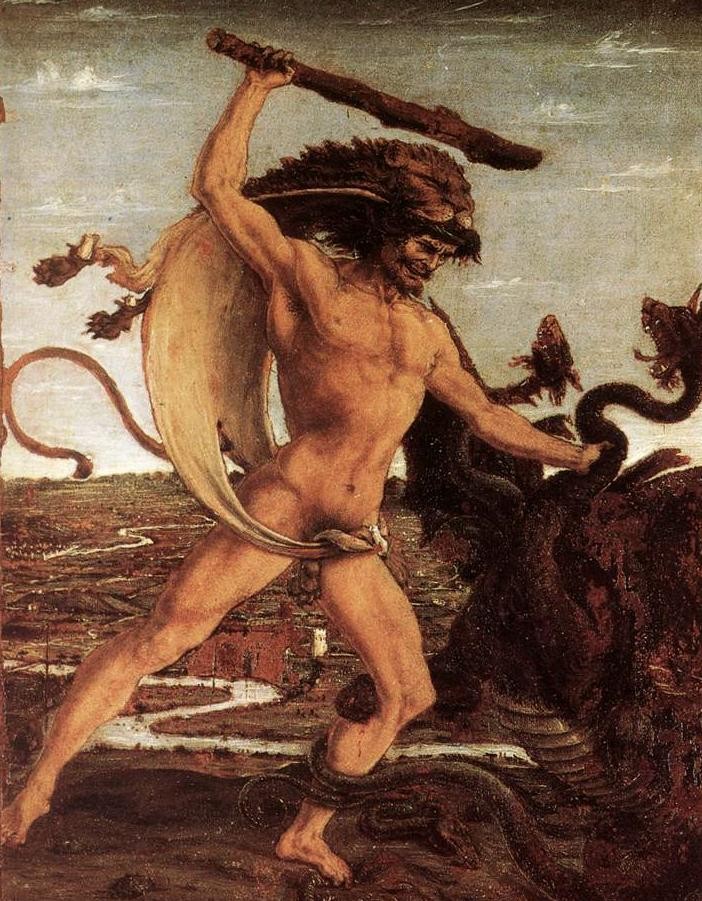
Description: After killing the lion of Nemea, Hercules wears the lion’s skin which grants him super powers to fight the hydra from Lerna. Could the killing of the lion symbolise winning over fear? Or over domination instincts? Painting: “Hercules and the Hydra” by Antonio del Pollaiolo, 1475 exposed at Galleria degli Uffizi-Florence.
Book Excerpt
Do you remember that old cartoon of a fish eyeing a fat, juicy worm, only to find it wriggling on a sharp fishing hook? The question, of course, is timeless: how do you get the worm without getting caught by the hook? The cartoon offered a surprising answer—detachment. With detachment, you don’t dive headfirst into desire, blinded by hunger or fear. You don’t scramble on the ground like the desperate tribesman, fleeing a lion while chasing a wild buffalo—caught in survival, driven by urgency. Instead, you rise above the chaos. You become like the falcon, gliding in silence, scanning the world from above, choosing your moment with calm precision. Detachment doesn’t mean avoiding the worm or denying the hunt. It means gaining the height and clarity to act without being trapped. It is from that higher vantage point that true freedom begins.
Artist: Valerio Giovannini.
Source; License: Illustration commissioned for the book. Permission to share provided credits to the artist and book are clearly provided below the picture.
Chapter: Chapter 11: Transcendence From Duality, Illustrated
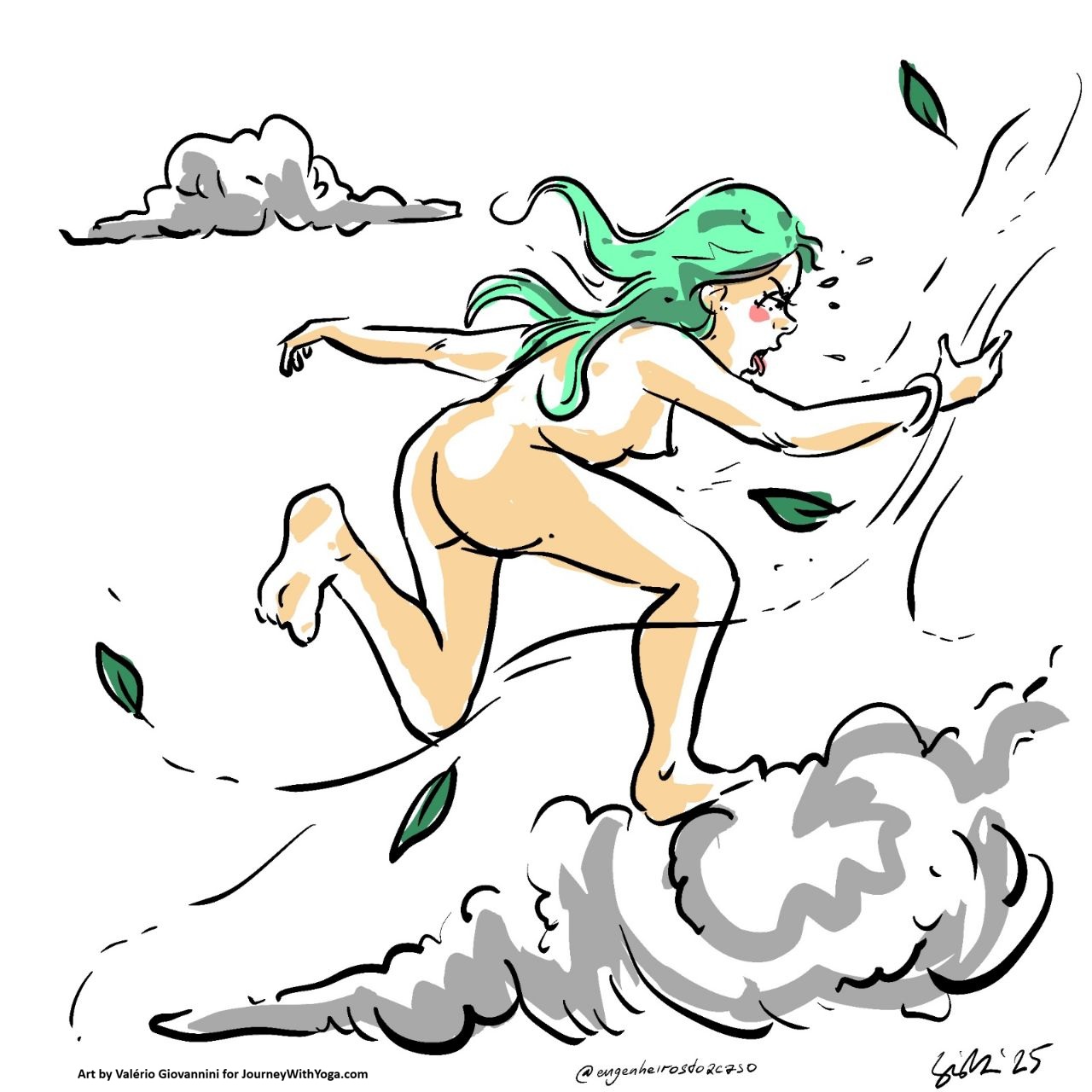
Description: It is important to understand that “there is nothing new under the sun”. It is important to understand that pleasure seeking is “like chasing the wind” , the wind comes and goes. People come and go like Shanti said. Things also come and go.
Book Excerpt
This is why being moved by sensations for the mere sake of sensations is futile. Pleasure and pain are ordinary occurrences in a bigger process. Pleasures are not to be collected like one collects flowers in a garden (yama of aparigraha). A garden has a different purpose for a yogi.
Home Cocooning

Artist: AI Generated for this edition at least.
Source; License: Source: Gemini. Copyright: André Cesta. Reproduction is allowed provided mention to the book source is made as caption.
Chapter: Chapter 11: Transcendence From Duality, Illustrated
Description: The cocooning generations.
Book Excerpt
A person like that typically ends-up locking himself in a home fortress chasing an endless stream of pleasant fake food; goodies; gizmos and movies to enjoy in a comfortable couch in front of the screen. Everything this person does will be to improve his castle and pantry. Maybe his family leaves the couch to spend a week in a fake amusement park far away from nature. Sounds like our times? To me it is our times.
The Pashupati Seal
Author: Unknown, Harappan Civilization, 2600-1900 BC
Source; License: Wikipedia. License: Public Domain.
Chapter: Chapter 11: Transcendence From Duality, Illustrated
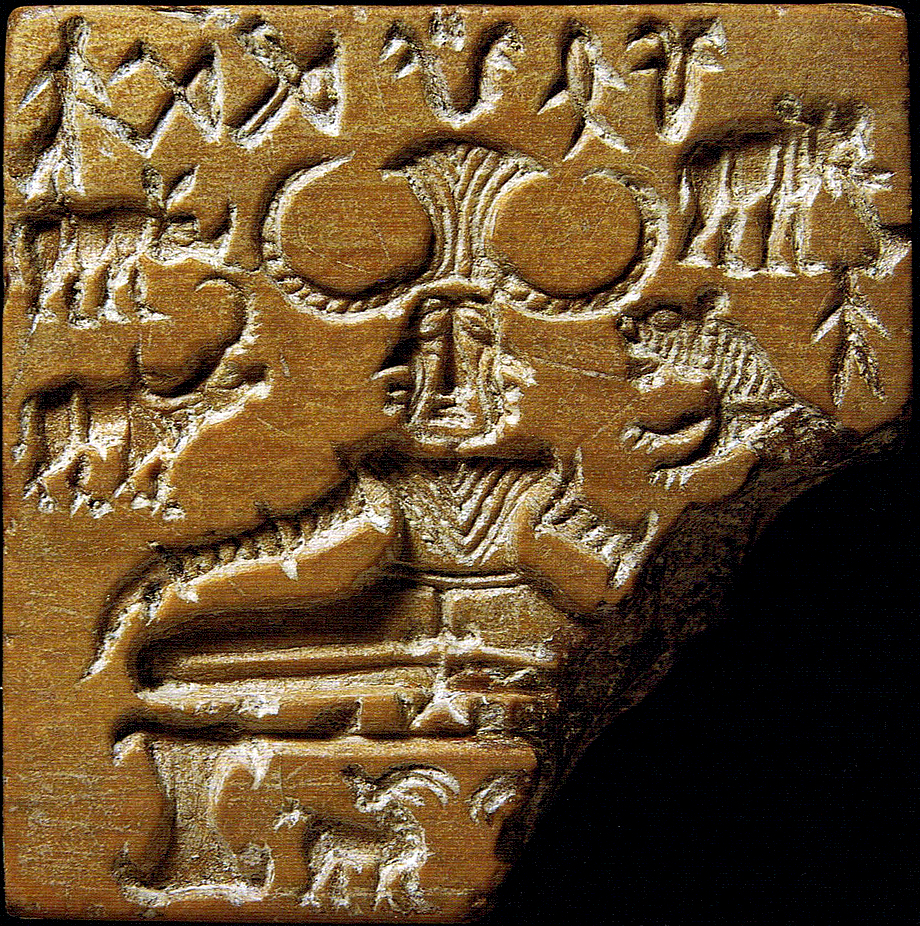
Description: The Pashupati Seal and the painting called Pain, Silence and Pleasure, the Human Enigma are the visual cornerstones of this book.
Book Excerpt
What this seal communicates is so deep, that I will need the whole of chapter 9 (some of the conclusion on yoga) to explain it.
A Seated Ardhanarishvara with both the Vahanas

Author: Copyrighted to Himalayan Academy Publications, Kapaa, Kauai, Hawaii.
Source; License: Wikipedia: https://commons.wikimedia.org/wiki/File:God_marriage_AS.jpg. License: ASAG 2.4.
Chapter: Chapter 11: Transcendence From Duality, Illustrated
Description: A transcendence from duality theme.
Book Excerpt
At this point you should know the meaning from all the symbols which just repeat from the Indus valley Pashupati: bull and lion to each side symbolizing duality. The male and female reinforcing the duality concept and symbolising the ida and pingala nadis (more about it soon). Tiger skin, or flat animal (see below Tibetan): conquering ego, making it transparent, victory over disturbing emotions. The victorious god in the centre symbolizing transcendence. Third-eye meaning one chakra below the crown chakra of transcendence. High hair knot: crown chakra of transcendence. The trident (two become one, transcendence). Yes, writing in transcendence from duality bold in painting is evoking the same concept multiple times, across several cultures.
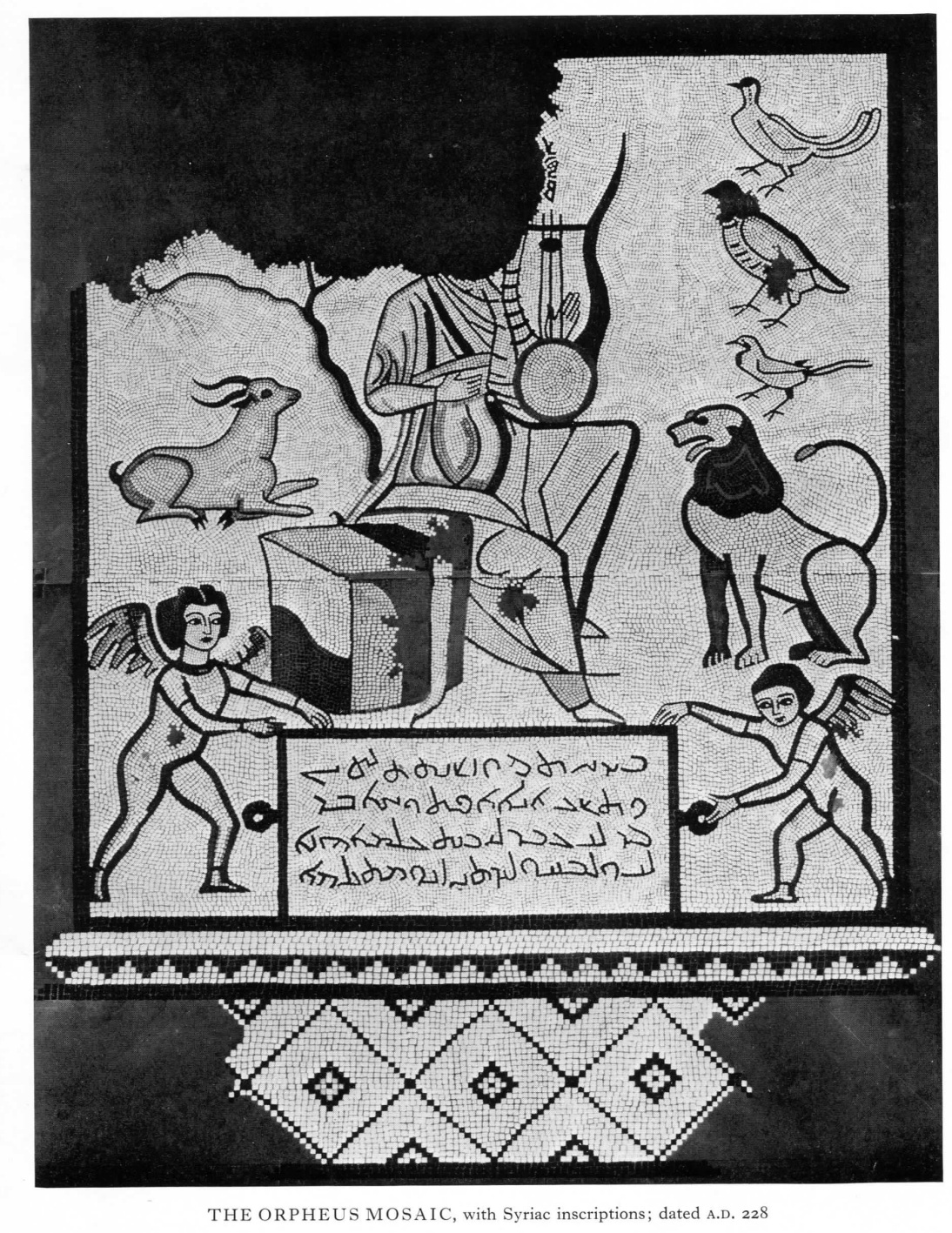
Author: Unknown. Syriac inscribed.
Source; License: Edessa the Blessed City - J. B. Segal.
Chapter: Chapter 11: Transcendence From Duality, Illustrated
Description: A transcendence from duality theme.
Book Excerpt
Little known and lost Orpheus Mosaic from Edesa. Documented in black and white photograph by J.B. Segal in his book: Edessa the Blessed City. Notice the gazelle; and the lion. Even the sides these animals occupy coincide with Pashupati, Ardhanarishvara, except that in the later a cow/bull is used.
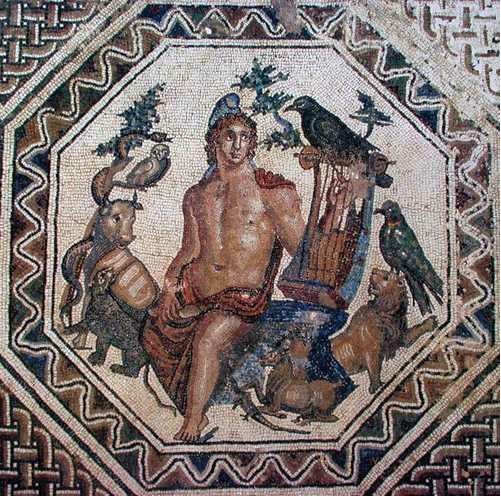
Author: Unknown.
Source; License: Wikipedia; ASAG 3.0.
Chapter: Chapter 11: Transcendence From Duality, Illustrated
Description: .
Book Excerpt
Notice that only these six geographically distant mosaics from Orpheus split the animals in prey and predator. All others mosaics and frescoes from Orpheus seem to mix the pacified animals. In any case, he pacifies them, or plays the role of a “good shepherd” as it is said by scholars. Such is the power of this image from Orpheus that Christ has been depicted as Orpheus in artwork; King David also ; and even the Buddha has been compared to Orpheus . All of them are profoundly transcendent figures.
Artist: Unknown.
Source; License: https://books.openedition.org/pcjb/4614. Public Domain.
Chapter: Chapter 11: Transcendence From Duality, Illustrated
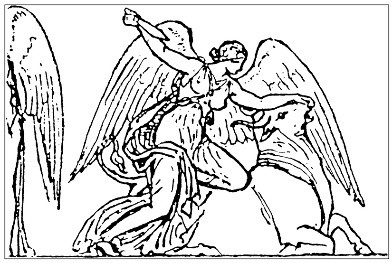
Description: The “Mystery of Mithras” book explains that this thematic representation of Nike precedes Mithras killing of the bull and can be traced back to the 5th century B.C.E. depiction of Nike on the parapet of the Temple of Athena Nike in the Athenian Acropolis.
Book Excerpt
Starting in the 1st century CE, in the Roman empire, the killing of the bull and integration of the lion took a fascinating turn in the cult of Mithras with its scenes of a slaying of the bull, plus a third mythic character, a lion-headed god likely representing, as academics say, time, cosmic power, or a struggle with lower instincts.
Mithras Initiation Mural: Front.
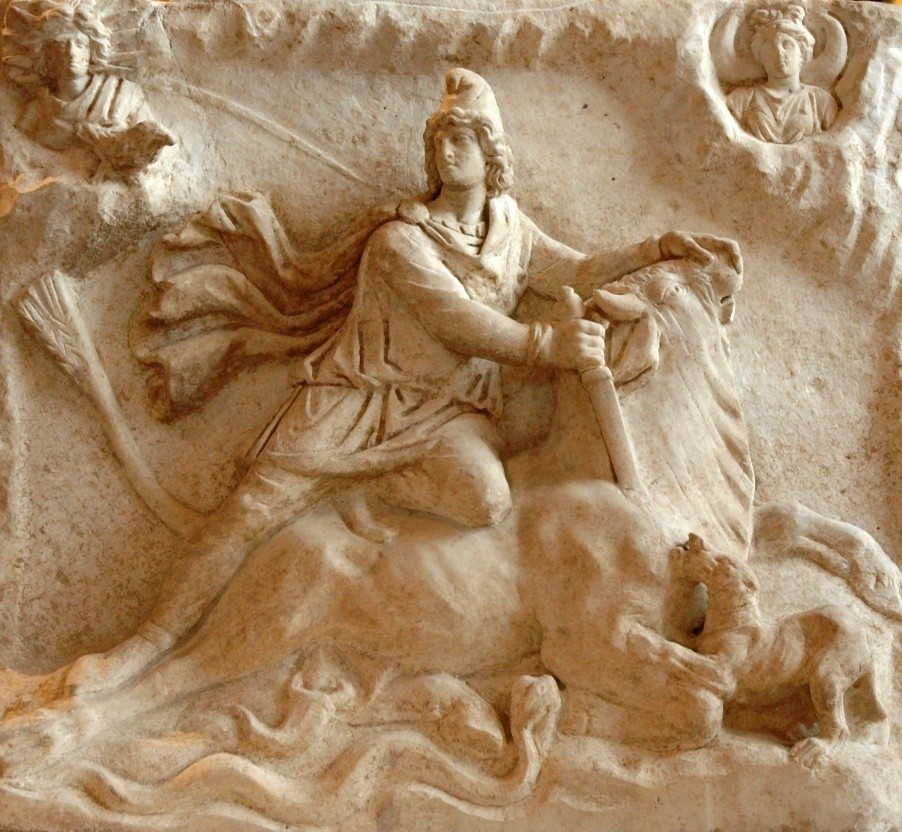
Artist: Unknown.
Source; License: Wikipedia. Public Domain.
Chapter: Chapter 11: Transcendence From Duality, Illustrated
Description: Initiation scene 1, Mithras slaying a bull, a Tauroctony scene, from the 2nd or 3rd century CE, near Fiano Romano, now on display in the Louvre. In the left upper corner we find Sol, Helios (sun) with the raven and rays of light behind his head, On the top right: Luna (moon) with a crescent moon on the background. Notice the snake below the bull (also a frequent theme in such Tauroctony scenes). While the slayer looks like Orpheus because of the Phrygian cap, it is actually Mithras. Persians also used this headwear, a sign of the origin of such symbolism and the wisdom behind it.
Book Excerpt
Regarding the presence of Helios and Luna above: I must comment that in Yoga, the sun and the moon energies are developed and balanced by Hatha yoga. In Sanskrit ‘ha’ means sun and ‘tha’ means moon. More specifically, Hatha Yoga refers to the male and female aspects (Shiva and Parvati in the Ardhanārīśvara), the hot and cold, yang and yin if you wish. Hatha Yoga refers to these energies and their interplay throughout the universe, and within ourselves. We will talk more about these hot and cold energies, including my personal experience with them, when we describe the Yoga subtle energy body later in Chapter 12.
Here is what Jung says about Mithras on his book, “Man and His Symbols”: “…like Orpheus, (Mithras) represents the longing for a life of the spirit that might triumph over the primitive passions of man and, after a ceremony of initiation, give him (the devotee) peace”.
When one kills the more physical bull (and lion...), then these Yoga ha-tha subtle body energies manifest. This is the reason why the sun and moon sit above the bull in the artwork (the heavenly plane) while the bull sits below (earthly, physical plane). While this may not seem entirely convincing at first, bear with me, as the number of reinforcing symbols with parallels to the Yoga tradition will build-up to an astounding number.
Mithras Initiation Mural: Back.
Artist: Unknown.
Source; License: Wikipedia. Public Domain.
Chapter: Chapter 11: Transcendence From Duality, Illustrated
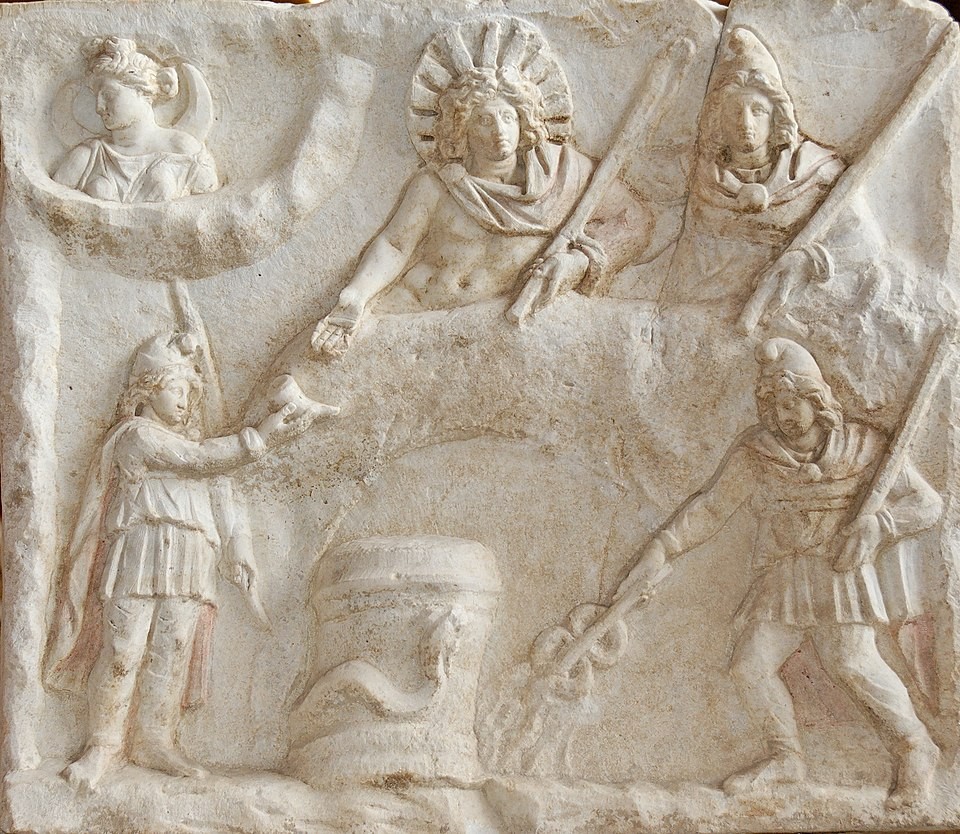
Description: Initiation scene 2 . It is the reverse side of the first relief above from Ostia-IT, a scene called the banquet between Mithras and Sol (Helios). The bull skin covers the table. The Nida-Hedernheim Mithras relief is also a similar two sided relief.
Book Excerpt
So what is the symbolism of a hero slaying a bull and dining in union/communion with the sun? I let C. G. Jung answer that: “The psychic life-force, the libido, symbolises itself in the sun or personifies itself in figures or heroes with solar attributes” - Carl Jung (Collected Works, Vol. 5, p. 297). Did we not say the bull symbolises desire, libido which if transmuted, becomes another type of energy? In his book on the psychology of the unconscious, Jung goes so as far as to say that the cap Mithras wears symbolises the penis foreskin. I must comment that the diagonally erect posture of Mithras over the bull is equally suggestive of this interpreation.
Mithras Gem
Artist: Unknown.
Source; License: Cumont. Public domain.
Chapter: Chapter 11: Transcendence From Duality, Illustrated
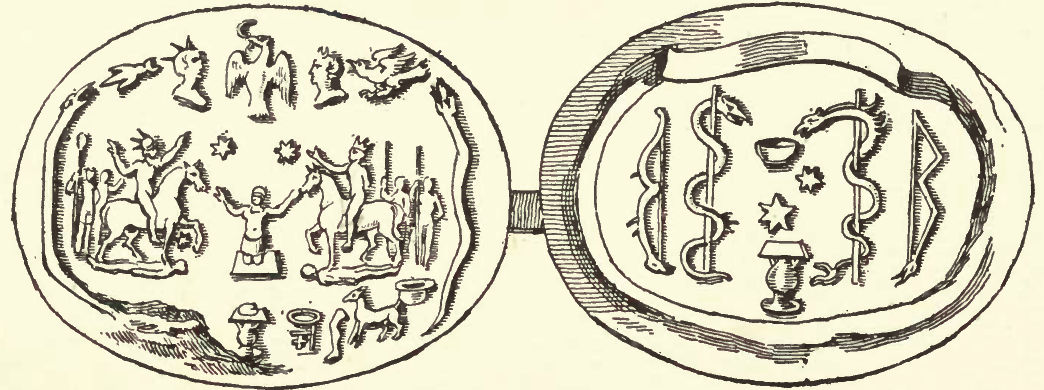
Description: Source : Cumont, The Mysteries of Mithra(s), 2nd revised edition. Notice the two snakes on the sides of the mixing bowl, paralleling the twins.
Book Excerpt
The image of the cup filling the vase shows that side-channel energy is no longer drained by desire at the base. Instead, it now supports the main energy channel and helps the energy rise. This idea (hypothesis) is supported, but the two snakes (ida and pingala) in the Mithras gem.
Kneeling Bull with Vessel
Artist: Unknown.
Source; License: Purchase, Joseph Pulitzer Bequest, 1966; Metropolitan Museum of Art. Public domain.
Chapter: Chapter 11: Transcendence From Duality, Illustrated
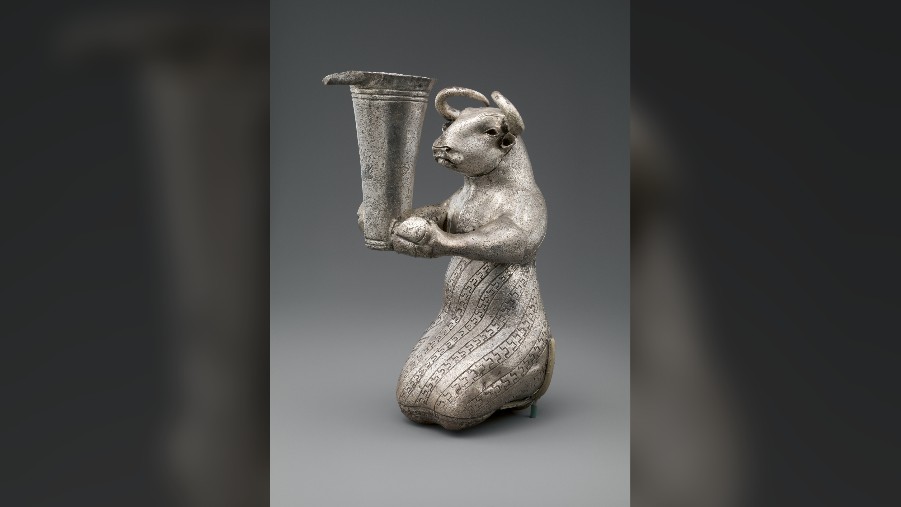
Description: This is a human-bull hybrid statuette, dating from 3100 to 2900 BCE and originating from Ancient Elam, now southwestern Iran. The hollow statuette, made of 98.5% silver, contains five ceramic rattling beads inside. It is depicted sitting in a praying posture while holding a pouring vase.
Book Excerpt
This is why in Mithras, the snake drinks from the blood of the bull, because the kundalini rises from the overflowing force of the bull sacrifice (the sacrifice of desire through abstinence, pranayama). How do we know this? Remember Nandi the vahana from Shiva? Nandi means anand. It stands for virility or libido, which is transformed into the bliss (Ananda) from Shiva that sits on it (pretty much like Mithras atop the bull).
Scholars assume the ancient human-bull hybrid figurine shown below, sitting in a vajra meditation posture, was likely involved in a ritual. Could it be a ritual of sacrificing of what the bull symbolises through sitting quietly in meditation? Could the result of the sacrifice overflow and pour like as if from a vase?
Leontocephaline of the Mithraic mysteries (line drawing from statue)
Author: Unknown, 16th Century.
Source; License: Wikipedia. License: Public Domain.
Chapter: Chapter 11: Transcendence From Duality, Illustrated
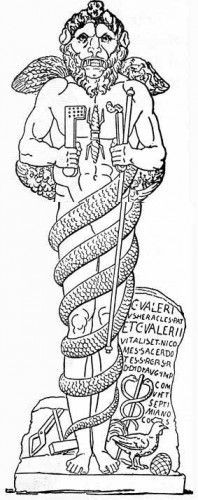
Description: “Leontocephaline of the Mithraic mysteries (line drawing). From statue at the Mithraeum of C. Valerius Heracles and sons (dedicated 190 CE) at Ostia Antica, Italy.
Book Excerpt
The identity of the leontocephaline is not certain, but it is almost certainly neoplatonic, and is commonly assumed to be in some way related to the god Aion the Greco-Roman personification of boundless time. Aion is often associated with the god Chronos (father time)”. Notice the visual similarity of this statue with Hercules wearing the lion skin as shown in: “Hercules wearing the lion skin:, Boston 99.538, Attic bilingual amphora, ca. 525-500 B.C. Photograph courtesy,Museum of Fine Arts, Boston. H. L. Pierce Fund. Hercules (Heracles) is associated with Chronus in the Orphic Theogony presented and this statue is associated with Aion (also known as Chronus).
Damascius’s account of the Orphic theogony of Hieronymus, Hellanicus
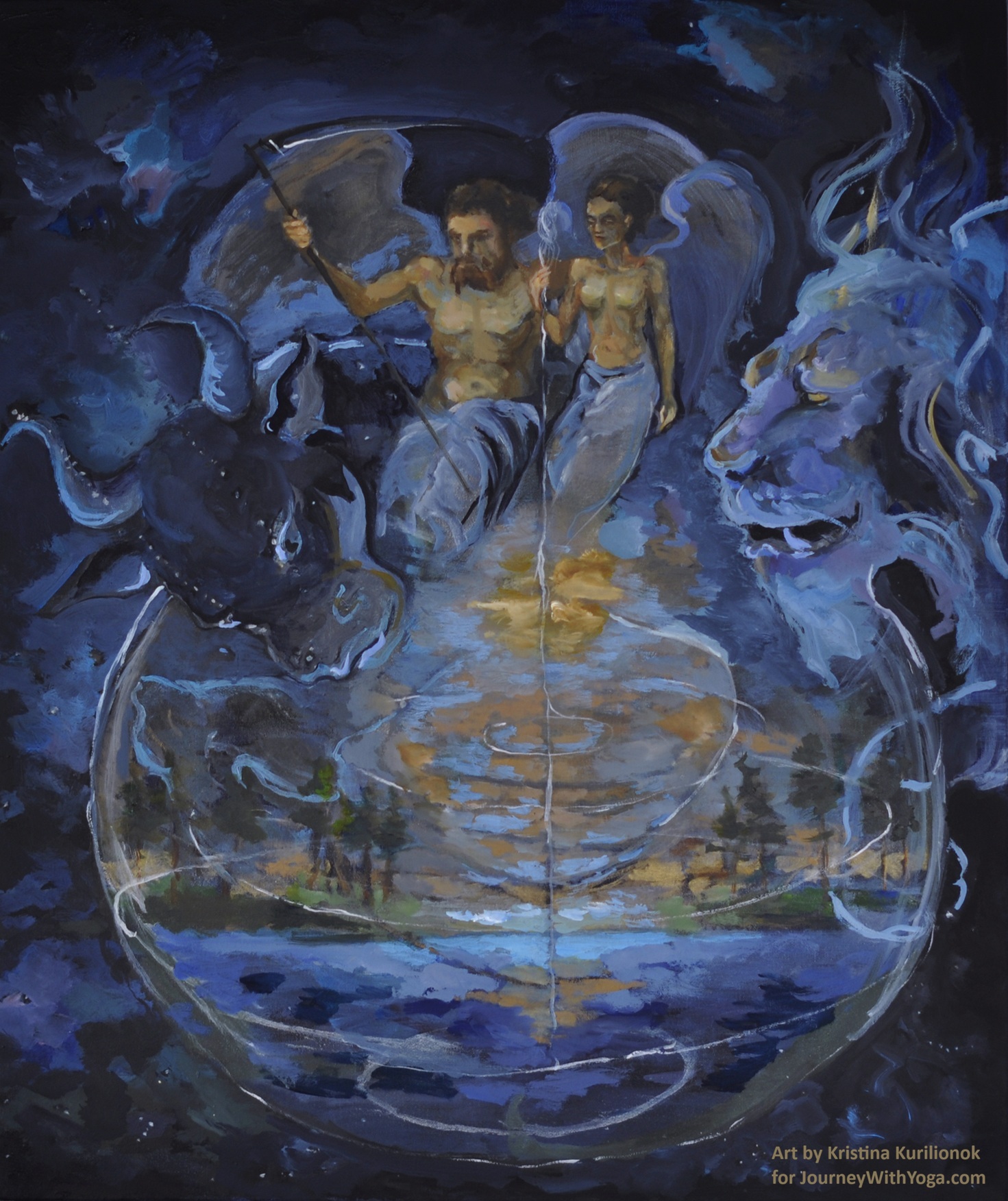
Author: Kristina Kurilionok
Source; License: Art commissioned for the book. In Author's collection. Permission to share provided credits to the artist and book are clearly provided below the picture.
Chapter: Chapter 11: Transcendence From Duality, Illustrated
Description: Oil on canvas, modern day artist Kristina Kurilionok’s first depiction in history of Damascius’s account of the Orphic theogony of Hieronymus, Hellanicus.
Book Excerpt
Above we have a depiction of the god Chronos with adjacent heads: bull and lion. Do you see the duality, prey and predator, and the transcendence from that as a divine figure in the centre?
Do you see the similarities from the Theogony with all the symbols sitting in between bovine and feline adored by different cultures? I mean these symbols: the Indus Valley Pashupati, the Greek/Hindu Ardhanārīśvara, the Roman Mithras who slays the bull and then brings a lion God associated to Chronos to the scene. The “Mystery of Mithras” book points out a strong link in between Mithras and the theogony of Orpheus as described by Hesiod, here we show a perhaps even stronger link with the theogony of Orpheus as described by Damascius, the two are somewhat different.
By the way, the Damascious theogony states that the heads of “the bull and the lion are naturally produced”. Therefore, it is natural to be stuck in duality, it is our ordinary state. What is god-like is to transcend these like Chronos and Adrasteia, or like the first yogi in the Pashupati seal, or Ardhanārīśvara or Mithras or Sivananda, or my teachers, and so on. Alas, the vast majority of human beings living on the planet today do not know this transcendent mind state related by the ancients. And this situation does not seem to have improved since the Greek times with the development of technology. Perhaps we are more likely to find transcended people in a tribe in the forest than in a city today!
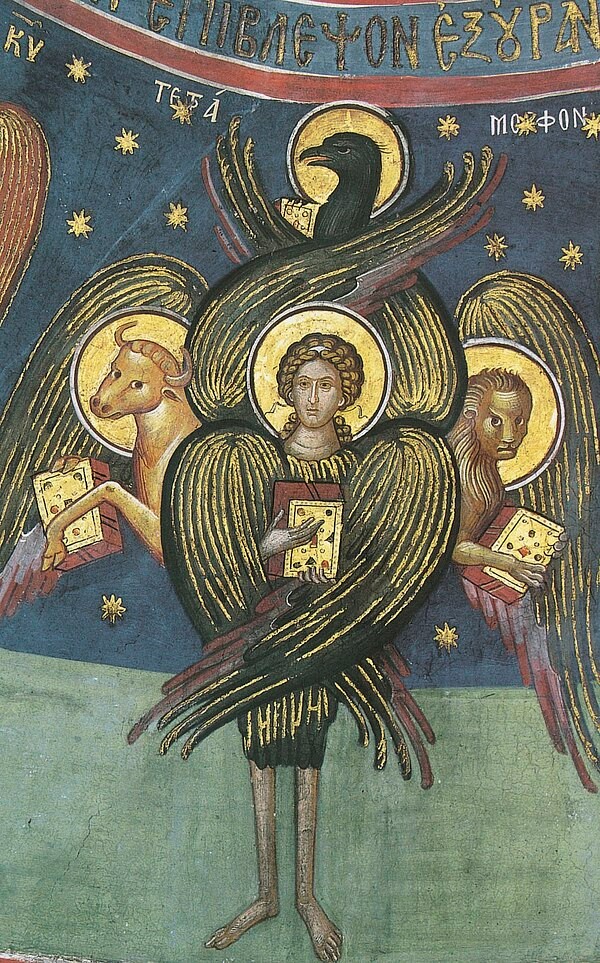
Tetramorph Fresco. Meteora
Author: Unknown, 16th Century.
Source; License: Wikipedia. License: Public Domain.
Chapter: Chapter 11: Transcendence From Duality, Illustrated
Description: Tetramorph Fresco. Meteora. 16th Century.
Book Excerpt
This symbology is consciously linked to Ezekiel, mentioned below. Notice the wings criss-crossing like ida and pingala or forming 8 links from the bottom chakras to the head chakras. It’s 8, as in the symbol for infinity (like in Chronos, father time). Are these last details a coincidence? Did the artist know it? They surely add to the whole set of symbols pointing to what we call transcendence from duality and the subtle body energy system. Transcendence into the eternal from Hakuin, and into the ultimate as we shall see by the end of the book.
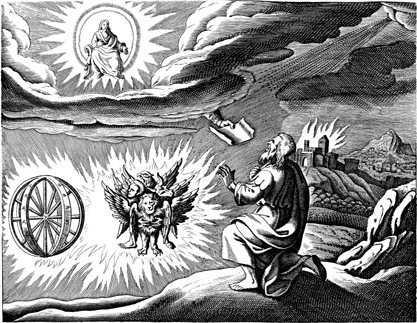
Ezekiel's Vision
Author: Matthaeus Merian, 1593-1650.
Source; License: Wikipedia. License: Public Domain.
Chapter: Chapter 11: Transcendence From Duality, Illustrated
Description: Notice next to the orb or chariot wheels we have a lion, a bull with horns a human or angel and an eagle (they are quite tiny so I reproduced a zoomed version below).
Book Excerpt
“An the first beast was like a lion, and the second beast like a calf, and the third beast had a face as a man, and the fourth beast was like a flying eagle” – Revelations 4:7 (est. 90-96 AC).
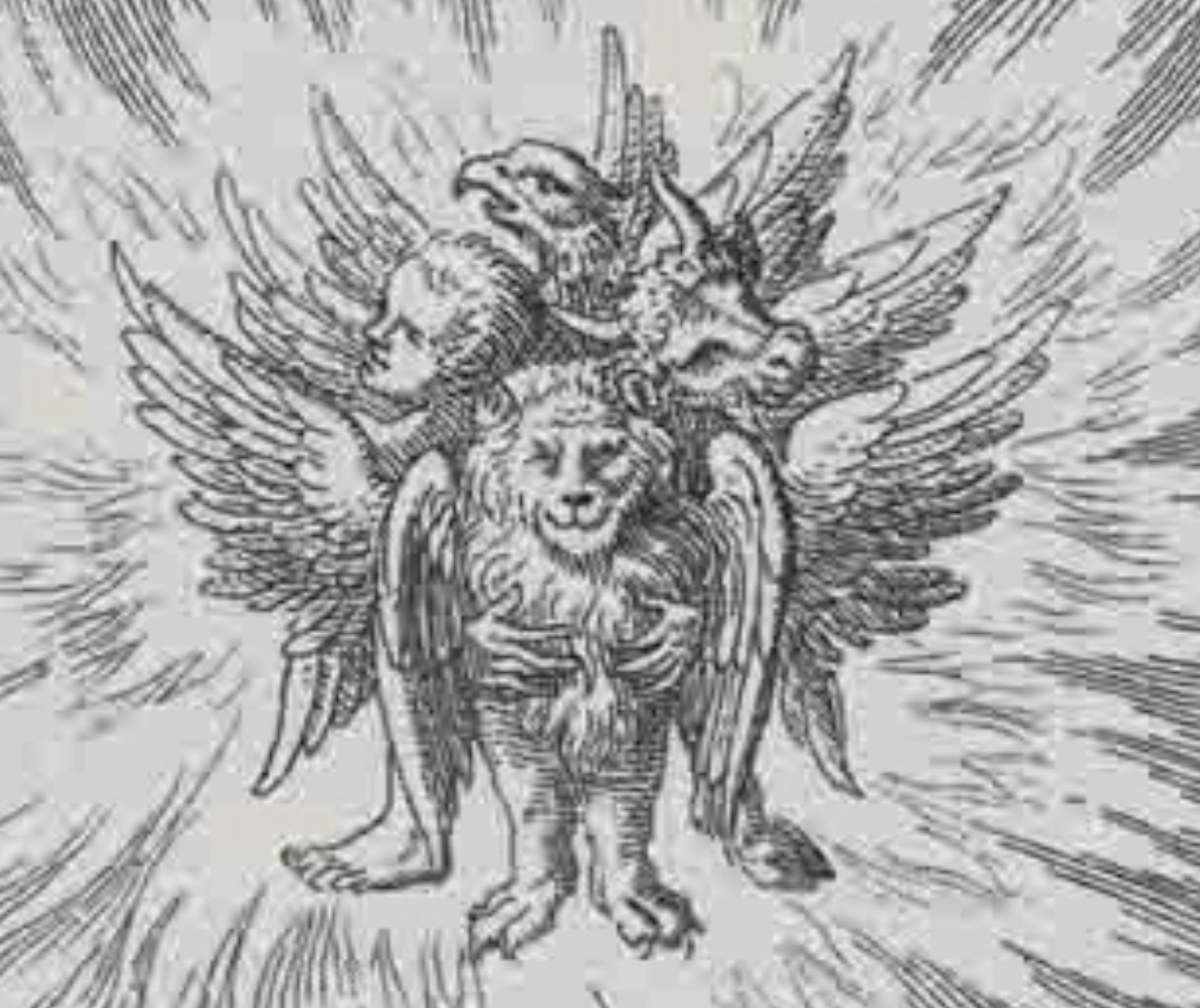
Ezekiel's Vision, Zoom on the Cherub Angel
Author: Matthaeus Merian, 1593-1650.
Source; License: Wikipedia. License: Public Domain.
Chapter: Chapter 11: Transcendence From Duality, Illustrated
Description: We now zoom in on the cherub angel from the previous drawing.
Book Excerpt
“An the first beast was like a lion, and the second beast like a calf, and the third beast had a face as a man, and the fourth beast was like a flying eagle” – Revelations 4:7 (est. 90-96 AC).
Achaemenid lamassu cylinder seal
Author: Unknown.
Source; License: Wikipedia: https://commons.wikimedia.org/wiki/File:Cylinder_Seal,_Achaemenid,_modern_impression_05.jpg. License: ASAG 3.0.
Chapter: Chapter 11: Transcendence From Duality, Illustrated
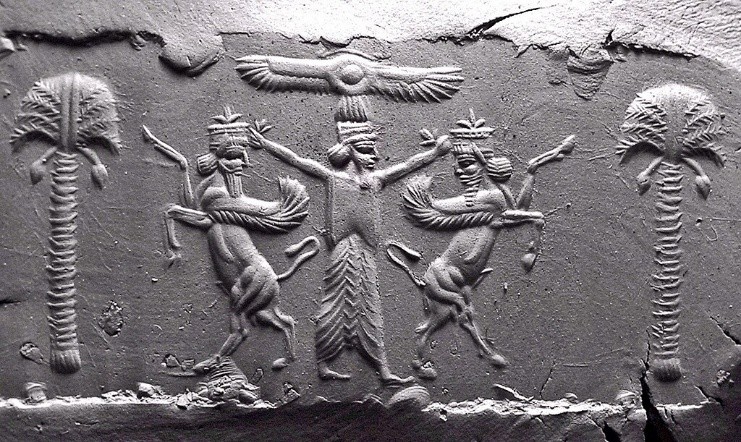
Description: One of the most beautiful Lamassus that are even more related to our kundalini symbolism is the Achaemenid cylinder seal, fifth century BC.
Book Excerpt
This one has the Ida, Pingala as Lamassus on the sides, and the transcendence as a king in the centre (central energy channel in kundalini), totality as the solar disk with wings at the top (yes some interpret it as a symbol of royalty, but that is secondary in spiritual terms). The two palm trees reinforce the meaning of duality as it is often practiced (reinforcing what you imply).
Composite Bull and Lion
Author: Unknown.
Source; License: Source: Cleveland Museum of Art; License: Public Domain.
Chapter: Chapter 11: Transcendence From Duality, Illustrated
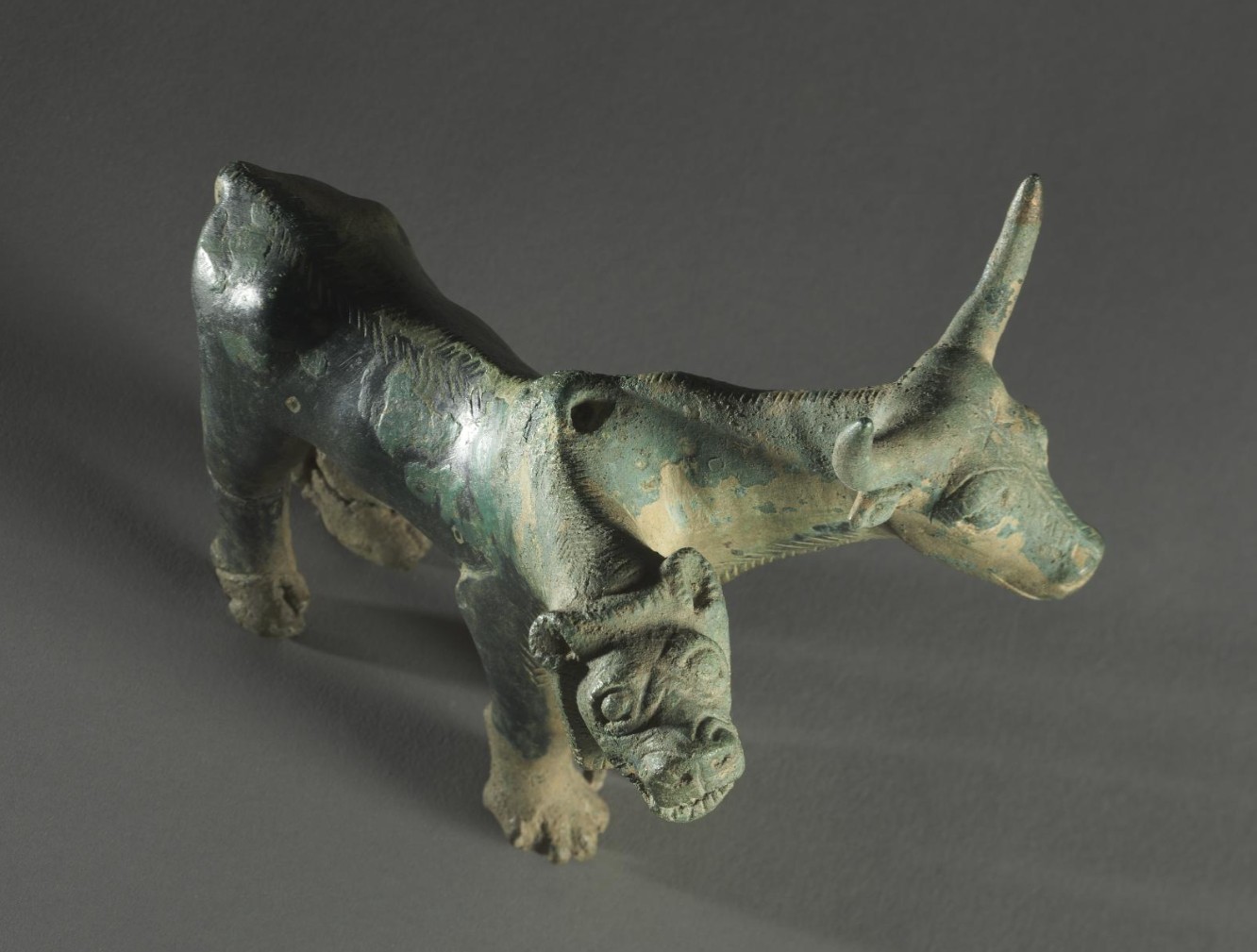
Description: Composite Bull and Lion. 1500-1000 BCE.
Book Excerpt
Could this be symbolizing both the animal nature in us and duality? Could it be that having two heads is not so auspicious? Such as the two-headed dog Cerberos that guards the gates of the Greek hell? Or as in the Mithraeum from Hawarte, where there is a fresco from after 360 CE that represents one of the two guardians of the temple holding in chains a two-headed demon (he has a human shape with two heads), see: “The Mystery of Mithras” in figure 5.
Prahlada shows his father that Vishnu exists everywhere
Author: Unknown.
Source; License: Wikipedia; Public Domain.
Chapter: Chapter 11: Transcendence From Duality, Illustrated
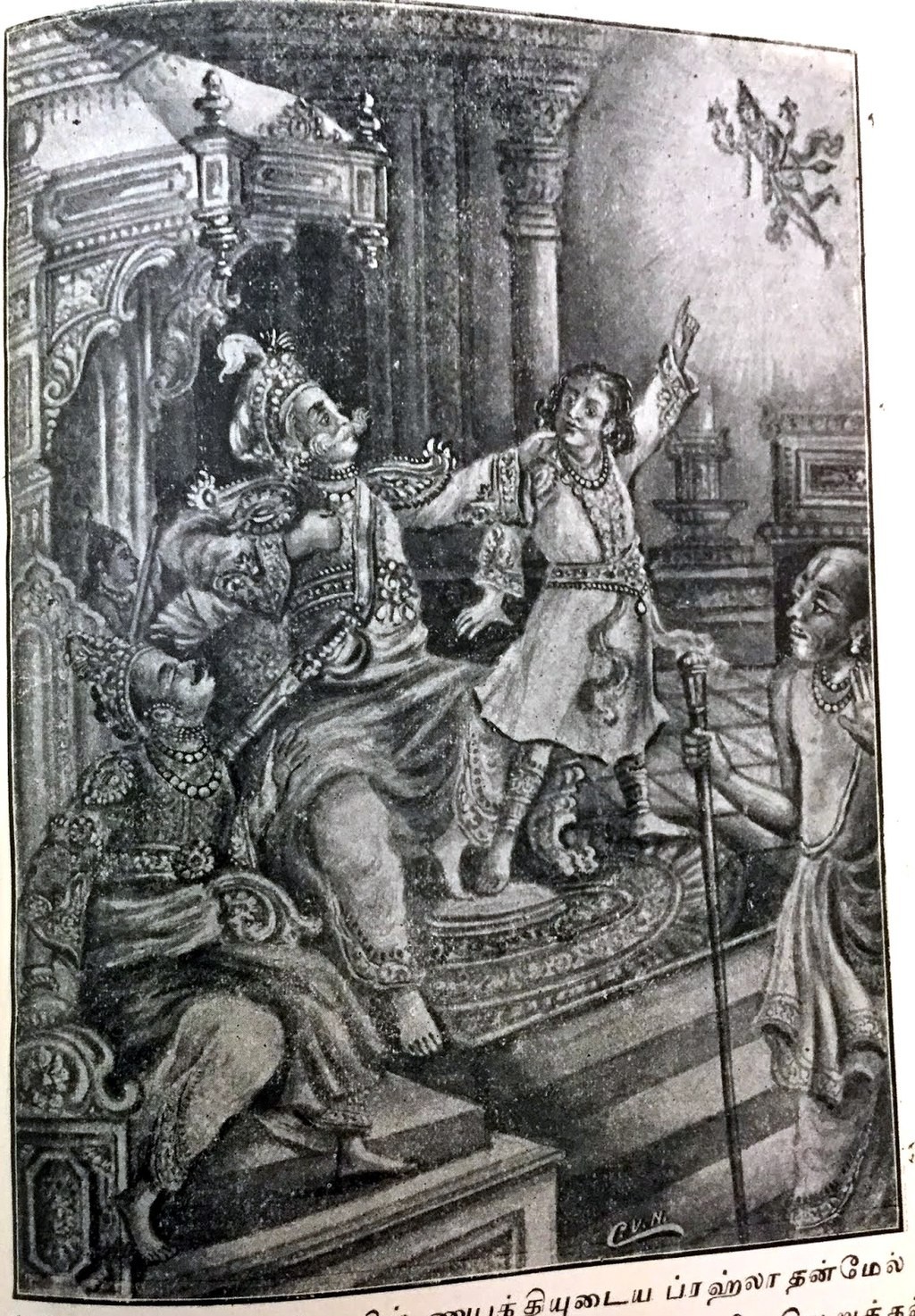
Description: Prahlada shows his father that Vishnu exists everywhere.
Book Excerpt
Hiranyakashipu had a son named Prahlada (sk. Supreme bliss), who was a formidable devotee of Vishu. Prahlada was a pure child capable of seeing the divine in all; much the opposite was his father, who perceived everything as having two sides: his own side covered with gold, and the other side without gold.
Varana Decapitates Hiranyaksha
Author: Unknown.
Source; License: Wikipedia; Public Domain.
Chapter: Chapter 11: Transcendence From Duality, Illustrated
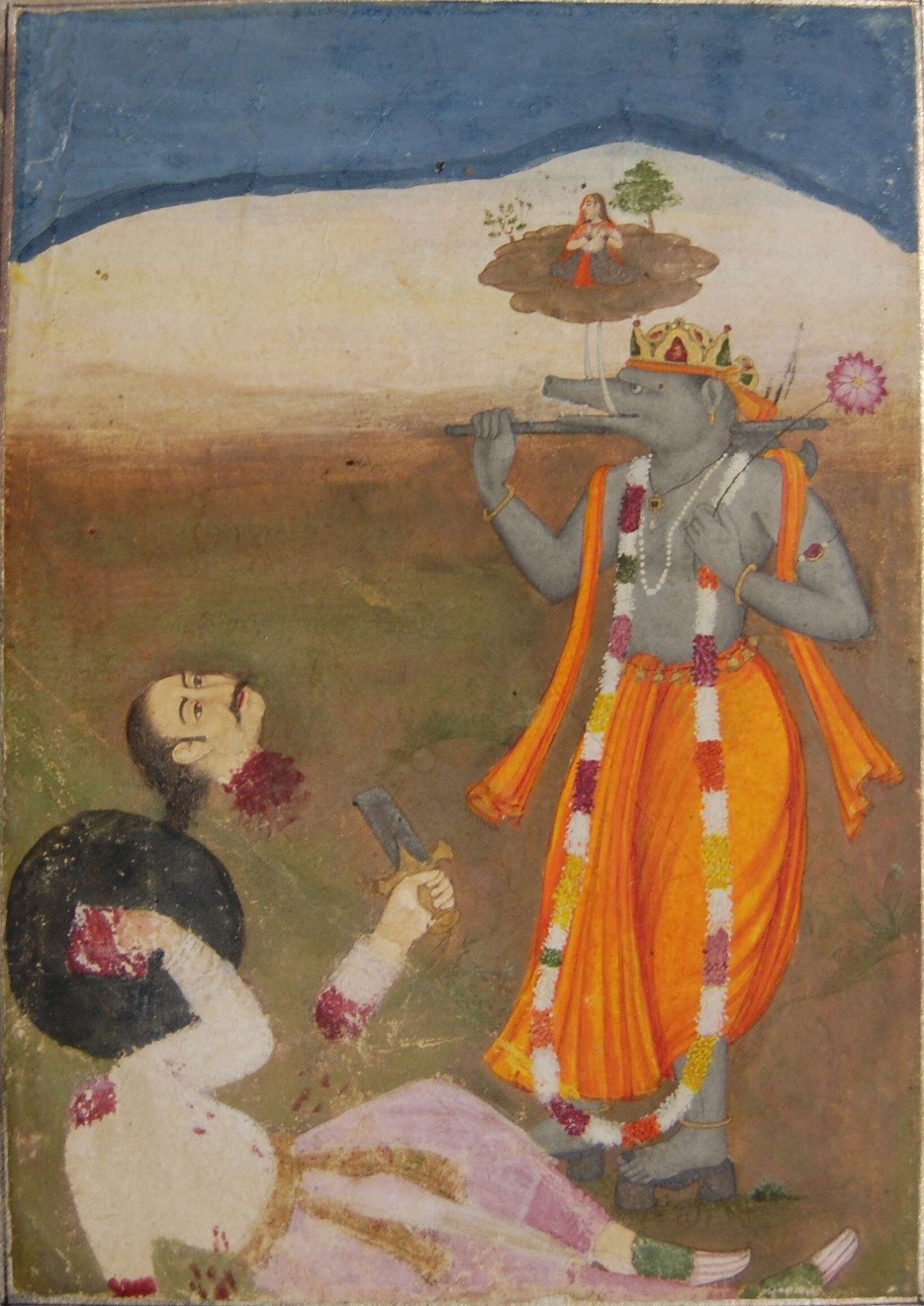
Description: The boar avatar Varaha, the third incarnation of Vishnu, stands in front of the decapitated body of the asura Hiranyaksha.
Book Excerpt
Hiranyakashipu's equally malevolent younger brother, Hiranyaksha, assaulted the defenceless goddess Bhumi, and ran away with her. As punishment for this transgression of desire, Hiranyaksha was slain by the Varaha (boar) avatar of Vishnu. The boar is similar to the bull that in previous chapters symbolises the side of desire, libido, and virility. Thus, the death by a boar fits the desire-driven assault and kidnapping of a goddess.
Hiranyakashipu Tries to Kill Prahlada
Author: Unknown.
Source; License: Wikipedia; Public Domain.
Chapter: Chapter 11: Transcendence From Duality, Illustrated
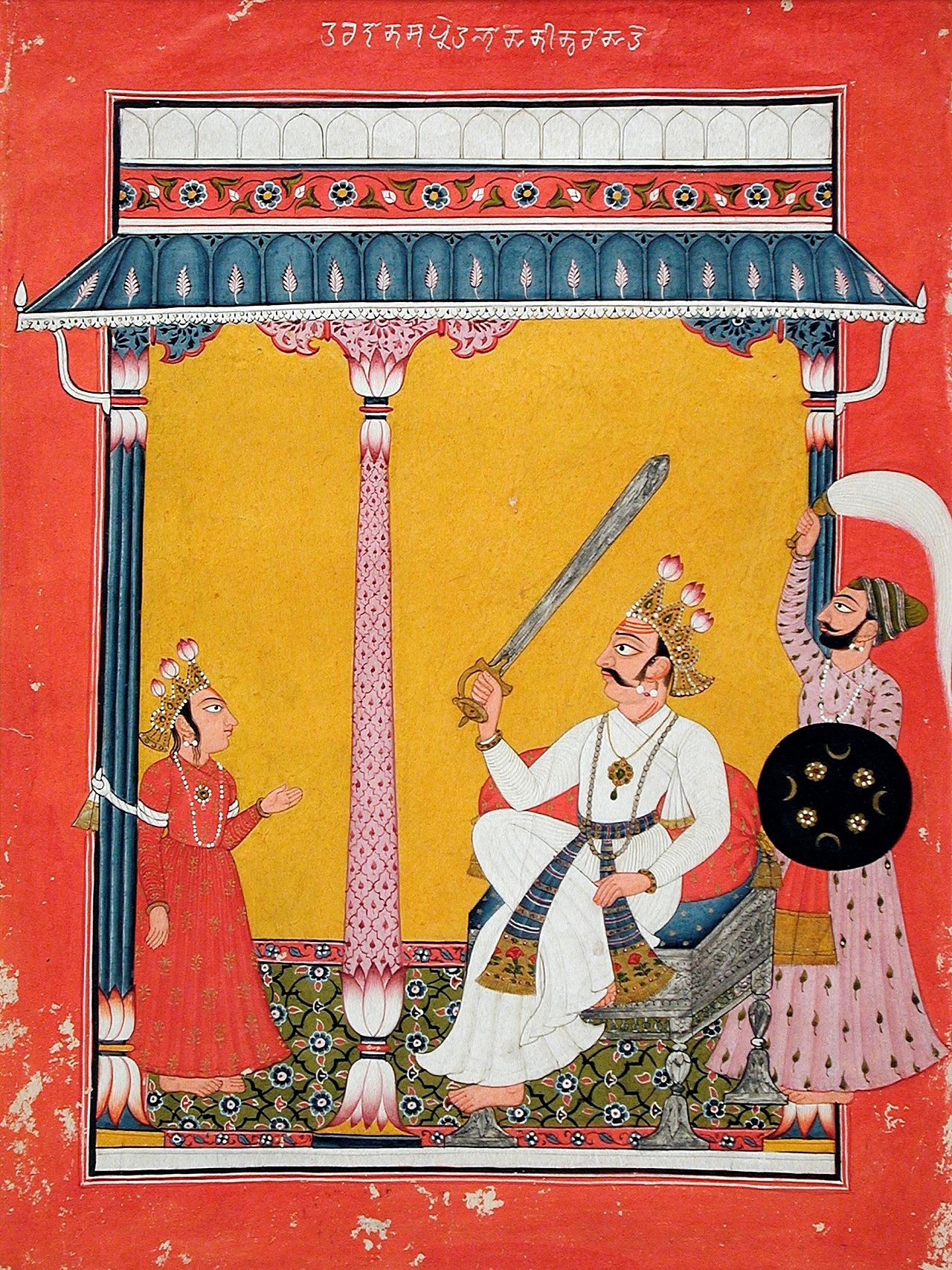
Description: 8th century painting depicting Hiranyakashipu seated on a throne, trying to kill his son, Prahlada (left).
Book Excerpt
Hiranyakashipu requested of Brahma: “Grant me that I not die within any residence or outside any residence, during the daytime or at nighttime, nor in the ground or in the sky. Grant me that my death not be brought about by any weapons or hands, nor by any human or animal. Grant me that I not meet death from any entity, living or non-living created by you. Grant me, further, that I not be killed by any deity or demon or by any other organisms and divinities.” – Roshen Dalal (2010) in “The Religions of India: A Concise Guide to Nine Major Faiths”. Penguin Books. p. 148. ISBN 978-0-14-341517-6.
Endowed with this boon, he began to wreak chaos and havoc, persecuting all the devotees of Vishnu, including his very son Prahlada who was a benevolent devotee of Vishnu.
The Devas approach Vishnu
Author: Unknown.
Source; License: Wikipedia; Public Domain.
Chapter: Chapter 11: Transcendence From Duality, Illustrated
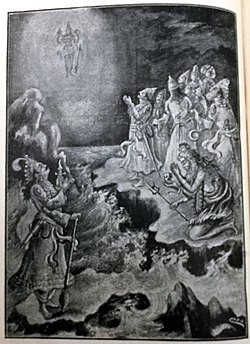
Description: The Devas approach Vishnu requesting Him to control Hiranyakashipu.
Book Excerpt
I make an interjection here: we know today that inside every bully lies a coward, dominated by fears.
Given the great havoc caused by Hiranyakashipu’s bullying, the devas requested Vishnu to intervene.
Hiranyakashipu wielding a mace against Narasimha
Author: Unknown.
Source; License: https://encyclopedia.pub/entry/34653 and https://handwiki.org/wiki/index.php?curid=1235753; the Attribution-Share Alike 3.0 Unported (CC BY-SA 3.0).
Chapter: Chapter 11: Transcendence From Duality, Illustrated
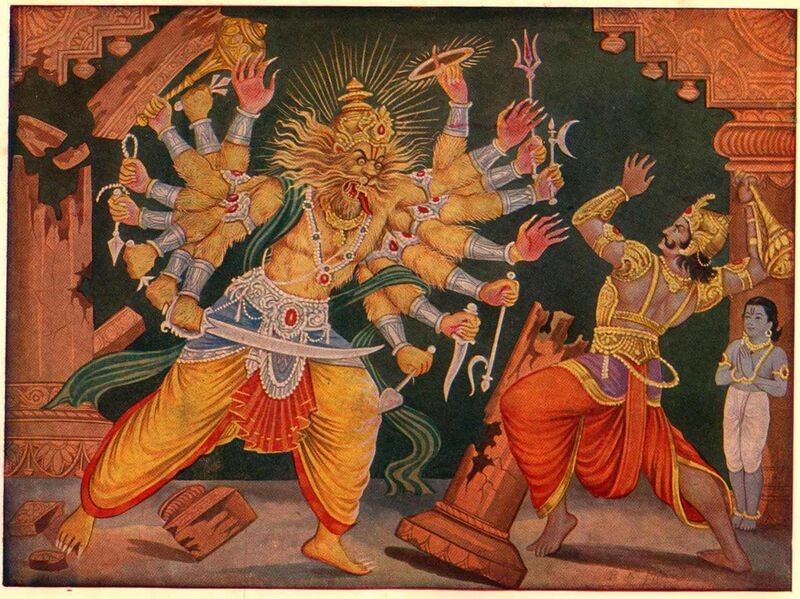
Description: Hiranyakashipu wielding a mace against Narasimha.
Book Excerpt
Vishnu took the form of a half-man, half-lion deity (neither man nor god) and sets out to disembowel Hiranyakashipu, on his lap (neither earth, nor sky!), in the window or balcony of his house (neither inside nor outside!), in the dusky evening (neither day nor night!), with its claws (neither by hand nor by weapon!).
Vishnu and his avataras (Vaikuntha Chaturmurti)
Author: Unknown.
Source; License: Wikipedia; ASAG 2.0.
Chapter: Chapter 11: Transcendence From Duality, Illustrated
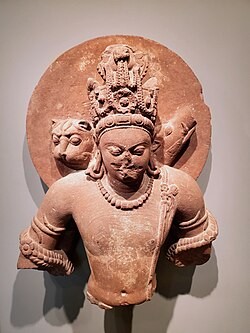
Description: Vishnu and his avataras (Vaikuntha Chaturmurti): Vishnu present as Krishna as a human , Narasimha as a lion, Varaha as a boar and Rama as a human. Art of Mathura, mid-5th century CE. Boston Museum.
Book Excerpt
Vishnu took the form of a half-man, half-lion deity (neither man nor god) and sets out to disembowel Hiranyakashipu, on his lap (neither earth, nor sky!), in the window or balcony of his house (neither inside nor outside!), in the dusky evening (neither day nor night!), with its claws (neither by hand nor by weapon!).
Narasimha Disembowels Hiranyakashipu
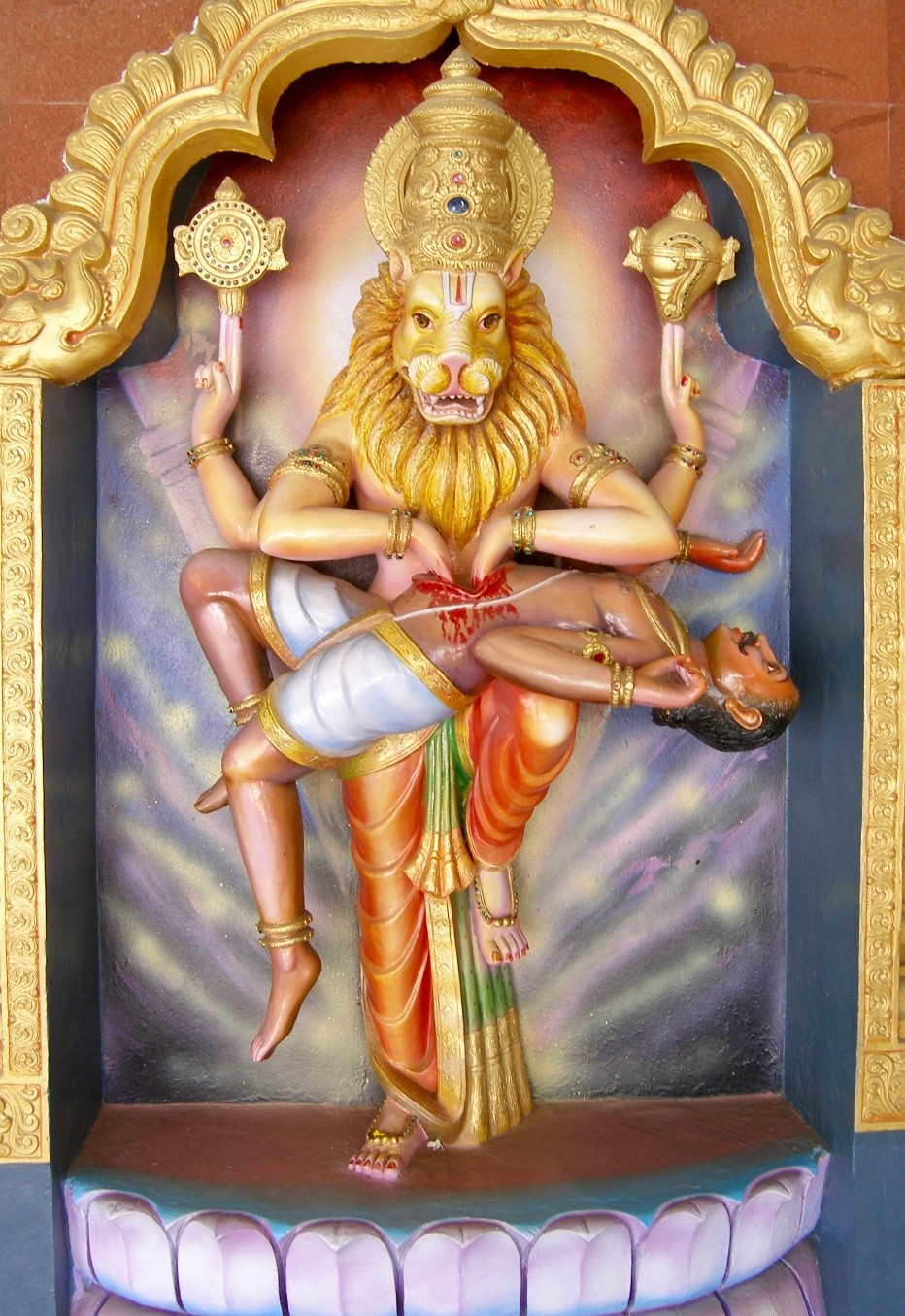
Author: Unknown.
Source; License: Wikipedia; ASAG 4.0.
Chapter: Chapter 11: Transcendence From Duality, Illustrated
Description: Narasimha disembowels Hiranyakashipu.
Book Excerpt
Notice the similarity to the Mithraic lion god or to Hercules wearing the lion skin. The similarity with the Mithraic lion is not only to the half-human, half-lion god shape, but also to the disc they often wield, which symbolises cyclical time (the Mithraic lion was the god of unbound time, Aion). Both gods share the same time period from 1st century CE to 5th century CE, and both gods display elements (disc) symbolising boundless time.
Vajrakilaya with consort

Author: Yurei Fukuro.
Source; License: Wikipedia: https://commons.wikimedia.org/wiki/File:Vajrakilaya_(8557221604).jpg. License: CC2.0.
Chapter: Chapter 11: Transcendence From Duality, Illustrated
Description: Vajrakilaya (dark blue) with consort Diptachakra (light blue in front). Two demons lie crushed under his feet. Source: Wikipedia: Yurei Fukuro – Vajrakilaya. License: CC2.0.
Book Excerpt
The Vajrakilaya embodies the enlightened activity of all the Buddhas. We can see the three faces quite clearly, like in the Pashupathi seal. We can see its consort, like the male and female Ardhanarishvara shiva form. We can see the Buddha above its head symbolizing enlightenment, transcendence. It also has wings which are a symbol of transcendence. Like Shiva, it has a trident on one of his hands. Like on the triptych, it has a white skull at the bottom of the painting. You will be able to read and deep dive in the symbolism by starting at the Wikipedia page: https://en.wikipedia.org/wiki/Vajrakilaya.
Vajrakilaya' Phurba or Cermonial Knife
Author: Yurei Fukuro.
Source; License: Wikipedia: https://commons.wikimedia.org/wiki/File:Vajrakilaya_(8557221604).jpg. License: CC2.0.
Chapter: Chapter 11: Transcendence From Duality, Illustrated
Description: Vajrakilaya (dark blue) with consort Diptachakra (light blue in front). Two demons lie crushed under his feet. Source: Wikipedia: Yurei Fukuro – Vajrakilaya. License: CC2.0.
Book Excerpt
The Vajrakilaya embodies the enlightened activity of all the Buddhas. We can see the three faces quite clearly, like in the Pashupathi seal. We can see its consort, like the male and female Ardhanarishvara shiva form. We can see the Buddha above its head symbolizing enlightenment, transcendence. It also has wings which are a symbol of transcendence. Like Shiva, it has a trident on one of his hands. Like on the triptych, it has a white skull at the bottom of the painting. You will be able to read and deep dive in the symbolism by starting at the Wikipedia page: https://en.wikipedia.org/wiki/Vajrakilaya.
A Walk Among the Animals

Artist: AI Generated for this edition at least.
Source; License: Source: Gemini. Copyright: André Cesta. Reproduction is allowed provided mention to the book source is made as caption.
Chapter: Chapter 11: Transcendence From Duality, Illustrated
Description: Do animals do that? Do animals run away from pain and towards pleasure like ordinary people?
Book Excerpt
Back to our main painting from Giorgio Kienerk. Regarding the “human” word from the “human enigma” of “pain, silence and pleasure”. Do animals do that? Do animals run away from pain and towards pleasure like ordinary people? Not always. Wild animals are particularly good at enduring pain.
Diet Footprint welcome.org

Artist: welcome.org.
Source; License: Source: https://wellcome.org/news/diet-food-and-climate-change
Chapter: Chapter 11: Transcendence From Duality, Illustrated
Description: The appendix A on nutrition will explain a diet that is among those with the lowest ecological, climate change footprint. Looking at the chart from welcome.org I also realize I need to eat more nuts. Fruits and veggies are not in the chart, but they would be ranking among the lowest also. It is because of the trees carbon sequestration.
Book Excerpt
The natural diet on chapter 10 will also have a material impact on the amount of packaging waste which is detrimental for ourselves and the planet.
Yogis typically live frugally and make wise consumption choices such as buying wool clothing as opposed to synthetic (read about microplastics if you are not motivated yet). This way of living redirects the efforts of society towards what is really needed instead of what is superfluous. Focusing on what is needed is even more appropriate in our times where we fight for planetary resources. I see the extreme deprivations some in the younger generation face when I do volunteer with children (teaching yoga; swimming; computing skills; English).
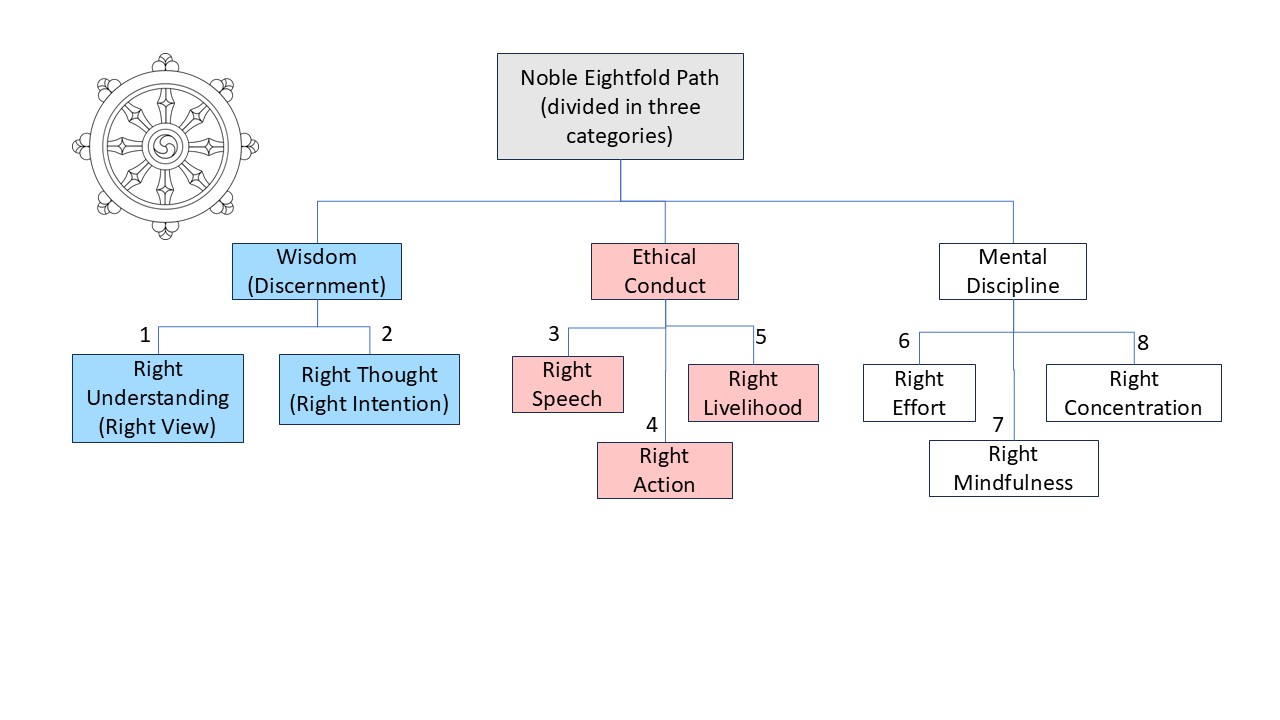
The Eightfold Path
Artist: André Augusto Cesta.
Source; License: The wheel icon is from the wikipedia. License: all uses permitted as long as credit is provided by linking to this site.
Chapter: Chapter 11: Transcendence From Duality, Illustrated
Description: Buddhism more than 2000 years ago already had – through the eightfold path – established the necessity of an integrated way of life. It did this mainly through the “correct livelihood” component of the eight-fold path (depicted in the centre bottom of the diagram in pink).
Book Excerpt
The above divide the eightfold path in three large categories of conduct.