 EN
EN PT
PTArtwork from Chapter 5
Here is a list of all the artwork quoted in the chapter. It is displayed in colour in the sequence it appears in the book for those who want to listen to the book on Kindle and see the illustrations here.
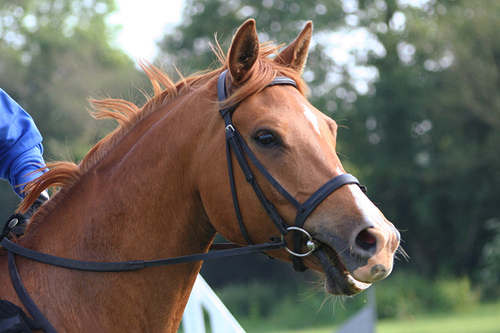
Horse Briddle in Black Leather
Artist: Thowra_uk.
Source; License: Wikipedia: https://commons.wikimedia.org/wiki/File:Hunt_bridle_head.jpg License: C.C.2.0.
Chapter: 5 The Path of Yoga
Description: The yamas and niyamas are not meant to be like morals or bridles for horses.
Book Excerpt
A horse needs bridles for when it does not want to go on the path. If you apply yamas and niyamas like morals or bridles, it will become a process that is both slow and full of relapses. It will cost you your freedom and openness.
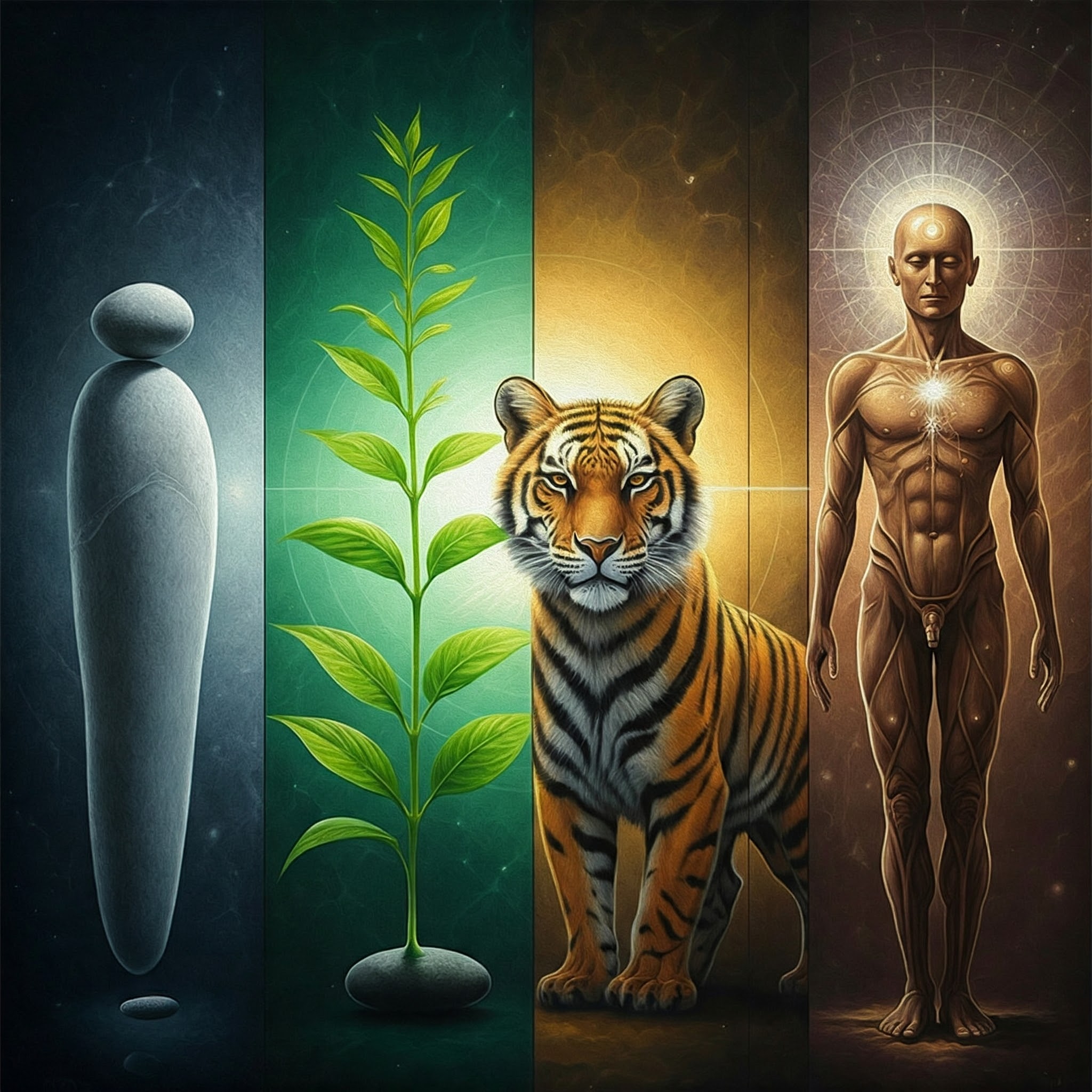
Mineral, Vegetable, Animal, Human
Artist: AI Generated for this edition at least.
Source; License: Source: Gemini. Copyright: André Cesta. Reproduction is allowed provided mention to the book source is made as caption.
Chapter: Chapter 5: The Path of Yoga
Description: An interesting classification of stages of consciousness and their dualistic nature in all stages.
Book Excerpt
I learned from my first lineage (Dr. Celso) that the Tibetans have this classification of humans in four stages of evolution of consciousness: .
Stage 1. Stones stage. These people are like a stone blocking other’s path. They can be sharp things that hurt us. There is hope for them though, as they can be lapidated to become a gem or they can progress to the next stages below. If we find a stone in the path, and it won’t hurt our feet, we can best move it away so it does not hurt others. Do you know any stone in your life? Some ‘tamasic’ person saying no all the time or not even saying anything when you need some help? Someone refusing to move to get it their way?
Stage 2. Plant stage. These people are like little plants requiring lots of care, attention, water and sun. The worse ones are those weedy ones that give nothing in return: no flower, no fruit, no wood, no medicine. That reminds me a lot of the speaking rose flower character from the book “The Little Prince” which needed lots of attention: “I love you”, said the little Prince. “I want you too”, said the rose. “Is not the same”, he answered… That rose made me imagine a lady putting make-up in the mirror every single morning.
Stage 3. Animal...
Stage 4. Human...
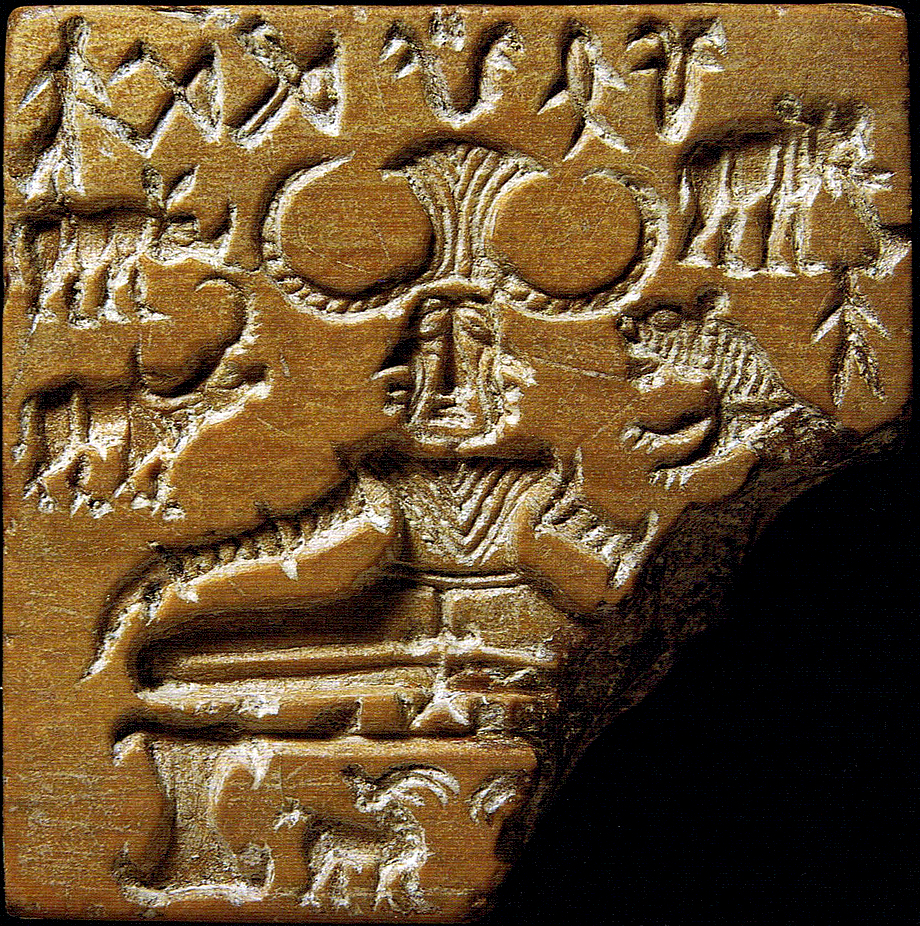
The Pashupati Seal
Author: Unknown, Harappan Civilization, 2600-1900 BC
Source; License: Wikipedia. License: Public Domain.
Chapter: 5 The Path of Yoga
Description: The Pashupati Seal and the painting called Pain, Silence and Pleasure, the Human Enigma are the visual cornerstones of this book.
Book Excerpt
What this seal communicates is so deep, that I will need the whole of chapter 9 (some of the conclusion on yoga) to explain it.
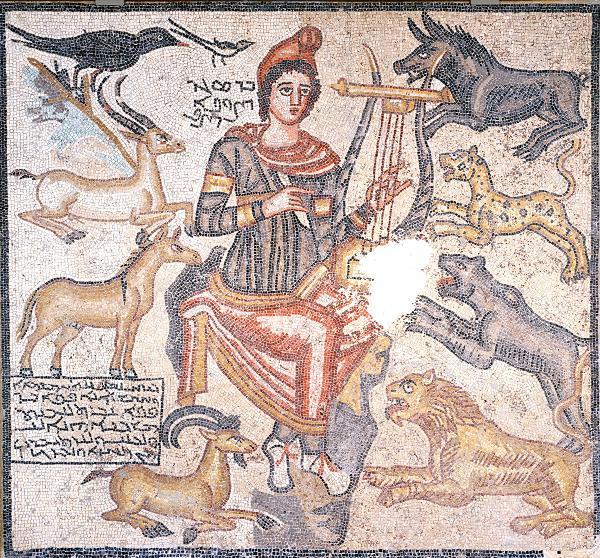
Orpheus Mosaic, from near Edessa, 194 AC,
Author: Unknown.
Source; License: Wikipedia. License: Public Domain.
Chapter: 4 Diving Deeper Into Yoga
Description: Many are the similarities connections of this mosaic with Pashupathi.
Book Excerpt
Orpheus is surrounded by animals. Orpheus is harmonic, in peace as he plays his lyre and enchants the animals. The animals are separated well in prey and predator creating a triptych division of the mosaic above, like the triptych we will show on chapter 9.