 EN
EN PT
PTArtwork from Chapter 2
Here is a list of all the artwork quoted in the chapter. It is displayed in colour in the sequence it appears in the book for those who want to listen to the book on Kindle and see the illustrations here.
Journey With Yoga Book Cover.
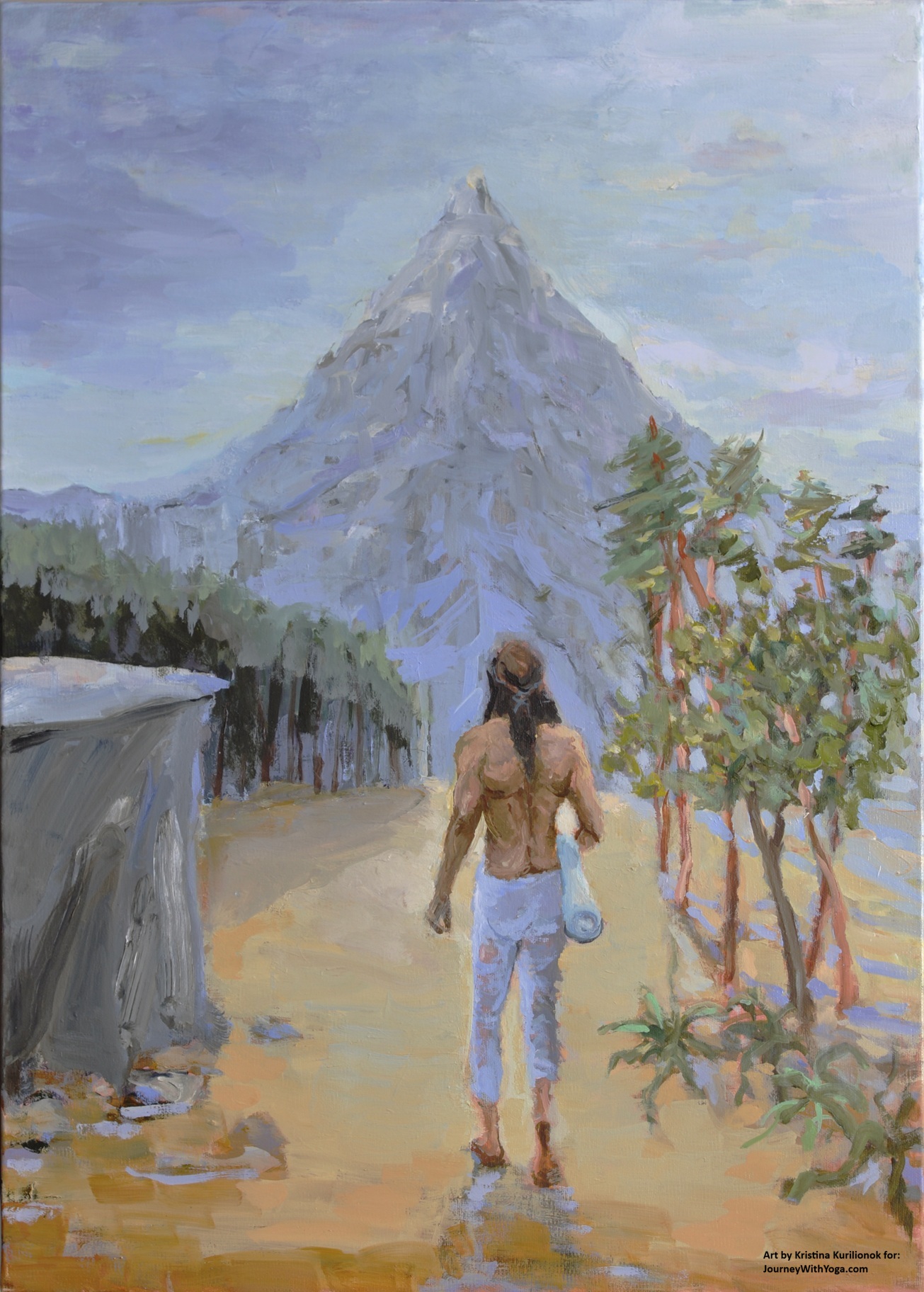
Author: Kristina Kurilionok
Source; License: Illustration commissioned for the book. Permission to share provided credits to the artist and book are clearly provided below the picture.
Chapter: Chapter 2 - Motivation.
Description: This is the start of our yogi journey. Imagine you are leaving home. At your doorstep, what is your motivation for the journey with yoga?
Book Excerpt
Let us talk about the different motivations to transform one’s mind. Let us get lost a bit before we find ourselves. The whip as motivation...
‘Book of the Dead (Chapter 30B)’, Papyrus of Ani.

Author: Photographed by the British Museum; original artist unknown.
Source; License: Source: Wikipedia. License: Public Domain.
Chapter: Chapter 2 - Motivation.
Description: For instance, the Egyptian would tell in their book of the dead that if a person’s heart would not be as light as a feather, this person would not enter the kingdom of heaven.
Book Excerpt
This doubt of whether there will heaven or there will be hell is exploited because our minds typically dislike and want to eliminate doubt. In other words, our minds are naturally motivated to seek the truth or see reality as it is. More about truth on Chapter 3.
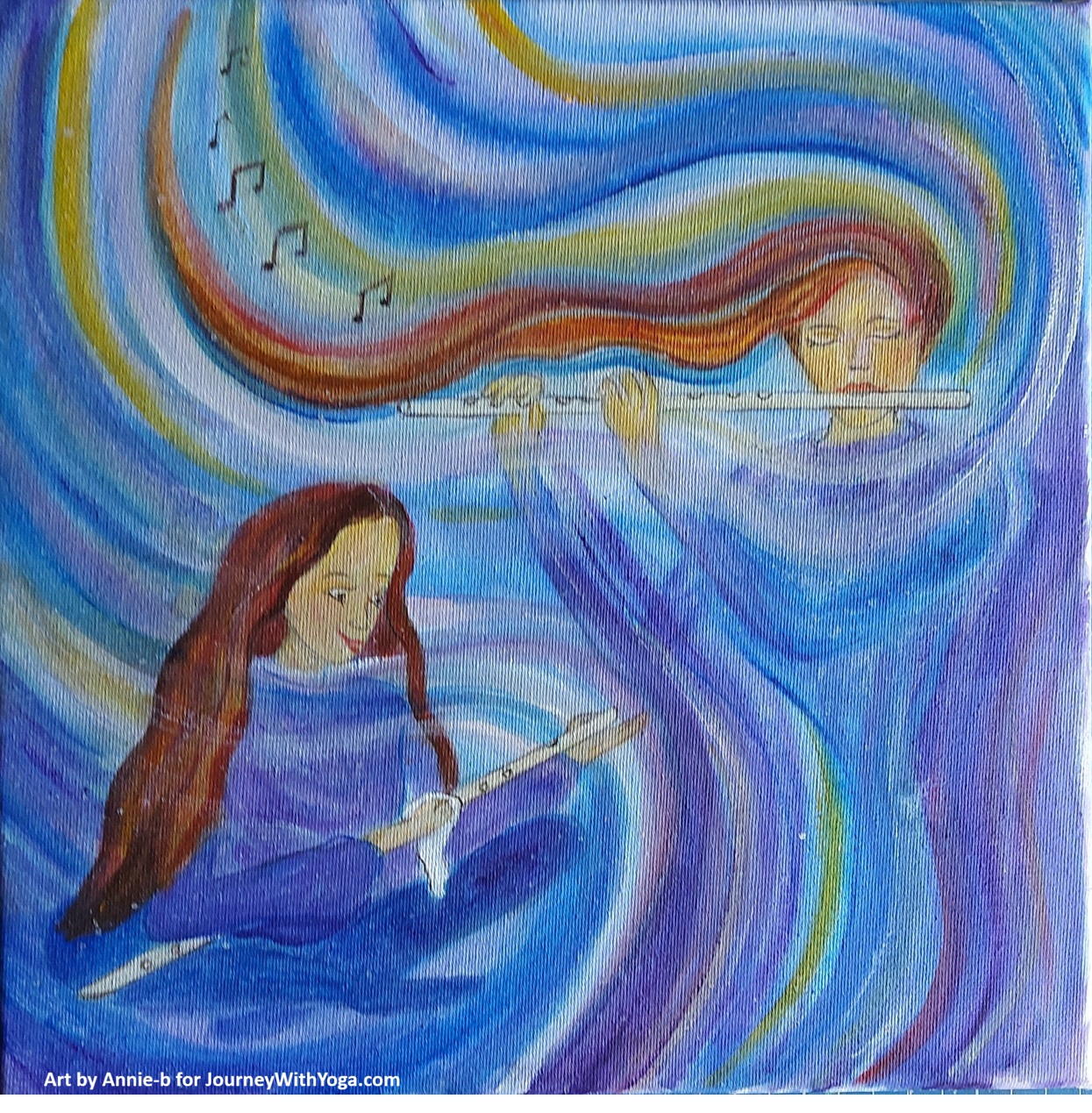
Musician cares for his instrument.
Author: Annie-b.
Source; License: Illustration commissioned for the book. Feel free to share these low-resolution images on social media and web platforms provided mention to the artist and the book are clearly made below the image! Please note that all rights are reserved, and reproduction for prints or commercial use is strictly prohibited.
Chapter: Chapter 2 - Motivation.
Description: Have you ever observed a good musician playing? For instance, a pianist? He will come by and clean his piano with a cloth; adjust the seat.
Book Excerpt
A good musician cares for his musical instrument. But he does not wake-up and say: “I feel like cleaning piano today.” Like a good musician, a yogi cares for his body so he can continue to generate harmony for all. Harmony, flow is heaven on earth. Yes, I am comparing the body to an instrument. Harmony, peace are good motivations...
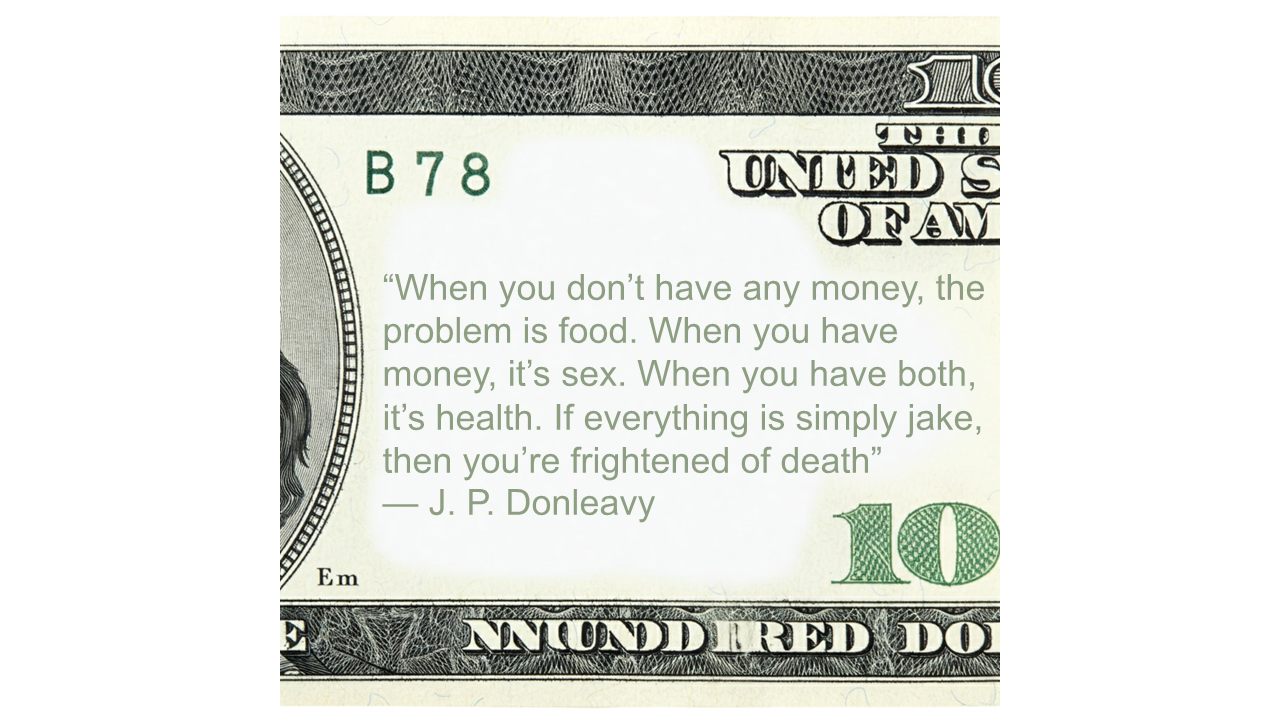
A view on ordinary approaches to life.
Author: André Cesta.
Source; License: Copyrighted, reproduction is allowed provided mention to the book source is made as caption.
Chapter: Chapter 2 - Motivation.
Description: Most of the middle income seems to live in a pendulum in between those two life approaches: amusement park until the pay-check is over, and after the pay-check is over: slave-away dreaming of a retirement.
A man tramples over flowers to reach towards a brand new automobile.

Author: Kristina Kurilionok.
Source; License: Illustration commissioned for the book. Permission to share provided credits to the artist and book are clearly provided below the picture.
Chapter: Chapter 2 - Motivation.
Book Excerpt
Do not worry. As a yogi having a bigger than life objective, you can still get that car and house, but these mundane objectives will just look smaller in your mind. And most likely be less painful to attain. And you probably do not trample over the flowers in a hurry to achieve these mundane objectives.
Paradise lost.

Author: AI Generated for this edition at least.
Source; License: Source: Gemini. Copyright: André Cesta. Reproduction is allowed provided mention to the book source is made as caption.
Chapter: Chapter 2 - Motivation.
Description: A student walks away from paradise, when he wants it the most.
Book Excerpt
A small story to complement the above one and to illustrate how we get lost first before we find ourselves: I once taught computer science students at the University of Auckland, which is close to the beaches such as Mission Bay. I asked some of the students outside the class. Why do you want to study computer science? - Because I want to make money. - Why do you want to make money? - Because I want to buy a car and take my family to the beach. - For that you need computer science? You could have it now: Invite a girl which could later become your family, walk together ten metres to the bus stop and take the bus to the beach.
Diogenes Looking for an Honest Man.

Artist: J. H. W. Tischbein, c. 1780.
Source; License: Source: Wikipedia Media Commons.
Chapter: Chapter 2 - Motivation.
Description: By holding a literal light up to people's faces in broad daylight, Diogenes forced them to recognize their participation in practices that prevented them from living truthfully.
Book Excerpt
Most people live hypocritically. The Greek prefix hypo means below or under. Hypocritical means below critical, thus not critical enough (of their views, intentions, thoughts, words, actions).
Being critical requires awareness, requires shining light into our darkness. Diogenes walking with the lamp in full daylight was an invitation for the people to see they were living in darkness and were not aware of it.
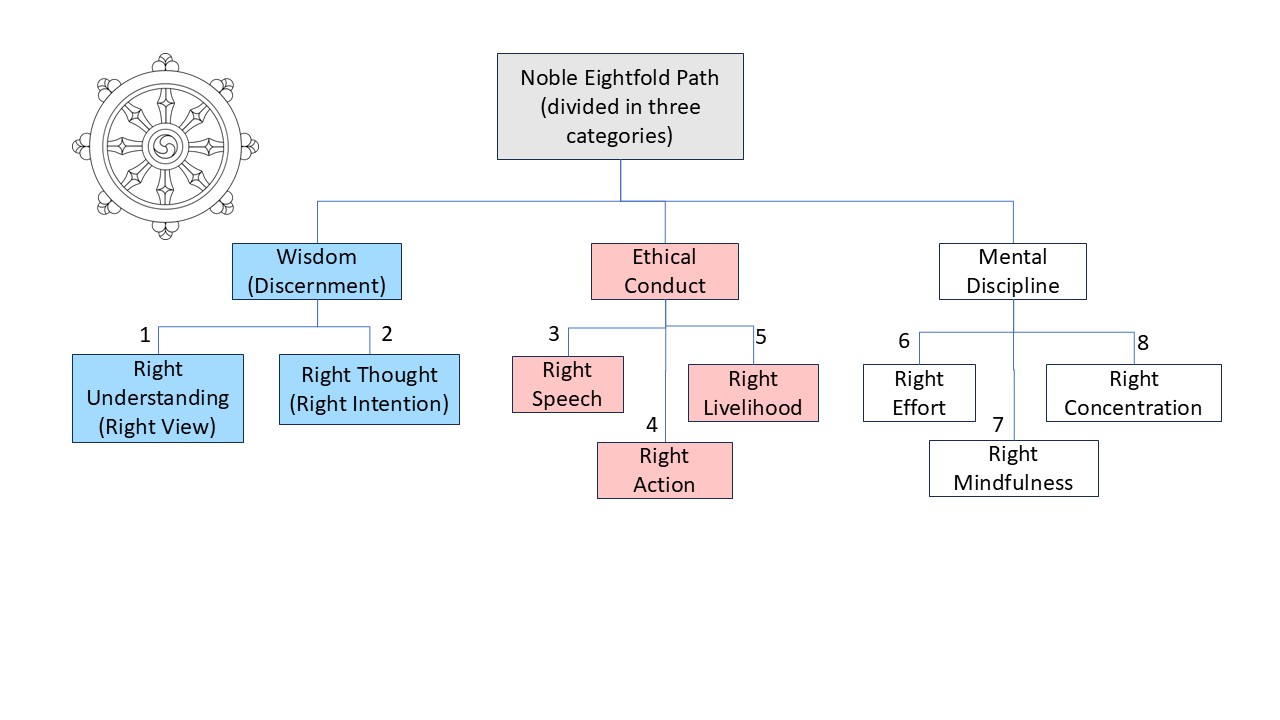
The Eightfold Path
Artist: André Augusto Cesta.
Source; License: Source: Wikipedia Media Commons.
Chapter: Chapter 2 - Motivation.
Description:The Eightfold Path and the Dharma Wheel. Icon source: Wikipedia. License: ASAG 3.0
Book Excerpt
On the Eightfold Path, thoughts are preceded by intentions, which are preceded by vision or view. Therefore, one way to fix the thoughts is to fix the view behind them. What is your view of the world now after this much reflection? Remember: you are in the world.
An eye amulet guarding a window against evil doers.
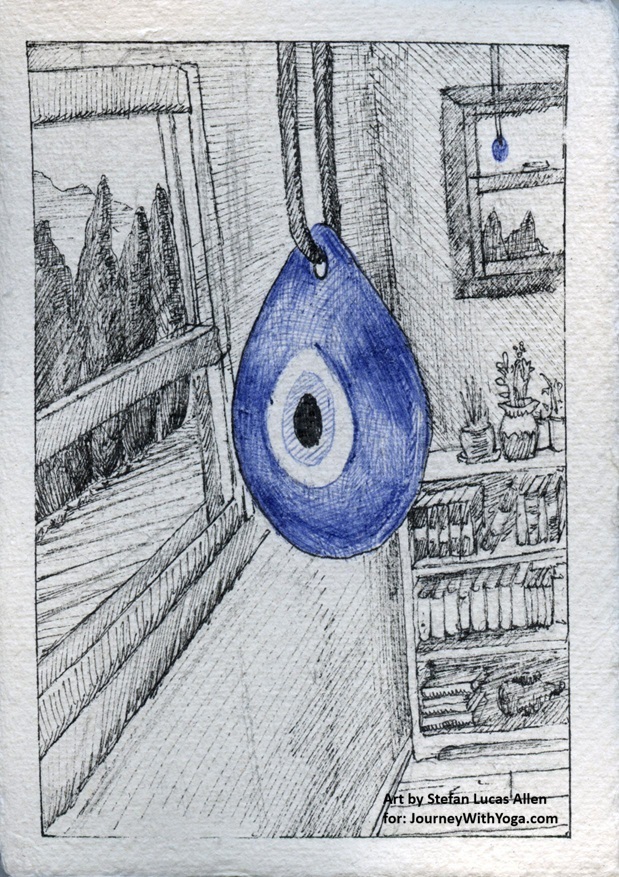
Artist: Stefan Lucas Allen.
Source; License: Illustration commissioned for the book. Permission to share provided credits to the artist and book are clearly provided below the picture.
Chapter: Chapter 2 - Motivation.
Description: An example of symbolism working without faith was a scientific experiment where customers at a fast-food restaurant had to return their trays. When symbolic eyes were drawn at the tray paper cover, significantly more trays were returned because the customers felt observed. This is studied in psychology as the: ‘watching eyes’ effect.
Book Excerpt
The above effect of an eye on our mind is not much different than the technique of imagining the face of your guru watching you when you feel that is going to help change (perhaps by bringing you wisdom from his lessons when you need it).
Four frogs sitting on a stone.

Artist: Stefan Lucas Allen.
Source; License: Illustration commissioned for the book. Permission to share provided credits to the artist and book are clearly provided below the picture.
Chapter: Chapter 2 - Motivation.
Description: To better explain: “(1). Proposition; (2). Deliberation; (3). Decision; (4). Action”. There is this story about three frogs sitting on a stone by the lake that my nephew told me. One frog proposed or started a talk about jumping into the cool water. The second frog deliberated; considering the pros and cons of such a leap. Finally, the third frog decided to jump. My nephew asked me: “how many frogs are left on the stone”? I answered confidently: “two, as one decided to jump in the water”. My nephew proved me wrong, he said with a grin: “I told you the frog just decided to jump into the water, he did not make the move or action to jump”.
Book Excerpt
“Well done is better than well said” – Benjamin Franklin.
Therefore, I ask you: In which phase of the “proposition; deliberation; decision; action” do you think you are for yoga? Take your time on each phase. Do not rush. And, be careful not to build ego in the process, ego is – as we said – made from stories we tell ourselves: “I decide”; “I will”; “I am”. “Walk the talk; don’t talk the walk” – Common wisdom.
So maybe you want to try yoga a little bit first; get just your feet wet; and finish the book; all before making a real commitment and jumping head first. That is OK.
However, it is important at one stage...