 EN
EN PT
PTTravel Guide: Locations of Near-Europe Artefacts
If you are planning a world tour, this list provides the locations of the artefacts mentioned in the book Journey with Yoga that are closest to Europe. There are, of course, many more artefacts located across Asia.
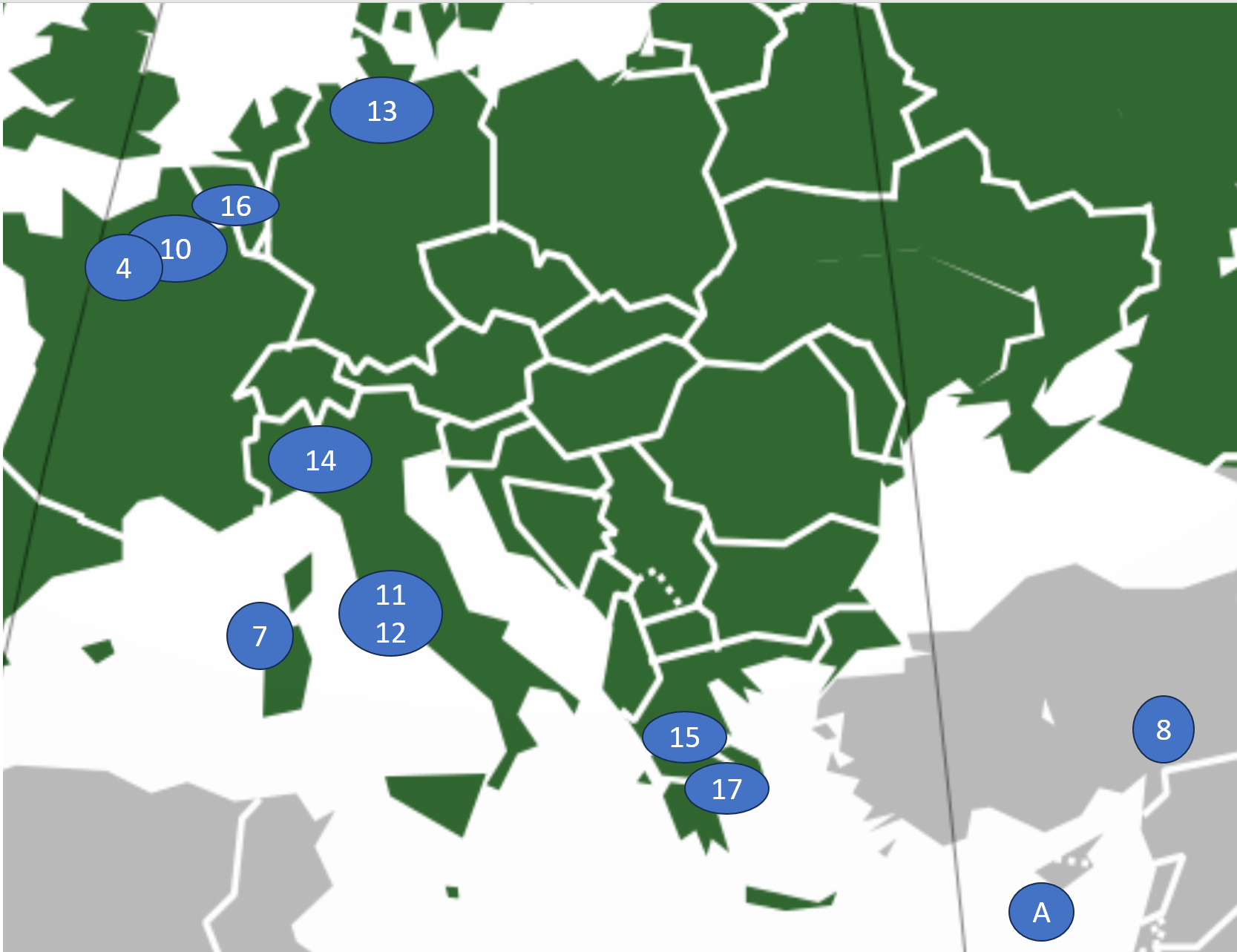
- Short tour (Northern France & Belgium): Visit artefacts 4, 10, and 16 listed below (along with other attractions en route).
- Medium tour 1 (France, Belgium, & Germany): Visit artefacts 4, 10, 16, and 13.
- Medium tour 2 (France & Italy): Visit artefacts 4, 10, 14, 11, 12, and potentially 7.
- Medium tour 3 (Greece & Italy): Visit artefacts 14, 11, 12, 7, 15, 17, and many others.
- Full European tour: Covers all artefacts except those in Turkey and Cyprus.
All Artefacts
Listed roughly in chronological order, including items outside Europe.
1. "Pashupati Seal"
- Date: 2350–2000 BCE
- Location found: Mohenjo-daro
- Location displayed: National Museum, New Delhi
- Visitable to the public: Very likely (please let me know if you have updated information).
- Location in the book: See Chapters 4 and 11 for a reproduction.
- Comments: This seal is particularly fascinating because it predates even the Rigveda—one of the foundational books we quote as the first to mention the chakras.
2. The Rigveda
Composed between c. 1500 and 1200 BCE in the northwestern region (Punjab) of the Indian subcontinent, near where the Pashupati Seal was discovered. The oral transmission dates back to at least 2000 BCE.
- Location found: Rigveda manuscripts were discovered in Nepal and are dated to around c. 1040 CE.
- Location displayed: A separate, highly significant collection of Rigveda manuscripts is preserved at the Bhandarkar Oriental Research Institute in Pune, India. While this collection is invaluable and contains unique features, its oldest dated manuscript is from 1464 CE. One particularly important manuscript is written on birch bark using the ancient Sharada script. These manuscripts are included in UNESCO's Memory of the World Register. (See: namami.gov.in)
- Visitable to the public: Unsure.
- Location in the book: Chapters 9 and 12.
- Comments: Implicitly introduces chakras and kundalini.
3. "Isis Nursing the Child Horus" Statue
Although this specific artefact dates from the 7th century BCE, similar depictions of Isis with the lunar disk atop her crown chakra go as far back as the 13th century BCE, overlapping with the Rigveda timeline.
- Location found: Egypt
- Location displayed: Walters Art Museum, Baltimore
- Other locations displaying similar items:
- USA: The Met Fifth Avenue (New York); Walters Art Museum (Baltimore).
- Cuba: Museo Nacional de Bellas Artes de Cuba.
- Location in the book: See Chapter 12 for a reproduction.
4. Ulysses and his Companions Blinding Polyphemus (Laconian black-figure cup)
- Date: 565–560 BCE
- Description: One of several famous ceramic paintings depicting Odysseus (Ulysses) and his crew blinding the Cyclops.
- Location found: Laconian Gulf
- Location exhibited: Cabinet des médailles, Bibliothèque nationale de France (French National Library), Paris.
- Location in the book: Chapter 9.
5. Manuscript by Damascius: "Problems and Solutions Concerning First Principles"
5th century CE. The section of interest refers to the Orphic Theogony, which was composed before 340 BCE¹. The author of the Theogony (Orpheus) was from Phrygia and had travelled to Egypt. This period likely overlaps with the life of the Buddha (c. 450 BCE – 370 BCE).
- Location found & displayed: If you have any information regarding the location of the earliest Damascius manuscripts, please share it. For context, the related Derveni Papyrus was found in 1962 in a tomb 10 km north of Thessaloniki and is preserved in the Archaeological Museum of Thessaloniki, Greece.
- Location in the book: See Chapter 11 for text, visuals, and a reproduction of the later Orpheus mosaic from Edessa.
6. Elephanta Caves & Sopara Ancient Port
Elephanta Caves (2nd century BCE); nearby Sopara ancient maritime Silk Road trade port (active from the 3rd century BCE). Sopara actively traded with Mesopotamia, Egypt, Cochin, Arabia, and Eastern Africa.
- Description: The Elephanta cave temple houses key sculptures relevant to this book: (1) a three-faced Shiva (Sadashiva Trimurti), (2) Ardhanarishvara, and (3) a Shiva Lingam as the central focal point of the temple (associated with tantric practices, among other meanings).
- Location: Ancient Sopara Harbour, India
- Visitable to the public: Most likely.
7. "Orpheus Mosaic from Porto Torres"
- Date: 46 BCE (though the mythological figure of Orpheus dates back to at least 340 BCE).
- Location found & displayed: Porto Torres, Sardinia, Italy.
- Visitable to the public: Most likely.
8. "Orpheus Mosaic from near Edessa"
- Date: 194 CE
- Location found: Edessa
- Location displayed: Şanlıurfa Archaeology and Mosaic Museum, Turkey.
- Visitable to the public: Most likely.
- Location in the book: Chapter 5.
9. Roman Orpheus Mosaic
- Date: c. 1st–5th century CE
- Location found: Blanzy, France
- Location exhibited: Musée de Laon, France.
- Visitable to the public: It is currently housed in a separate storage facility and can only be viewed by prior appointment with the museum staff.
10. Mithras Slaying a Bull (Tauroctony Scene)
- Date: 2nd or 3rd century CE
- Location found: Fiano Romano, near Rome
- Location displayed: The Louvre, Paris.
- Location in the book: Chapter 11.
11. Leontocephaline (Lion-Headed Figure of the Mithraic Mysteries)
This line drawing depicts the figure found at the Mithraeum of C. Valerius Heracles and sons (dedicated c. 190 CE) in Ostia Antica, Italy.
- Location found: Ostia Antica, Italy
- Location displayed: The original white marble statue is located beside the entrance of the Vatican Library (Biblioteca Apostolica Vaticana).
- Similar artefacts on display: The Louvre houses a similar lion-headed figure from the Sidon Mithraeum (c. 500 CE).
12. Reconstruction of the Polyphemus Group (Ulysses Blinding Polyphemus)
- Date: Roman copy (1st century CE) of a Hellenistic marble sculpture by Agesander, Athenodorus, and Polydorus.
- Location displayed: Museo Archeologico Nazionale di Sperlonga, Italy.
13. Wanderer Above the Sea of Fog (Painting by Caspar David Friedrich)
- Date: 1818
- Location displayed: While it occasionally travels on loan across Europe, its permanent home is the Hamburger Kunsthalle, Germany.
14. Pain, Silence and Pleasure (The Human Enigma) (Painting by Giorgio Kienerk)
- Location: When not on loan, it is hosted at the Musei Civici di Pavia (Castello Visconteo), Italy.
- Location in the book: Appears across multiple chapters, primarily Chapters 10 and 11.
15. Tetramorph Fresco, Meteora
- Date: 16th century
- Location: Monastery of the Great Meteoron (Transfiguration of Christ), Meteora, Greece.
- Visitable to the public: Yes.
16. Royal Museum of Mariemont
- Description: While it does not house specific individual items mentioned, this museum features excellent collections on Greek antiquity, Buddhism, and Mithraism. It is perfectly situated between Paris and Hamburg.
- Location: Morlanwelz, Belgium
17. Archaeological Museum of Eleusis
Located in a region famous for the Eleusinian Mysteries and deeply tied to Orphic wisdom. Look for the Proto-Attic amphora found at Eleusis (near Athens) dating to ca. 660 BCE. It features early Greek art showcasing: (1) a lion chasing a boar, (2) Ulysses blinding Polyphemus, and (3) a decapitated Medusa (which shares a profound symbolic meaning with the blinding of the Cyclops).
- Location: Eleusis, Greece
Other Notable Sites (Not Explicitly in the Book)
- A. Orpheus Mosaics in Paphos, Cyprus: A stunning archaeological site featuring various intricate mosaics, including depictions of Narcissus.
¹ The first explicit verse quotation of an Orphic theogony is found in the Derveni Papyrus, dated between 340 and 320 BCE.