 EN
EN PT
PTThe Study for the Theogony Painting from Chapter 11 of Journey With Yoga
Introduction
This appendix is only of interest to you if: (1) you want to learn about the study for the "Theogony" painting in Chapter 11. Thus, if you are a fan of art or mythology, or just want to know how the author and the artist, Kristina Kurilionok, worked together to establish how to paint the theogony, this is for you.
The Orphic Theogony by Damascius
Orphica, Theogonies Fragment 54 (from Damascius) (trans. West) (Greek hymns C3rd A.D. - C2nd B.C.) : "Originally there was Hydros (Water), he [Orpheus] says, and Mud, from which Ge (Gaea, the Earth) solidified : he posits these two as first principles, water and earth . . . The one before the two [Thesis], however, he leaves unexpressed, his very silence being an intimation of its ineffable nature. The third principle after the two was engendered by these--Ge (Earth) and Hydros (Water), that is--and was a Drakon (Dragon-Serpent) with extra heads growing upon it of a bull and a lion, and a god's countenance in the middle; it had wings upon its shoulders, and its name was Khronos (Chronos, Unaging Time) and also Herakles. United with it was Ananke (Inevitability, Compulsion), being of the same nature, or Adrastea, incorporeal, her arms extended throughout the universe and touching its extremities. I think this stands for the third principle, occuping the place of essence, only he [Orpheus] made it bisexual [as Phanes] to symbolize the universal generative cause.
Please read the Damascius Orphic theogony interpretation from the point of view of Yoga in Chapter 11 of Journe with Yoga. Notice that it is the Damascius Theogony from Orpheus and not Hesiod’s.
Annotated Bibliography
- Adrasteia: Inevitability, fate, and the inescapability of punishment (sounds similar to karma, cause, and consequence). She is also known as Ananke: force, constraint, and necessity. See: Wikipedia: Adrasteia; Wikipedia: Ananke. There are not many paintings or sculptures of Adrasteia; one of the oldest—if not the oldest—can be seen here: Theoi: Ananke. She wields a scythe. Another common object for her to have with her is a spindle (more below).
- Chronos: (The personification of unbound time, not to be confused with the Titan Cronus, which is spelt without an 'H' and with a 'U' at the end). Regarding the relationship between the two:
“The figure of Khronos/Chronos was essentially a cosmological double of the Titan Kronos (Cronus) ('Father Time').” – Source: Theoi: Khronos
- Chronos (and also Cronus) are known for the movement or passage of time and that of the stars and constellations in the sky (see link above). This is perhaps why he is also called Heracles in the Theogony of Damascius; Herakles was known for moving the zodiac wheel, as seen in later depictions and as also mentioned by Radcliffe G. Edmonds III in “Misleading and Unclear to the Many: Allegory in the Derveni Papyrus”.
On this Wikipedia page, we have two paintings of Chronos where he has wings, a long white beard, and holds a scythe: Wikipedia: Chronos. The two paintings presently displayed on this Wikipedia page are: Time Clipping Cupid's Wings (1694) by Pierre Mignard, and Chronos and His Child by Giovanni Francesco Romanelli (held in the National Museum in Warsaw), a 17th-century depiction of Chronos as Father Time wielding a harvesting scythe.
In other, more modern paintings, such as those from the medieval period, Chronos is also depicted with an hourglass.
While in modern times Death’s personification holds a scythe like Chronos, a scythe is not only a symbol for ending a life, but for ending the harvest of grains by using it in agriculture—a practice dating back to Göbekli Tepe or earlier. Thus, we are comparing here the cycles of human lives with the cycles of nature (harvest) and the cycles in the sky (seasons and the zodiac passage of the 12 months represented as constellations).
The above (Adrasteia and Chronos) are primordial gods in the cosmology, often described as more powerful than the Titan-gods themselves. They are gods related to the origin of the universe and all other gods within it.
Adrasteia is the consort of Chronos, with whom she had various divine children. This is no different from Shiva and Parvati in Chapter 11 (Ardhanarishvara).
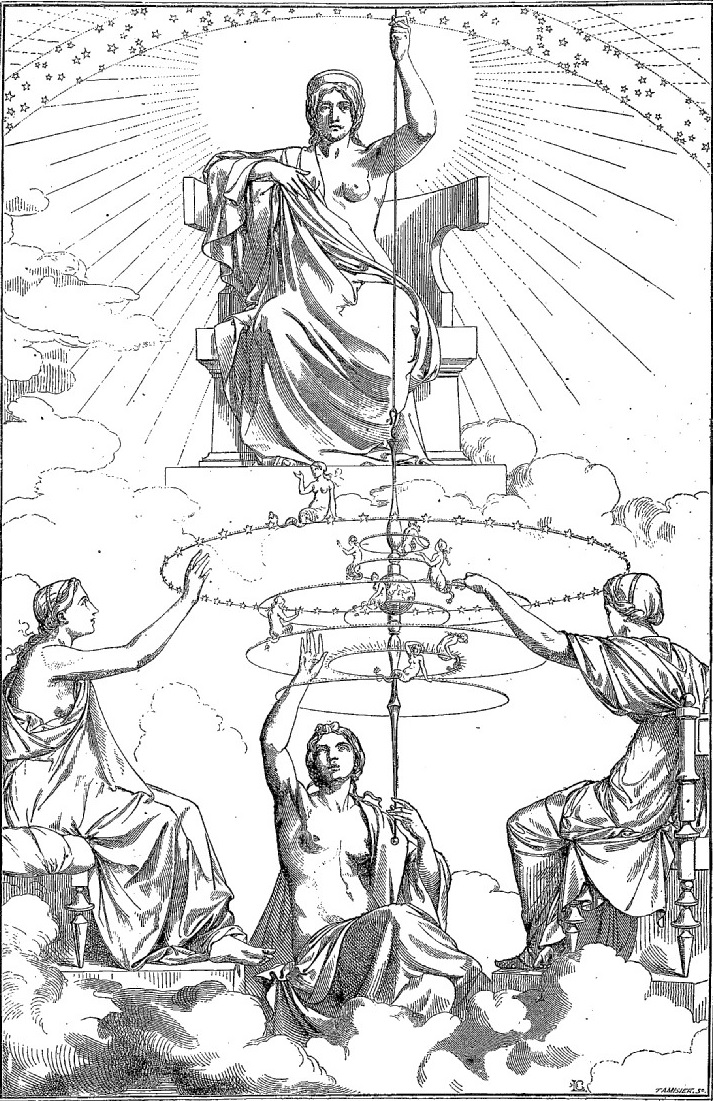
Ananke (a synonym for Adrasteia) is often depicted with a spindle in late works, such as the one below from Plato’s Republic:
What is a Spindle?
Some Greek goddesses were said to be able to spin people’s lives, symbolising cause, consequence, and continuum—the inescapability of fate and interconnectedness via the thread of a spindle. If two threads crossed, people would meet in life. If a thread were cut, somebody would die. The latter is more aligned with how the Moirai legend is described.
Some Greek spinner motifs (often associated with the Moirai who work under Adrasteia):
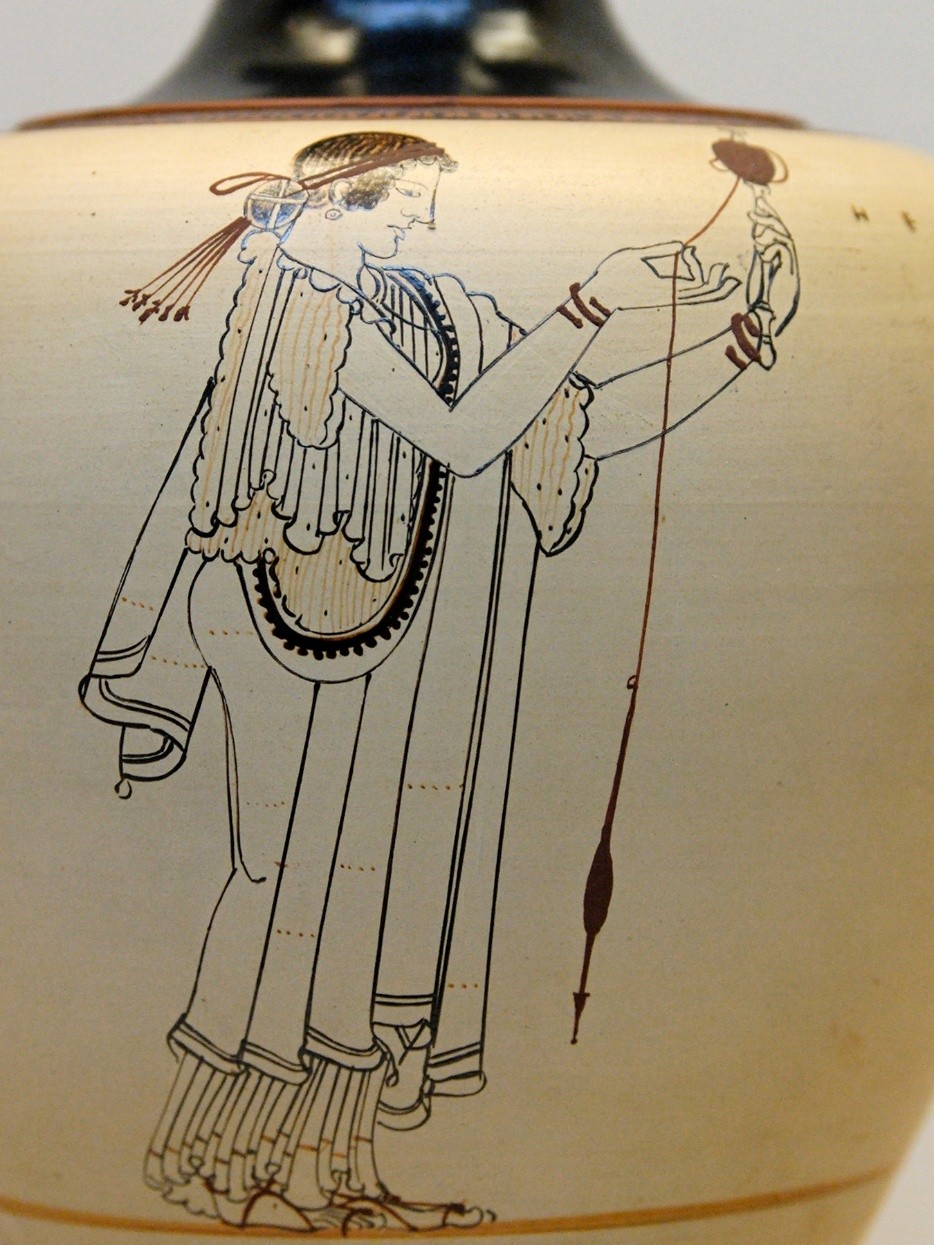
I love, for instance, the weavers' pottery here: Weavers, Athenian black-figure lekythos c. 6th century BC, Metropolitan Museum of Art. See reproduction at: Theoi: Moirai
Regarding the Zodiac
The zodiac is attributed to early Mesopotamian astronomy and describes not exactly the passage of time (which is mastered by Chronos), but the passage of the constellations in the ecliptical line as one of the many manifestations of time passing.
While the Mesopotamians developed the full zodiac around 1000 BCE, the symbols for some constellations, such as Leo and Taurus, go back many thousands of years more. See, for instance, the Taurus constellation, most likely depicted in the Lascaux cave from c. 15,300 BCE! Source: The Pleiades in the "Salle des Taureaux", grotte de Lascaux. Does a rock picture in the cave of Lascaux show the open star cluster of the Pleiades at the Magdalénien era (ca 15.300 BC)? – Michael A. Rappenglück.
I honestly believe that the illustration on the website below provides a better visual explanation than the article above: Tree of Visions: Paleo-Astronomy
This is how we would paint it in the "Theogony Painting".
So, How to Paint the Theogony?
I love the painting on the header of this webpage; it was probably done by AI: Mystery in History: Chronos
I also love this painting here depicting Ananke; it is quite sensual, but that is no problem, as many consort paintings are depicted in union, as one: Tumblr: Gods of Time
We would paint the bull on the left side of the painting and the lion on the right side.
If we paint the bull as above with the horns facing left, how would we paint Leo? Here are some similar displays:
Urania's Mirror - Leo Major and Leo Minor from the main Wikipedia page: Wikipedia: Leo Constellation (this page has a better map of the stars and a better painting).
The Start of the Painting
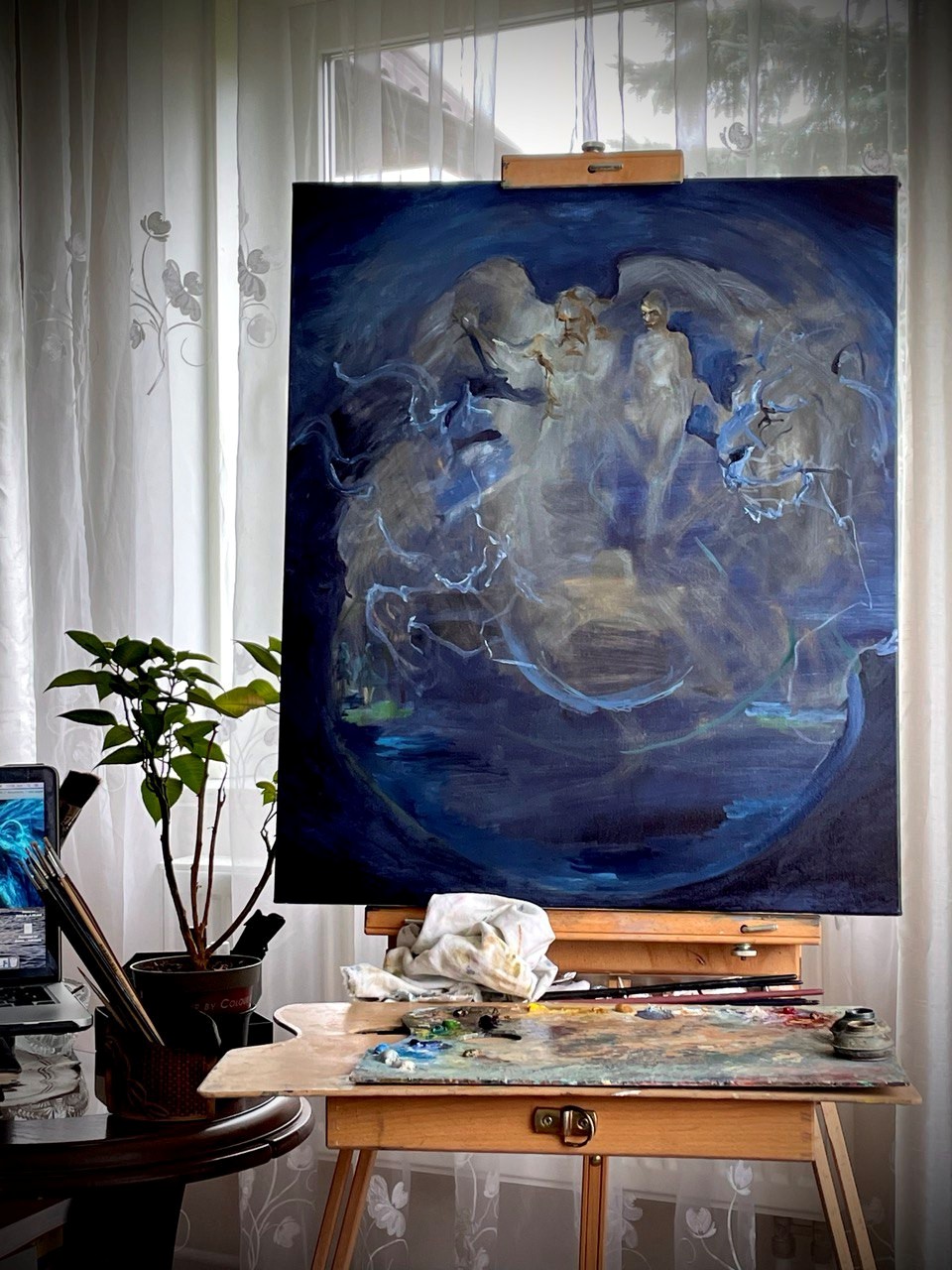
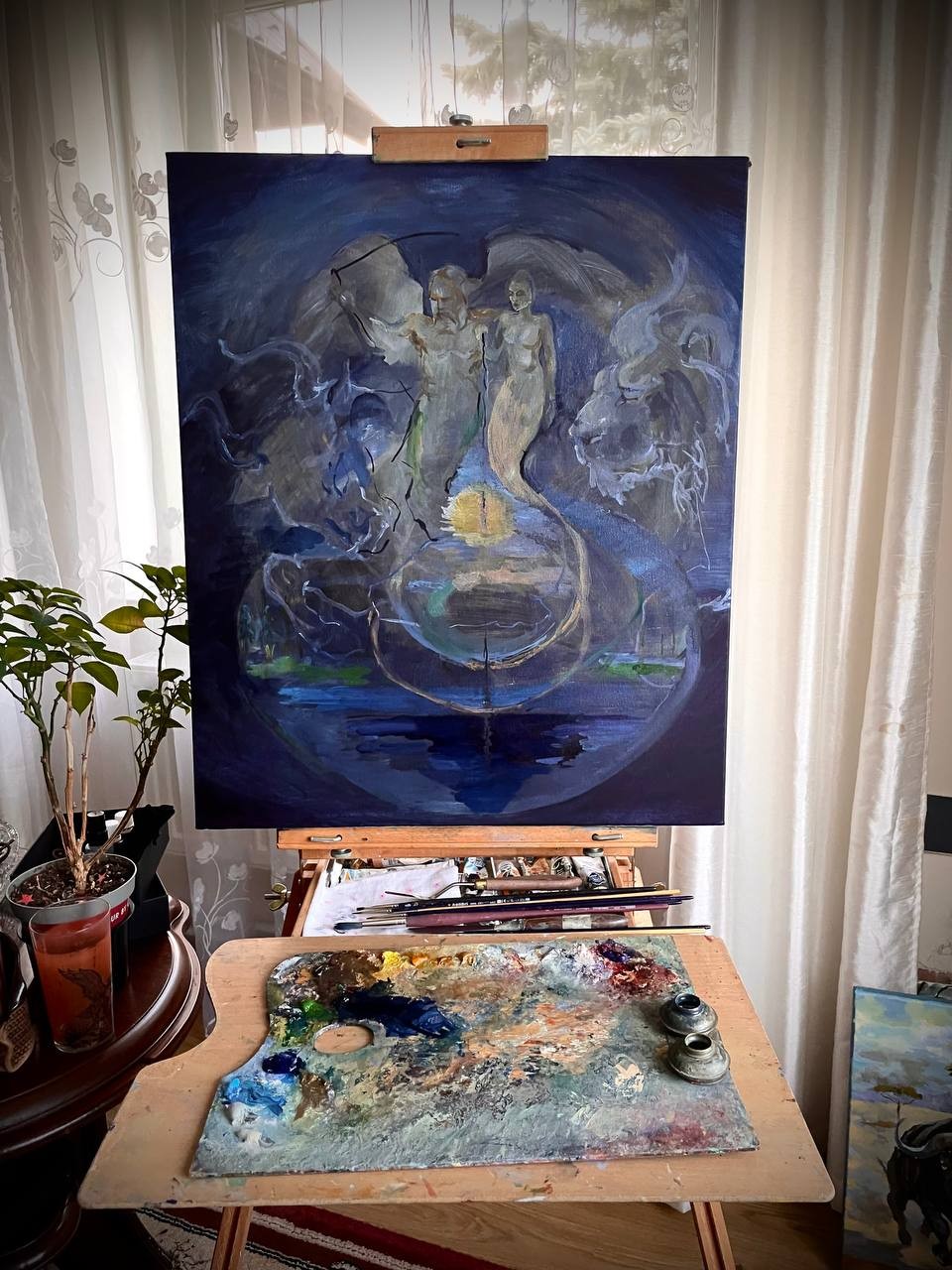
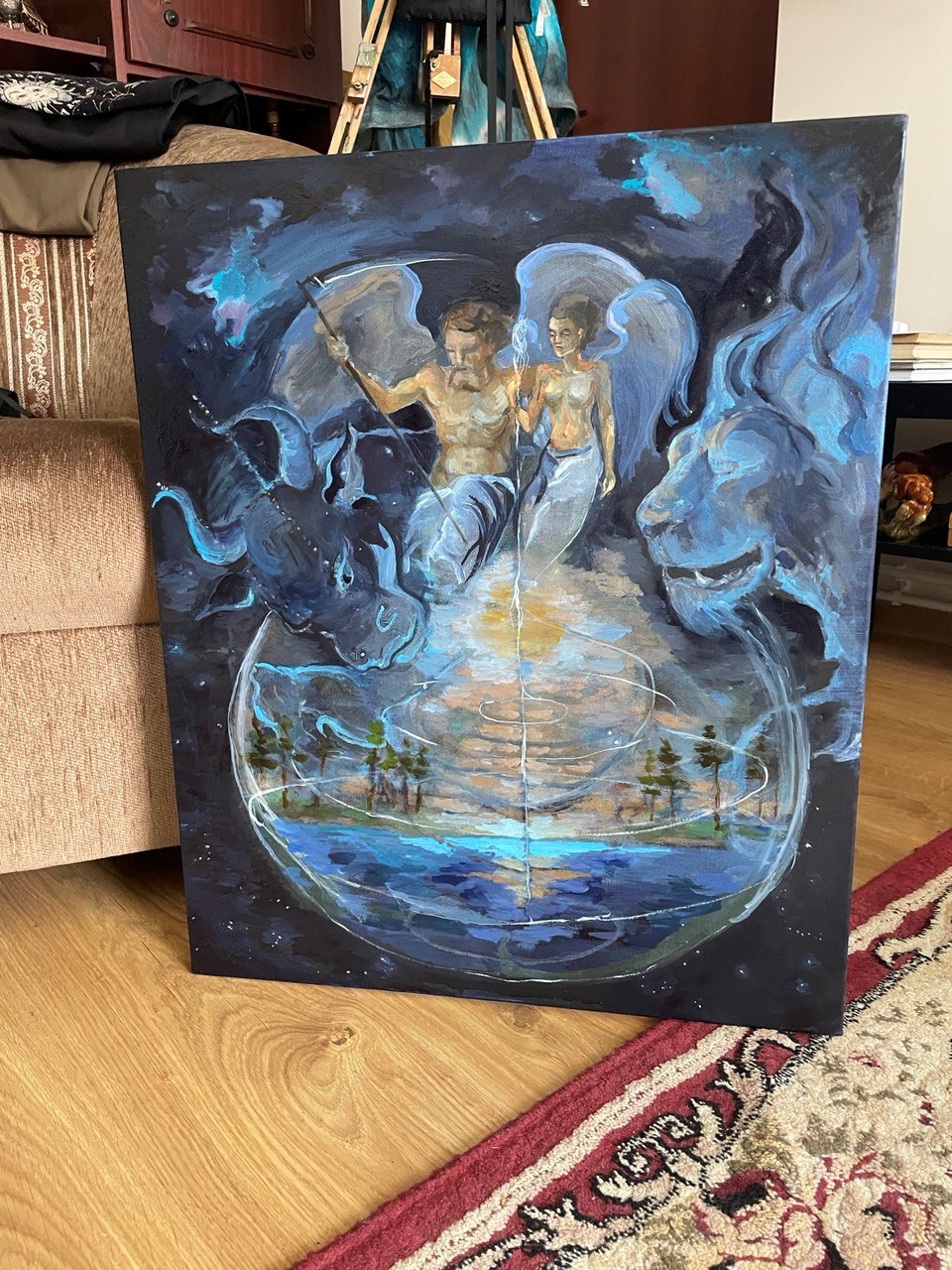
I absolutely love its abstract look. It leaves a lot to the imagination. The night sky is coming up beautifully. It gives me goosebumps to see how Chronos looks at the bull.