 EN
EN PT
PTMy Odyssey of Consciousness: From Homer to the Himalayas
Note: This article is a second text interpreting the Odyssey from perspective aligned with Yoga and the thought of Joseph Campbell, C.G. Jung. For our first text on the Odyssey from this perspective, click on the sample chapter link above.
We often think of The Odyssey as a simple narrative of a long, treacherous journey home. It’s an adventure story, a tale of monsters, gods, and a war hero desperate to see his family again. But while watching Christopher Nolan’s screen adaptation of The Odyssey, I had an “aha!” moment. I realized that Ulysses’ physical path through the Mediterranean is also a profound map of the progression of human consciousness.
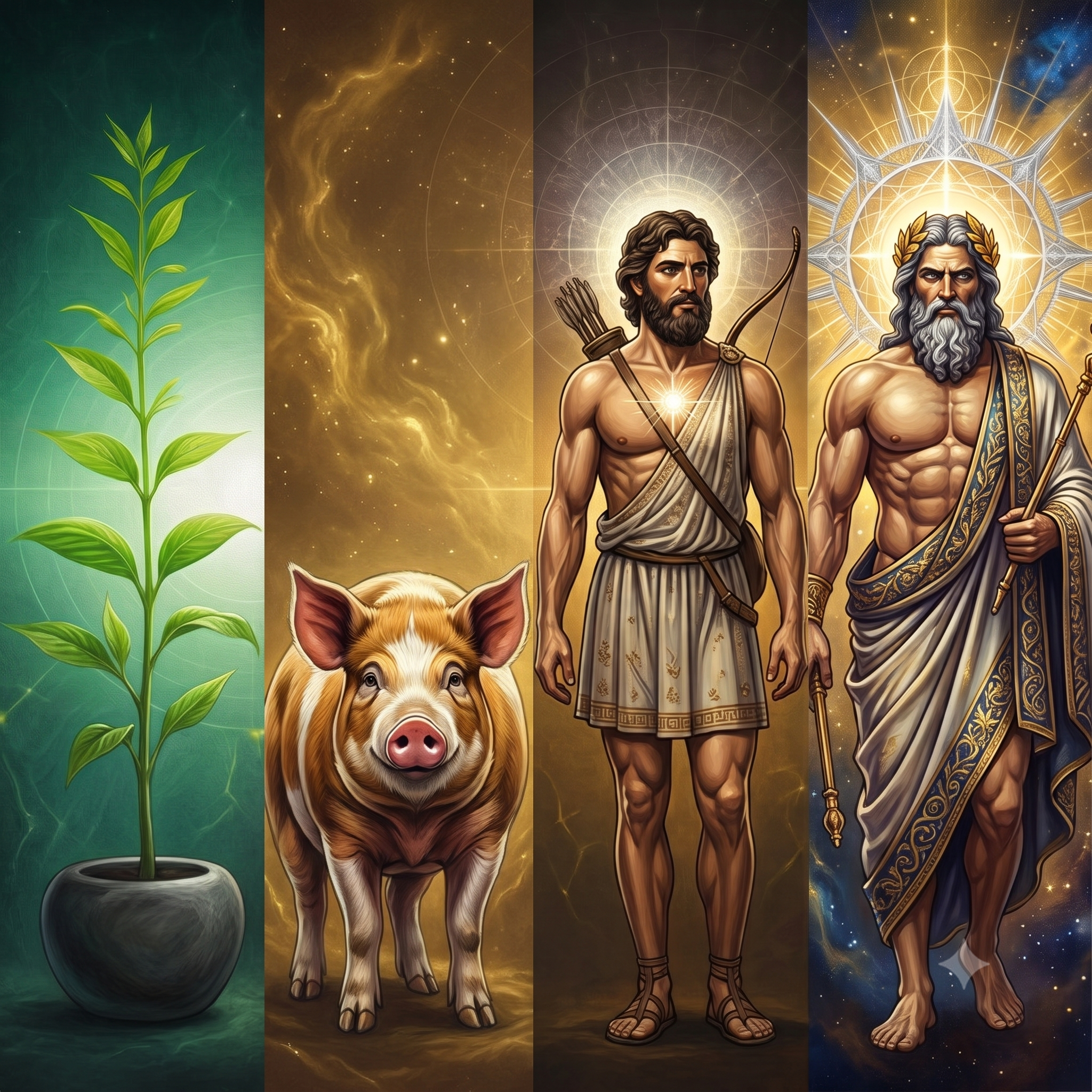
My insight struck me while visualizing the different islands and challenges Ulysses faces. It struck me that these are not just locations; they are metaphors for levels of awareness. The associated image I’ve included, represents this evolutionary ascent.
The Mythological Ladder
My first insight was the connection between the lands Ulysses visits and the hierarchy of conscious states. You can visualize this ascent on the image above.
- The Plant Stage: The image begins with the pot plant. This corresponds to Ulysses passing through the land of the Lotus Eaters. This encounter symbolizes a vegetative, numb state. Feeding on the lotus (a plant often interpreted as containing an opiate) keeps the inhabitants in a passive, oblivious, and inert existence. They are ‘stoned’ into inaction (see my stone, or mineral state on the quote from my own book below).
- The Animal Stage: Next, Ulysses visits the sorceress Circe. As shown in the image by the pig, Circe’s magic famously turns men into swine. This passage perfectly symbolizes man stuck at an animal consciousness level—beings that are driven only by base instincts, appetites, and sensory desires, lacking higher reasoning or virtuous impulse. The Buddhist came a bit later than The Odyssey, using pigs as symbols for ignorance (specifically as one of the Three Poisons, Moha).
- The God Stage: Ulysses’ final significant stay (and longest entrapment) is with the nymph Calypso. She offers him an everlasting, immortal stay. This state, visualized as the crowned, divine-looking figure on the far right, symbolizes the “God state.” It is a temptation of static, everlasting perfection. Ulysses risks staying in this divine realm forever, accepting the offer of godhood. But he chooses, profoundly, to reject immortality. He chooses mortality. He chooses to be a human again, to return to his family and his memories after becoming nobody in the Cyclops cave.
This third stage, for Ulysses, is the true test. Will he choose the “easy” perfection of the divine, or the struggling, memory-driven (and therefore belonging and interacting) state of being fully human? He chooses humanity.
The Origins of this Philosophical View
My “aha” moment led me to wonder: has anyone else seen The Odyssey this way? It turns out that this psychological and evolutionary reading has a long, fascinating history in both philosophy and general psychological interpretation.
- Ancient Philosophers (Porphyry): The idea that Homer’s myths contained hidden philosophical allegories is ancient. Porphyry (c. 234–c. 305 AD), a Neoplatonic philosopher, famously wrote an allegorical interpretation of Homeric myths, particularly The Cave of the Nymphs (about The Odyssey Book 13). Porphyry and fellow Neoplatonists viewed the epic as a journey of the soul from a state of sensory enslavement (embodiment) to intellectual and spiritual freedom.
- Modern Psychology (Carl Jung): More recently, the Swiss psychiatrist Carl Jung (and his students) established depth psychology, which reads mythology as the “dream language” of the collective unconscious. Within Jungian analysis, Ulysses’ journey is seen as a classic process of individuation—the development of a full, mature, and unified psyche. His interactions with the different islands represent confronting different aspects of the self (or archetypes). Circe’s transformation is a confrontation with the “Shadow” or base instinct, and Calypso is a confrontation with the Anima/Soul-Image (the tempting, static ideal).
- Scholarly References: If you are looking for specific names in academic criticism, you might find the work of scholars who apply these concepts directly:
- Joseph Campbell (Mythologist): While not specifically an academic classicist, his seminal work The Hero with a Thousand Faces describes the “Hero’s Journey” exactly as a process of psychological transformation through stages of evolution.
- General Academic Approach: The general academic term for this type of reading is psychological allegory or an evolutionary model of consciousness within epic poetry.
The Connection to Tibet
When this realization hit me, I went back to a passage I had already written in my own book (see. JourneyWithYoga.com). The fascinating thing was that I had outlined a system that perfectly mirrored this structure, drawing from a completely different later cultural lineage. I wrote this without knowing that this specific evolutionary path of consciousness was present—at least metaphorically—in The Odyssey as well.
My training offered a remarkably similar Tibetan four-stage model. While the visual mapping starts with a mineral/plant stage and climbs up, the underlying evolutionary logic remains identical.
Here is the excerpt from my book detailing that framework and the image I used in the book which starts at a mineral stage and ends in a human stage, without the God stage of consciousness:
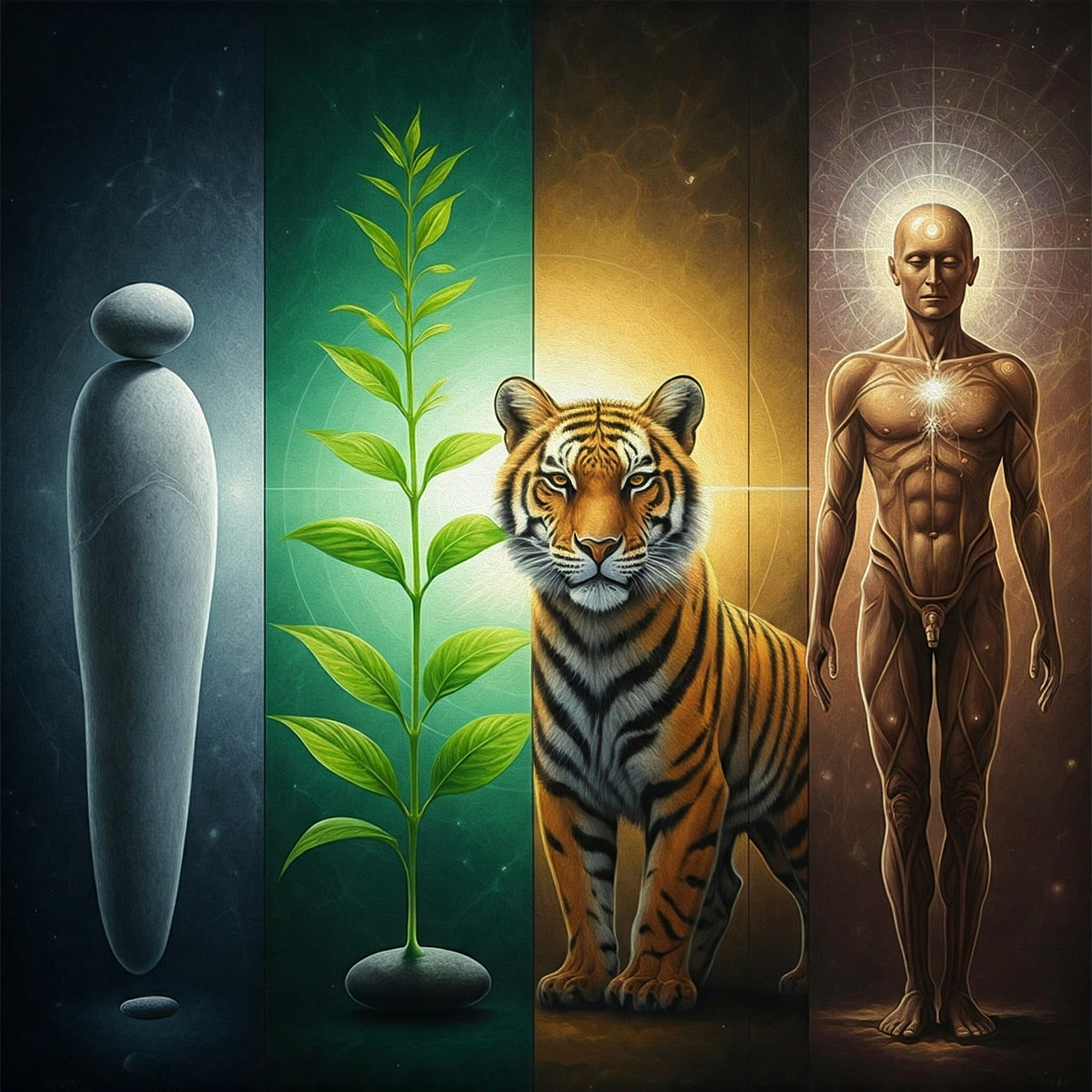
“I learned from my first lineage (Dr. Celso Charuri) that the Tibetans have this classification of humans in four stages of evolution of consciousness:
Stage 1. Stone stage. These people are like a stone blocking other’s path. They can be sharp things that hurt us. There is hope for them though, as they can be lapidated to become a gem, or they can progress to the next stages below. If we find a stone in the path, and it won’t hurt our feet, we can best move it away so it does not hurt others. Do you know any stone in your life? Some ‘tamasic’ person saying no all the time or not even saying anything when others need their help? Someone refusing to move to gain power?
Stage 2. Plant stage. These people are like little plants requiring lots of care, attention, water, and sun. The worse ones are those weedy ones that give nothing in return: no flower, no fruit, no wood, no medicine. That reminds me a lot of the speaking rose flower character from the best selling book “The Little Prince” which needed lots of attention: “I love you”, said the little Prince. “I want you too”, said the rose. “Is not the same”, he answered… That rose made me imagine a lady putting make-up in the mirror every single morning.
Stage 3. Animal Stage. People at this stage can give, such as cows give. They also can think, plan. Many of them are not so virtuous, using their thinking capabilities like wolves, rats, snakes to attack you from behind. Each one needs to be handled in a different way. Snakes are best approached from the tail, for instance.
Stage 4. Human Stage at last. This whole book is about reaching this stage in its full glory.
“’We are not born human, we become human.’ - Emanuel Swedenborg. This Swedish theologian and philosopher believed that while we are born into human bodies, our spiritual growth and development are essential to becoming truly human. This aspect alone is very aligned with Yoga and Buddhism.
“’The fact that someone belongs to the species homo sapiens does not guarantee that that person leads a human existence. In fact, Kierkegaard seems to think that few people — or at least, a minority of people — genuinely live as human beings.’ — María G. Amilburu on Kierkeggard”
A Unified Journey
Ulysses’ epic struggle, therefore, is not merely a geographic battle. It is a journey through consciousness stages. He overcomes the ‘Stone’ and ‘Plant’ level of the Lotus Eaters (inert tamas); he navigates the ‘Animal’ instinct represented by Circe (and visually, the pig); and finally, in his most profound test, he is tempted by the passive bliss of the ‘Divine’ (the Calypso/God state).
But the hero’s path must end in humanity—full, conscious, memory-driven, relational state. He rejects the heavenly, static perfection of Calypso to become, at long last, what my book defines as Stage 4: “Human Stage at last.” The images above, showing the ascent from a plant to a pig, to the human hero, and finally to the divine archetype, tells this singular, universal story.
My “aha moment” wasn’t that I discovered something entirely new; it was the powerful realization that ancient Greeks and modern psychology share a fundamental understanding of what it means to truly evolve and become human—an insight that transcended cultures and eras to connect with my own training in Tibetan thought.
We came from this planet and evolved together with all the life forms in it. The ascent of life in this planet seems to map to the ascent of our consciousness through different levels.
Copyright André Augusto Cesta - Jul 2026