 EN
EN PT
PTArtwork from The Appendices A, B, C, D, E
Aqui está uma lista de todas as obras de arte citadas no capítulo. Elas são exibidas em cores na sequência em que aparecem no livro para aqueles com cópias Kindle que desejam ouvir o livro em Kindle e ver as figuras aqui.
A Summary of What I Eat

Artist: AI Generated for this edition at least.
Source; License: Source: Gemini. Copyright: André Cesta.
Appendix: A My Journey In Diet and Nutrition
Description: I combine: mediterranean; intermittent fasting; other fasting; ketogenic; sometimes on the same day; sometimes on different days. For instance when I sport I do no fasting or less.
Book Excerpt
My typical daily intake of food is: three eggs; some yogurt; unlimited plants (seeds; roots; leaves; fruits).
Caress of the Sphinx
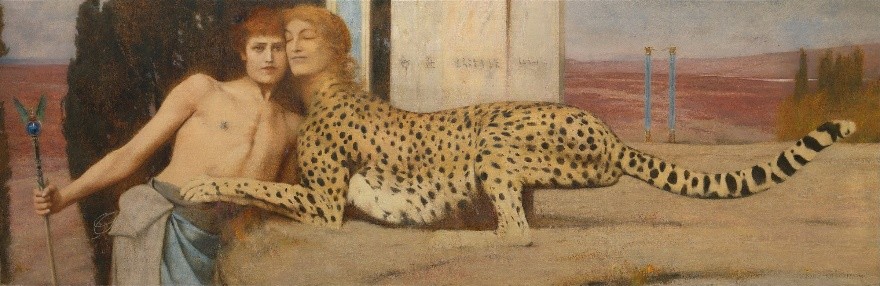
Artist: Fernand Khnopff.
Source; License: Source: Wikipedia. License: Public Domain.
Appendix: B An Exercise in Symbology in Art
Description: I combine: mediterranean; intermittent fasting; other fasting; ketogenic; sometimes on the same day; sometimes on different days. For instance when I sport I do no fasting or less.
Book Excerpt
My typical daily intake of food is: three eggs; some yogurt; unlimited plants (seeds; roots; leaves; fruits).
Silk Road Map Adaptation To Reflect Artifacts from the Book
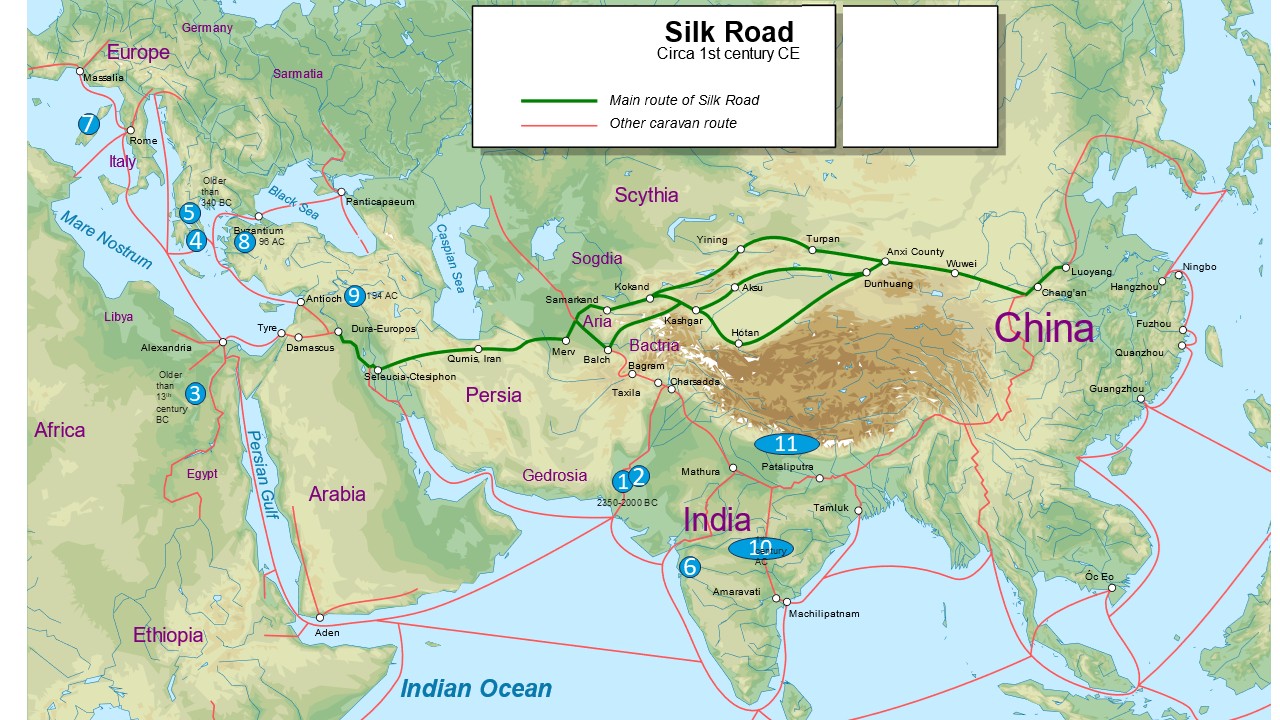
Artist: André Augusto Cesta; adaptation from Wikipedia map.
Source; License: Map adapted from: https://en.wikipedia.org/wiki/Silk_Road . Map original license: ASAG 4.0.
Appendix: C Silk-Road Map and Location of Artifacts
Description: Throughout the book we have presented a number of artifacts which helped explaining the yoga journey. In this appendix we present a map of the silk-route overlayed with the locations of the key artifacts and their estimated dates.
Book Excerpt
1. Artifact: “Pashupati Seal”. Date: 2350-2000. Location: Mohenjodaro. See chapter 9 for a reproduction. What is interesting about this seal is that it predates even the Rigveda one of the books we quote as the first to mention chakras.
2. The Rigveda. The Rigveda was composed in the northwestern region (Punjab) of the Indian subcontinent, not far away from the Pashupati Seal location. But much later in time, between c. 1500 and 1200 BC.
3. Artifact: “Isis nursing Horus child” statue. Location: Egypt. Date: although the artifact dates from the 7th century BC, similar depictions of Isis with the lunar disk on top of the crown chakra go as far back as the 13th century BC, thus overlapping with the Rigveda timeline. See chapter 9 for a reproduction.
4. Various ceramic paintings of Ulysses and his companions blinding the cyclops Polyphemus. In specific the one with what most likely represents the kundalini serpent 565 BC.
5. Artifact: “Orphic theogony of Hieronymus, Hellanicus”. Date: est. older than 340 BC ). Location: Athens, other. See chapter 9 for text and visuals, including a reproduction of the later Orpheus mosaic from Edessa. The author of the Theogony (Orpheus) was from Phrygia, which is a little to the right of the #7 on the map. He had also been to Egypt which is on #3 on the map. This period is most likely overlapping with the life of The Buddha (450 BC – 370 BC).
6. Elephanta Caves (2nd century BC), and nearby Sopara ancient maritime silk route trade port (active from 3rd century BC). The Sopara port was trading with: Mesopotamia, Egypt, Cochin, Arabia and Eastern Africa . The Elephanta cave temple contained the following sculptures of relevance to this book: (1). A tree faced shiva (Sadashiva Trimurti); (2). Ardhanarishvara; (3). A Linga or shiva lingan as the central place in the temple (related to tantric sex among other).
7. Artifact: “Orpheus mosaic from Porto Torres”. Date: 46 BC. Again, Orpheus himself dates back to at least 340 BC.
8. Artifact: “The Book of Revelation from the Bible”. Date: est. 96 AC in Asia Minor. The author was probably John the Elder from Ephesus. See chapter 9 for a text and visual description.
9. Artifact: “Orpheus mosaic from near Edessa”. Date: 194 AC. See chapter 9 for reproduction and description. Again, Orpheus himself is dated much further back.
10. Artifact: “Ardhanarishvara”. Date: various depictions going as far back as the 1st century from the Christian era. Locations: Greece and India. See chapter 9 for one reproduction with explanations. Of particular interest, is the Ardhanarishvara in the Elephanta caves in the Elephanta island, dated back to the 2nd century BC, that is located on point 6 on the map, next to the Sopara port. See point 6 description above.
11. Artifact: “Vajrakilaya” and other 3-faced Buddhist goddesses. Various dates. Mostly from Tibet and India. Some of its tantric practices are also quoted on chapter 6.
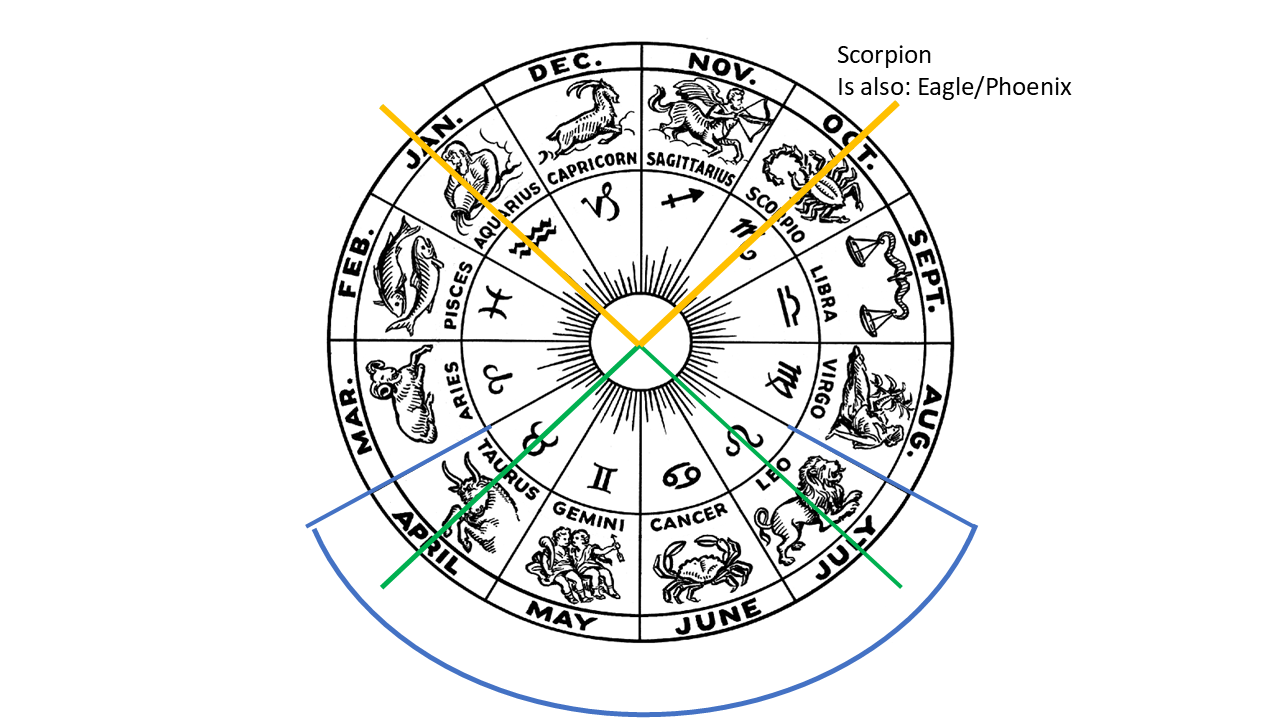
First Millenia BC Zodiac Calendar
Artist: Unknown.
Source; License: Source: Adapted from Wikipedia. Copyright: Public Domain.
Appendix: E Why the Ox, The Bull and the Eagle?
Description: The zodiac yearly calendar goes back in its complete form to at least the first millennia BC, Babilonia. With animals or symbols for each zodiac sign and the sun in the centre.
Book Excerpt
Where do the bull, the lion, and the eagle from Chapter 11 come from? Some hypothesize they are ancient symbols (since neolithic times) for the calendar seasons. Do you remember the mosaic of the seasons from Orpheus, the seasons in Giorgio Kienerk painting of the seasons, or the seasons engraved on the four wings of the Mithraic Aion god? Seasons represent cyclicality, or at least duality (winter and summer). We have seen that they could also symbolise desire (the bull) and fear (the lion) and the conquest of these (when the human slays the bull or becomes the lion god).
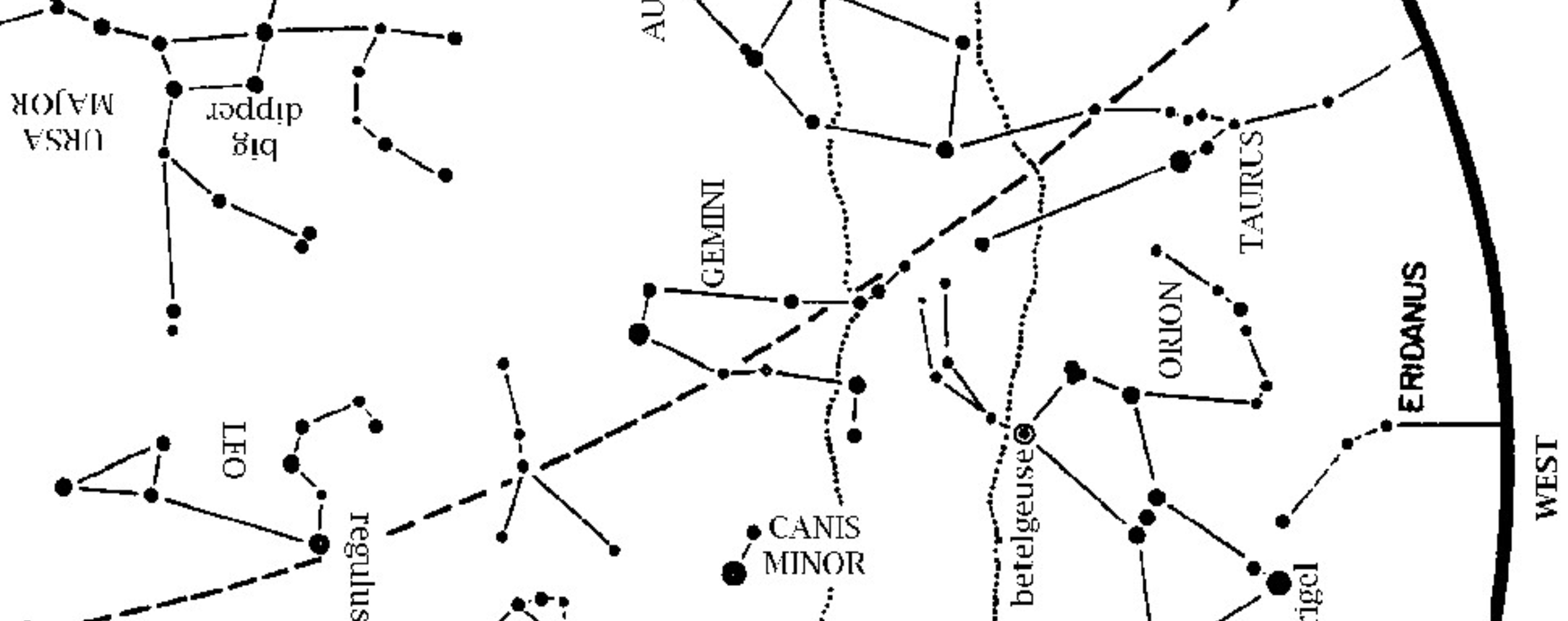
Northern Night Sky
Artist: Unknown.
Source; License: Source: Adapted from Wikipedia. Copyright: Public Domain.
Appendix: E Why the Ox, The Bull and the Eagle?
Description: Hindu astrology reinforces the potential coincidence in the order of symbols, and the order of constellations passing in the ecliptic line of the sun (see the dashed line). In Hindu astrology, Gemini (Mithuna in Sanskrit) has a unique role because it represents two sides of the same coin—two sides, as in having the male and female together as Ardhanārīśvara. Ardhanārīśvara sits between the lion and the bull, just as the Gemini constellation sits between Leo and Tauri in the sky. Is this a coincidence? Or further reinforcement for what they conveyed: cyclicality, duality, cold and warm, and the transcendence thereof?
Book Excerpt
As the seasons pass, we see in the northern night sky (figure above), along the ecliptic dashed line, in we see this order of constellations from right to left in the sky: (1). the Tauri, bull; (2). Gemini/Twins; Cancer; (3). Leo, Lion.
Devi (Goddess) riding on a lion slays Manisha (Asura) whose name means buffalo.
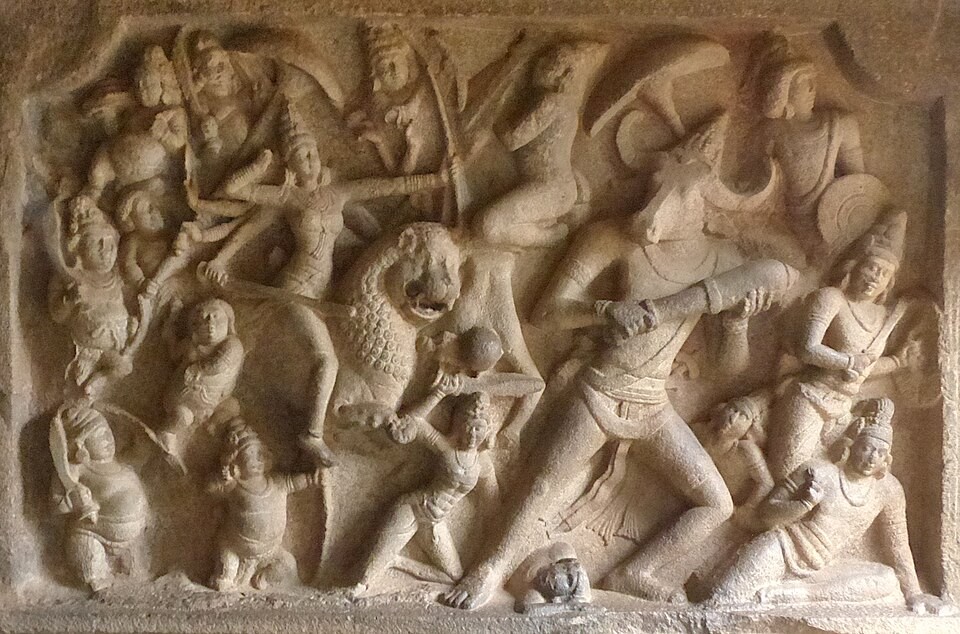
Artist: Unknown.
Source; License: Source: Wikipedia. Copyright: Public Domain.
Appendix: E Why the Ox, The Bull and the Eagle?
Description: This is the 7th c. CE depiction of the moment when the Devi (goddess) Durga riding on a lion slays Mahisha (Asura, demon) whose name means buffalo...
Book Excerpt
From Mahishasuramardini Mandapa, Mamallapuram, Tamil Nadu, India. The website above (old European culture) mentions that this symbology is about one season giving way to another (the bull season in April giving way to the lion season in July).