 EN
EN PT
PTArtwork from Chapter 4
Aqui está uma lista de todas as obras de arte citadas no capítulo. Elas são exibidas em cores na sequência em que aparecem no livro para aqueles com cópias Kindle que desejam ouvir o livro em Kindle e ver as figuras aqui.
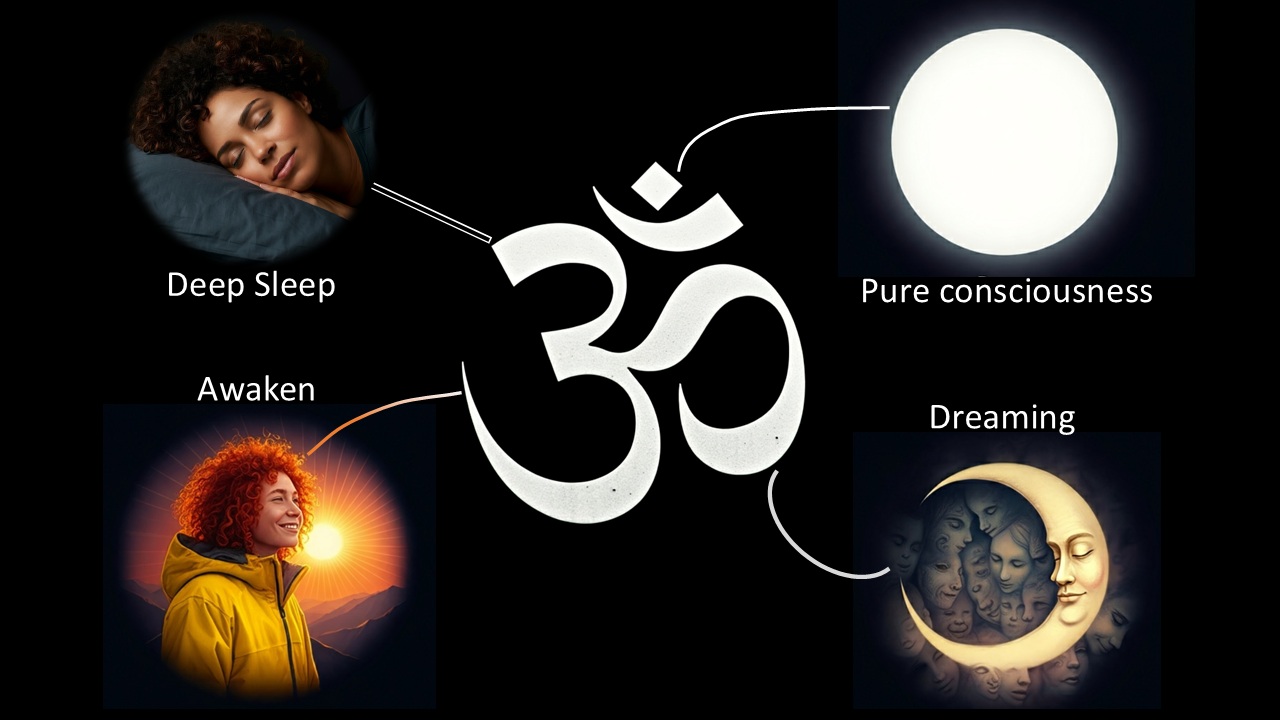
Awaken, Dreaming, Deep-Sleep
Artist: André Augusto Cesta.
Source; License: Copyright.
Chapter: Chapter 4: Diving Deeper Into Yoga.
Description: The Sanskrit letter Om symbol (ॐ), which is also a symbol for Yoga, has three parts that symbolize the three states of awaken; dreaming and deep sleep.
Book Excerpt
I like that the dream state is drawn as a loop on the right side, as most people are really looping in the bubble of their own fabrications during dreams. I mean, one can experience reality as it is, without colouring it, one can experience reality purely like this during awaken and deep sleep (see later). But during dreams it is all about looping around in those fabrications and creating your own “reality”.
Pure consciousness is not exactly a fourth state among awaken, dreaming, deep-sleep. Pure consciousness is more something that can shed light into any of these three states. Pure consciousness is non-coincidentally is drawn above and apart, disjoint, disconnected from the other shapes (like a sun or moon at the top shining down on different things).
It is common that some people, and many yogis and meditators will experience lucid, conscious dreaming. That is when the pure consciousness pricks the bubble of the dreams or removes the clouds over dreams and can shine there. ...
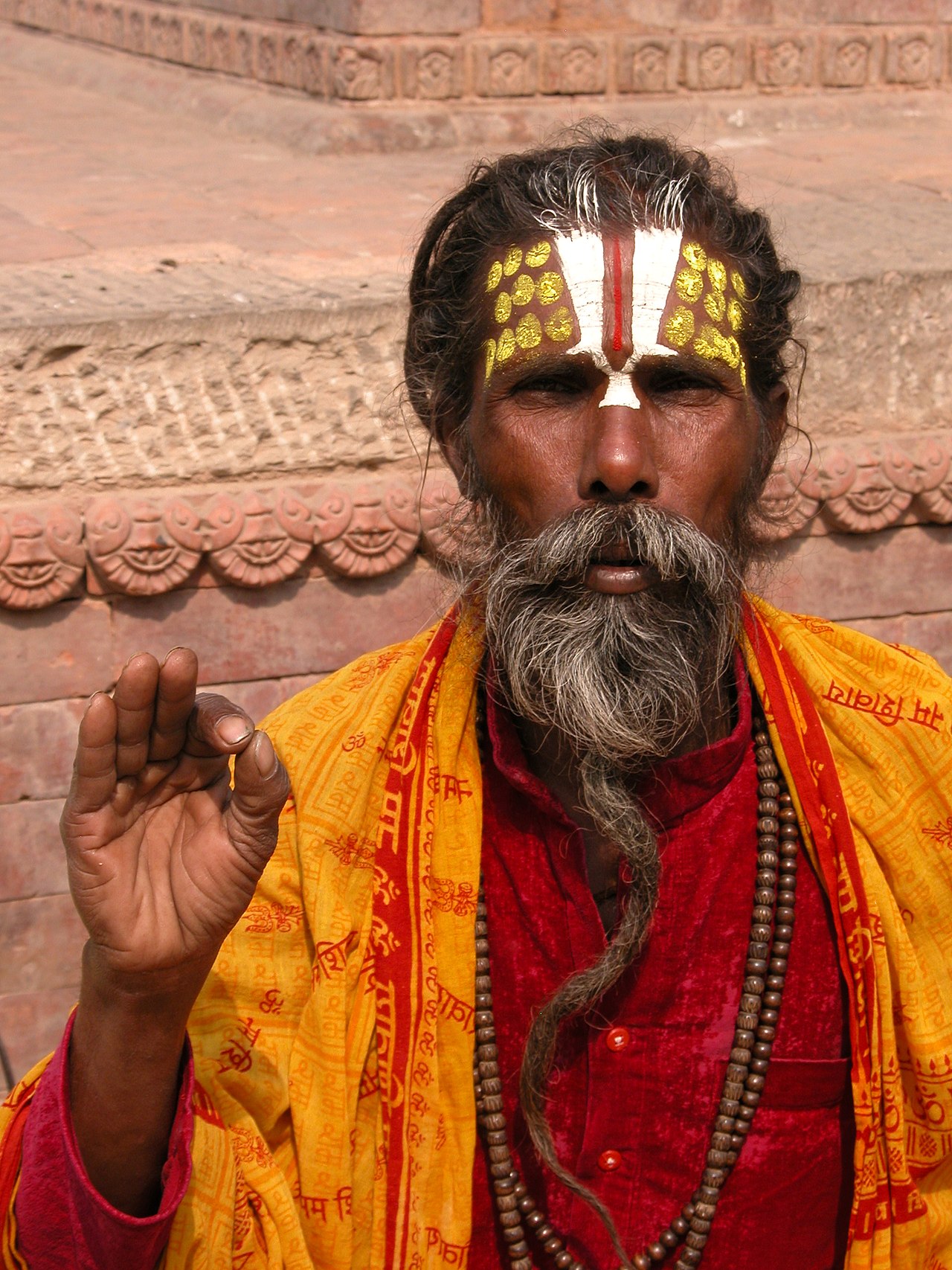
A sadhu performs a blessing in Kathmandu, Nepal
Artist: Unknown.
Source; License: Source: Wikipedia. License: ASAG 3.0.
Chapter: Chapter 4: Diving Deeper Into Yoga.
Description: When they paint 3 vertical likes like a trident (Ψ) it means transcendence from duality, two lines represent duality and the central one the transcendence.
Book Excerpt
This also explains why some yogis paint three horizontal lines on their forefronts (≡), in front of the eye of their mind (see Sivananda’s painting on the first chapters). It is perhaps a way of saying that one can be present during (1). awaken; (2). dream and (3). deep sleep states. This is usually true when they paint three horizontal lines. When they paint 3 vertical likes like a trident (Ψ) it means transcendence from duality, two lines represent duality and the central one the transcendence. The number three is used symbolically like this in many other contexts. No wonder the Om letter looks like the Devanagari number three: ३ and our Arabic number three: 3.
Cherries, Desire and Dream

Author: AI Generated for this edition at least.
Source; License: Source: Gemini. Copyright: André Cesta.
Chapter: 4 Diving Deeper Into Yoga
Description: The above makes me wonder of one of the functions of dreams described vaguely as: “dreams are useful to sort-out repressed desires”.
Book Excerpt
For instance, “a girl goes to the market with her mother and the mother does not let her eat cherries. Later she goes to sleep, and dreams she is having a bucket of cherries” – Dr. C. Charuri. After that dream, everything is sorted out and the girl wakes-up feeling better.
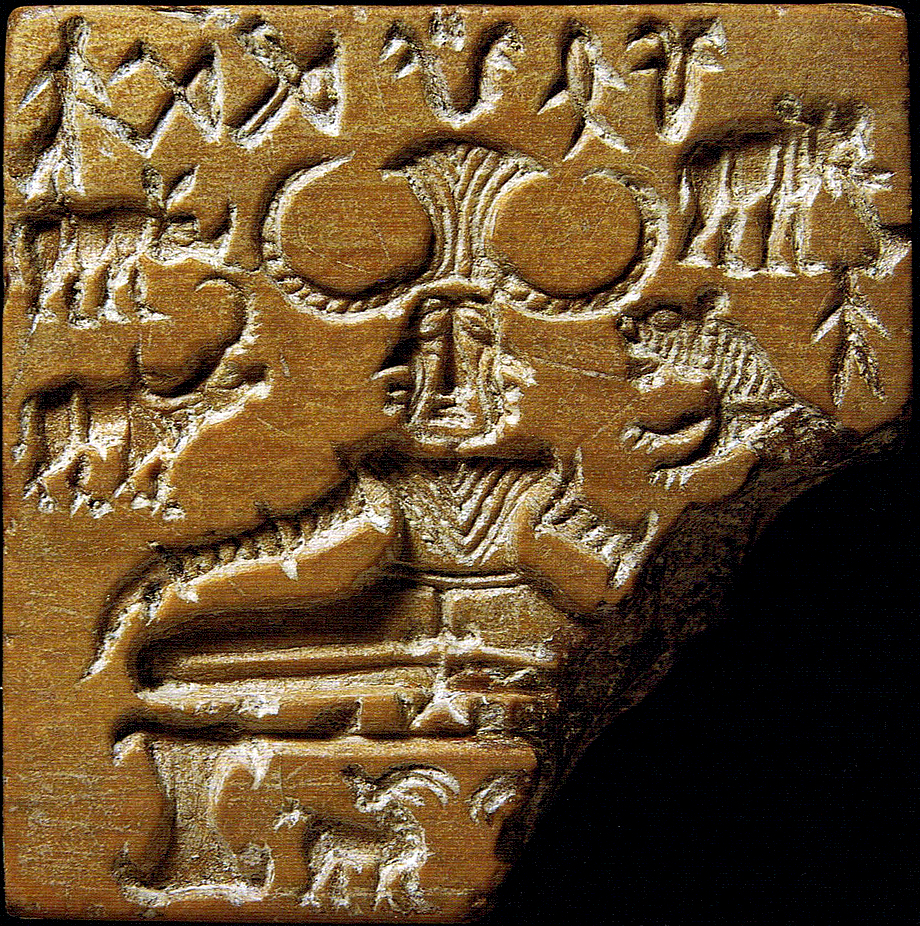
The Pashupati Seal
Author: Unknown, Harappan Civilization, 2600-1900 BC
Source; License: Wikipedia. License: Public Domain.
Chapter: 4 Diving Deeper Into Yoga
Description: The Pashupati Seal and the painting called Pain, Silence and Pleasure, the Human Enigma are the visual cornerstones of this book.
Book Excerpt
What this seal communicates is so deep, that I will need the whole of chapter 9 (some of the conclusion on yoga) to explain it.
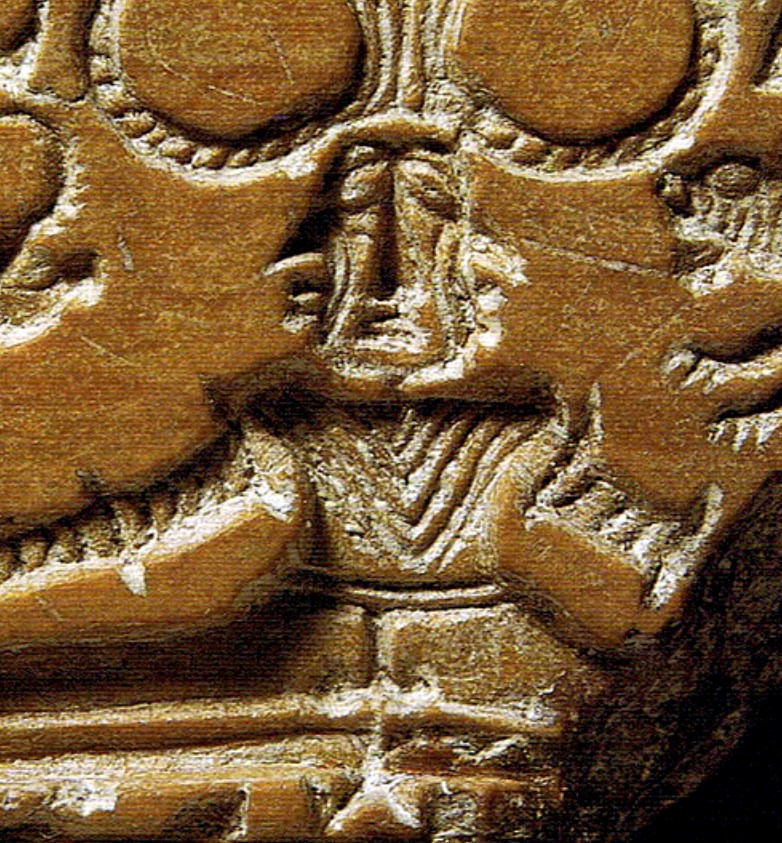
Detail on The Pashupati Seal
Author: Unknown, Harappan Civilization, 2600-1900 BC
Source; License: Wikipedia. License: Public Domain.
Chapter: 4 Diving Deeper Into Yoga
Description: Notice the three faces symbolising duality and transcendence thereof.
Book Excerpt
The three faces are completely in alignment with the triptych painting from Giorgio Kienerk that I present later on the chapter “The No-God, Not-Thinks No-Thoughts”. In the painting one can look to (1). Left side (pain); (2). the other side pleasure or (3). straight ahead or upwards transcending the pairs of opposites from the sides in a state of union (through meditation). Feel free to web search this painting. I will go over it in detail later.